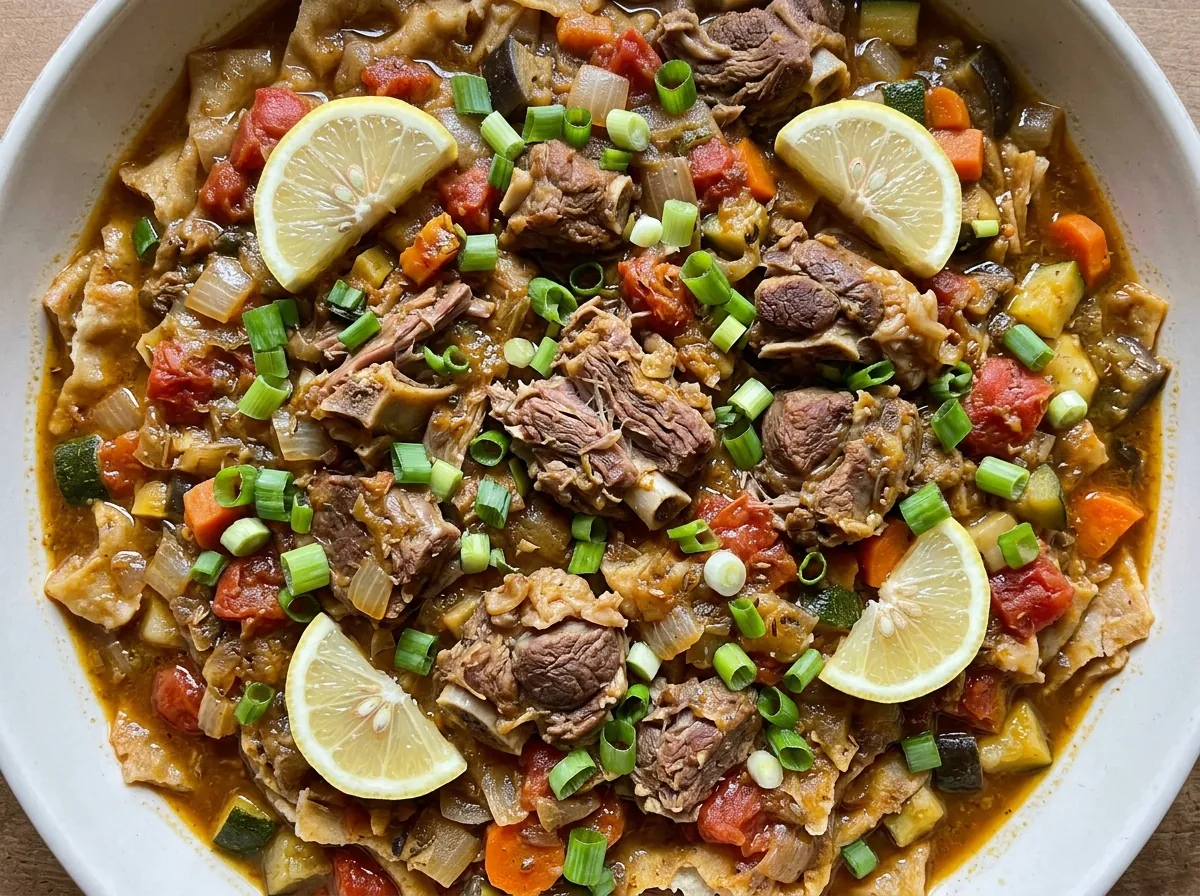
Thareed is one of the oldest dishes of the Arabian Peninsula, dating back thousands of years, and it was the main dish in ruling councils. The lamb version is the most famous in Saudi suhoor because the bread soaks up the stock and provides long-lasting satiety.
In Ramadan, you find it on large suhoor tables through the night. The dish dries slowly and stays warm for a full hour.
Preparation Steps
Boil the lamb
In a large pot, place the lamb with the onion, garlic, cardamom, cinnamon, and 1 liter of water. Bring to a boil and skim off the foam, then leave for 1 hour and 15 minutes until tender.
Prepare the vegetable base
Lift out the lamb and strain the stock. In the same pot, heat the ghee and sauté the onion for 5 minutes, add the tomato and leave for 10 minutes until it thickens.
Cook the vegetables
Add the zucchini, carrot, eggplant, dried lime, cumin, and turmeric. Pour in the stock and leave for 30 minutes over low heat.
Shred the lamb and combine
Remove the bone and shred the lamb. Add it to the vegetables with the green onion. Taste and adjust the salt.
Arrange the bread
In a deep baking dish, break the bread and scatter it over the bottom. Pour the stock, vegetables, and lamb over the bread until it soaks through. Place it in a 200°C oven for 15 minutes.
Serve
Take it out and scatter the cilantro and melted ghee. Serve hot with lemon.
Blood Sugar Impact
The glycemic index (GI) measures how quickly a food raises blood sugar, while the glycemic load (GL) measures how much a full serving raises it. Together they give the complete picture.
Glycemic Index
GI
31Low
Low0–55Medium56–69High70+
A low value (≤55) means a gradual rise in blood sugar — the most suitable range for diabetes and insulin resistance.
Glycemic Load
GL
6Low
Low0–10Medium11–19High20+
Glycemic load reflects the impact of the full serving. To lower it: take half a serving, or pair the recipe with a source of protein and fiber.
Nutritional Information
Per ServingMakes 6 servings · one serving is about 620 g of raw ingredients
Calories375 kcal19%of Daily Value*
Protein26 g52%of Daily Value*
Carbohydrates21 g8%of Daily Value*
Fat21 g27%of Daily Value*
Fiber3 g11%of Daily Value*
Sodium1450 mg63%of Daily Value*
Potassium1246 mg27%of Daily Value*
Phosphorus325 mg26%of Daily Value*
* Percent Daily Values are based on a 2,000-calorie diet per FDA food-label reference values — your daily needs may be higher or lower. Values are derived from the recipe's ingredients via the USDA database.
Troubleshooting
The most common problems when preparing Lamb Thareed, and how to fix them:
The thareed is dry
Add a cup of stock and return to the oven for 10 extra minutes. The bread absorbs the stock quickly.
The lamb is tough
Add 30 minutes to the boiling time. Frozen lamb needs more time.
The flavor is flat
Double the dried lime and add a pinch of cumin before serving.
The bread fell apart
Use bread that is less toasted, or place it in a single layer at the bottom.
Storage and Make-Ahead
Refrigerator
Two days. Reheat with stock in a 180°C oven for 20 minutes.
Freezer
One month. Freeze the stock separately from the bread and combine when serving.
Tested Ingredient Substitutions
Original Ingredient
Tested Substitute
Ratio
Flavor Difference
Lamb
Beef
1:1
30 minutes longer cooking time.
Regag bread
Arabic bread
1:1
Absorbs faster, reduce the stock by 20%.
Dried lime
Lemon + cumin
1:1
Different but acceptable flavor.
How Much Does It Make? Scaling Guide
Ingredient
6 people
12 people
18 people
Meat
700 g
1400 g
2100 g
Bread
4 loaves
8 loaves
12 loaves
Vegetables
700 g
1400 g
2100 g
Stock
2 L
4 L
6 L
EEINA Nutrition Tip
Break the bread by hand, not with a knife, because the uneven pieces soak up the stock better. Choose fresh regag bread, not frozen. Toasting the bread in the oven 5 minutes before using keeps its texture and prevents it from turning to dough.
Add This Recipe to Your Plan
The EEINA app saves your favorite recipes, calculates them from their real ingredients, and shows your daily numbers toward your goal. Try it free now.