A clear source
We show where a value came from, or the method used to estimate it.

Every value starts with an ingredient and its amount, is matched to reference nutrition data, then divided per serving. And whatever is an estimate, we show as an estimate.
We show where a value came from, or the method used to estimate it.
The result changes when the ingredients, the amounts, or the number of servings change.
We distinguish a calculated value, an estimated value, and data the user supplies.
Take mujaddara with lentils and bulgur as the example, and follow its number from the written amount to the per-serving value.
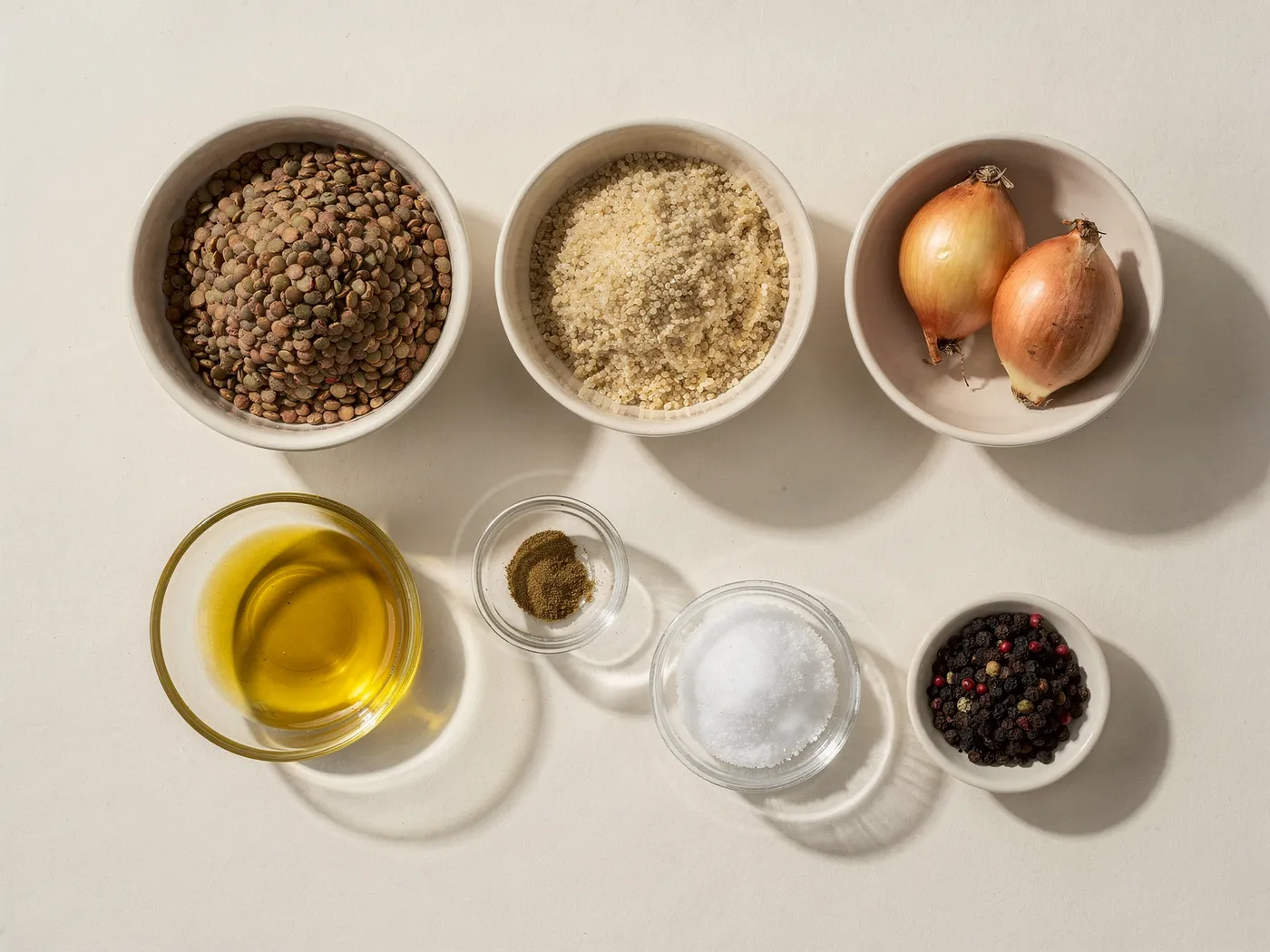
The result changes when the product, the amount or the preparation changes; that is why we present it as a nutritional estimate, not a lab measurement of the finished dish.
Some values are derived directly from the amount and the reference record; others depend on conversions or on data the user adds. Making that difference visible is part of the method.
Calories, protein, carbohydrate and fat, from the recorded amount and the source values.
Converting household measures to weight, and some glycemic values and preparation effects, where no direct measurement exists.
Your daily need changes with age, height, weight, activity and goal, and remains an estimate you can update.
EEINA estimates your baseline need with an equation suited to the data available, then accounts for your activity and your goal. If your data changes, update it and the calculation is redone.
This is an estimated result, and it is not a medical diagnosis.
EEINA uses the Mifflin–St Jeor equation to estimate basal metabolic rate when weight, height and age are available, then applies an activity factor to reach the daily need.
It is a common estimation equation, not a precise measurement; actual needs differ from person to person. That is why we present the result as a target you can update whenever your data changes, not as a final number.
We show a value when data we can attribute is available, and we mark the estimate when a meal's value is derived from its ingredients. We do not present the result as a medical prediction of your blood-sugar response.
We surface the known allergens in a recipe's ingredients according to the Saudi classification, but we cannot verify accidental cross-contact or differences between production lines. Check the product label if you have an allergy.
This alert does not reveal accidental cross-contact between products in a factory or a kitchen. Source: the Saudi Food and Drug Authority (SFDA).
We list only what the calculations actually rely on, and for each source we show its role, its edition and when we last reviewed it.
Start with a single meal, and review its ingredients and amounts before you save it.