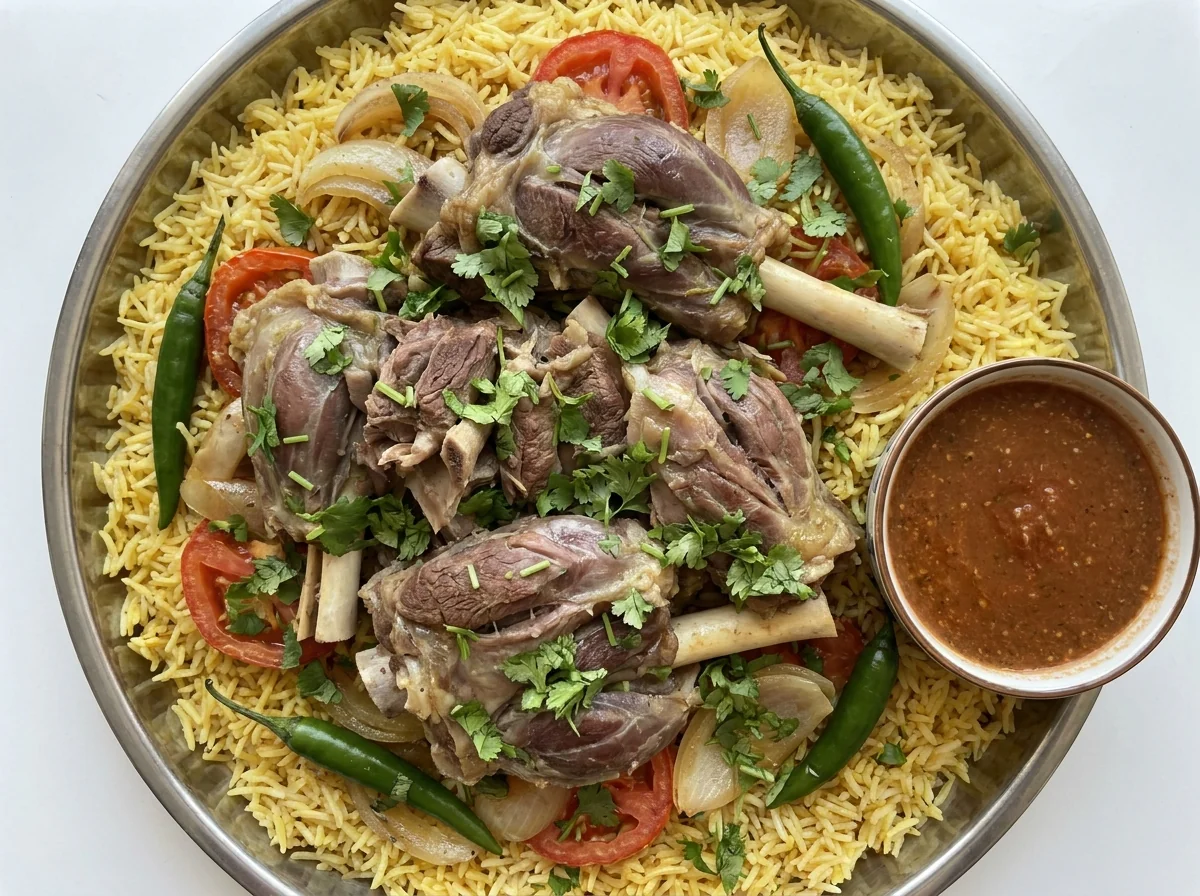
Madfoon is one of the well-known Gulf rice dishes: the meat is placed at the bottom of the pot and the rice is spread over it so they cook together, the meat in its juices and the rice in the steam of the broth beneath it.
It appears on the tables of Saudi Arabia, the Emirates, and Yemen, and it is distinguished by a spice blend dominated by turmeric that gives it its yellow color.
Preparation Steps
Season the meat with the madfoon blend
Rub the meat pieces with the garlic, ginger, madfoon spices, ground Loomi, and salt, and leave them at least an hour until the meat absorbs the spices. The turmeric and cumin blend is what gives madfoon its well-known yellow color.
Sear the meat and build the base of the pot
In a thick, wide pot, heat the ghee and sear the meat pieces on their sides until they take on color, then add the sliced onion and stir until it wilts, and add the sliced tomatoes and the hot chili and stir for a few minutes. The searing builds the flavor of the broth in whose steam the rice will cook.
Wash the rice and spread it over the meat
Wash the rice until its water runs clear, soak it, then drain it. Settle the meat pieces at the bottom of the pot and spread the rice over them in a full layer that covers them. From this burying the dish gets its name: the meat at the bottom cooks in its juices, and the rice above cooks in the steam of the broth.
Pour in the hot water and cook over low heat
Pour the salted hot water gently over the back of a spoon so it does not dig into the rice, let the pot come to a boil, then lower the heat to its lowest, cover tightly, and cook two hours. Do not stir the madfoon while it cooks, because stirring mixes the two layers and ruins the way they cook.
Rest the pot and flip it for serving
Lift the pot off the heat and leave it ten minutes until it sets, then flip it onto a wide serving plate so the meat comes out on top of the yellow rice, softened until it falls off its bone. Scatter the fresh coriander, and serve with daqqous.
Blood Sugar Impact
The glycemic index (GI) measures how quickly a food raises blood sugar, while the glycemic load (GL) measures how much a full serving raises it. Together they give the complete picture.
Glycemic Index
GI
70High
Low0–55Medium56–69High70+
A low value (≤55) means a gradual rise in blood sugar — the most suitable range for diabetes and insulin resistance.
Glycemic Load
GL
57High
Low0–10Medium11–19High20+
Glycemic load reflects the impact of the full serving. To lower it: take half a serving, or pair the recipe with a source of protein and fiber.
Nutritional Information
Per ServingMakes 6 servings · one serving is about 535 g of raw ingredients
Calories763 kcal38%of Daily Value*
Protein37 g74%of Daily Value*
Carbohydrates84 g31%of Daily Value*
Fat30 g38%of Daily Value*
Fiber2 g7%of Daily Value*
Sodium553 mg24%of Daily Value*
Potassium720 mg15%of Daily Value*
Phosphorus413 mg33%of Daily Value*
* Percent Daily Values are based on a 2,000-calorie diet per FDA food-label reference values — your daily needs may be higher or lower. Values are derived from the recipe's ingredients via the USDA database.
Troubleshooting
The most common problems when preparing Gulf Lamb Madfoon, and how to fix them:
The rice is cooked but the meat is still tough
The meat is from an old animal or the heat is higher than needed. Two hours over low heat is the right duration, and if the meat is a tough cut, simmer it half an hour before burying it.
The bottom of the pot stuck and burned
The heat stayed strong after lowering or the pot has a thin bottom. Use the lowest heat and a thick-bottomed pot; the light crust at the bottom (the hakaka) is acceptable and many love it.
The color came out a faded yellow
The amount of turmeric is too little. The madfoon blend is dominated by turmeric, so use a full teaspoon, not a pinch.
The rice cooked unevenly
The water was poured forcefully and dug into the rice layer. Level the surface of the rice before pouring, and pour the water over the back of a spoon.
Storage and Make-Ahead
Immediately
Served hot right after flipping the pot.
In the fridge
Three days in airtight containers, reheated covered with a spoonful of water so it does not dry out.
In the freezer
Two months, meat and rice, and it is among the dishes that withstand freezing well.
Tested Ingredient Substitutions
Original Ingredient
Tested Substitute
Ratio
Flavor Difference
Lamb
Whole chicken, quartered
1.2 kg
Chicken madfoon cooks in one hour from the burying
Ghee
Oil
1:1
Lighter in fat, and ghee has a deeper flavor
Hot chili
Omit it
~
A version without heat that suits everyone
The full flip
Scooping layer by layer
~
An easier option for those who do not want to flip the pot, and the taste is the same
How Much Does It Make? Scaling Guide
Ingredient
6 servings
3 servings
12 servings
Meat
1.2 kg
600 g
2.4 kg
Rice
600 g
300 g
1.2 kg
Water
1 L
500 ml
2 L
EEINA Nutrition Tip
When adding the water over the rice, pour it over the back of an upturned spoon and do not pour it directly. Pouring directly digs into the rice layer and exposes the meat so the two layers mix, while the back of the spoon distributes the water gently and the two layers stay separate until the end of cooking.
Add This Recipe to Your Plan
The EEINA app saves your favorite recipes, calculates them from their real ingredients, and shows your daily numbers toward your goal. Try it free now.
Kabsa is rice cooked in a broth of separately simmered meat, madghout cooks its meat and rice together quickly in a pressure cooker, and madfoon is two layers in one pot over low heat without pressure. Three ways to cook rice with meat.
Why is it described as deeper in flavor than Kabsa?
Because the meat is cooked in its juices trapped at the bottom of the pot rather than in plenty of water, so its flavor concentrates, and the rice above absorbs the steam rising from it.
Does it work in a pressure cooker?
A pressure cooker turns it into another dish, madghout. Madfoon is built on slow cooking, which is what gives it its texture and flavor.
How is its plate balanced?
A green salad, hot daqqous, and yogurt are additions that lighten the heaviness of the rice and complete the meal.