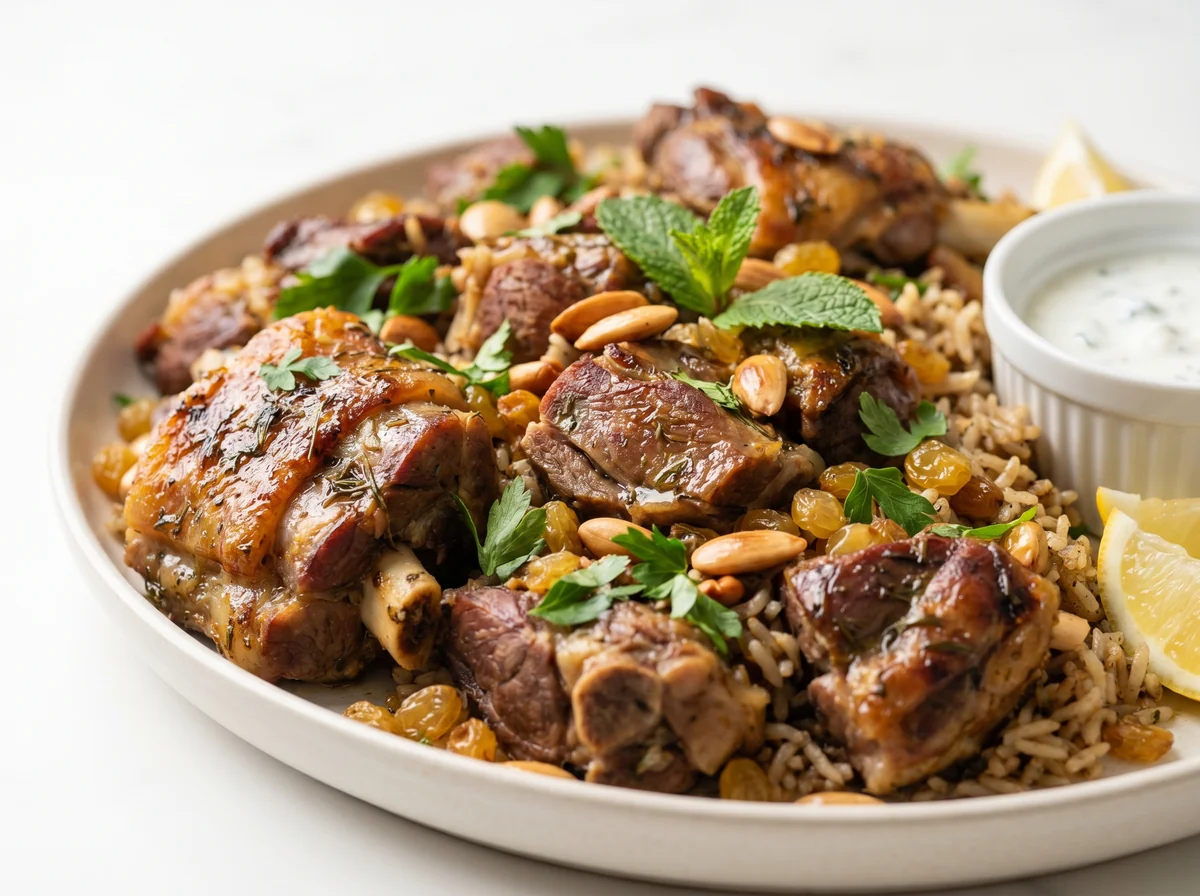
Spiced lamb grilled on a hot stone or in the oven over a rice tray — the dripping fat and juices infuse the rice with a distinctive smoky flavor. An EEINA version with lean meat and a controlled rice portion.
Madhbi is a Gulf dish of Yemeni origin named after the hot stone (madhbi) on which the meat is grilled. Its secret lies in grilling the spiced meat over a rice tray so the juices and fat drip onto the rice, giving it a uniquely smoky flavor.
It differs from Kabsa (Saudi spiced rice dish) and Mandi (Yemeni-Saudi smoked meat and rice) by its direct grilling over the rice. The EEINA version uses lean meat, olive oil, and a controlled rice portion, preserving the authentic madhbi flavor with a lighter profile.
Preparation Steps
Marinate the lamb
Rub the lamb pieces with the madhbi spices, crushed garlic, half the oil, and a pinch of salt. Leave to marinate for at least half an hour (or one hour in the refrigerator). Advance marinating deepens the flavor of the grilled meat.
Prepare the rice broth
In a pot, heat the remaining oil and brown the onion until softened. Add the grated tomatoes, tomato paste, pierced loomi, a pinch of salt, and the hot water. Bring to a boil to create a broth for the rice.
Cook the rice
Rinse the soaked rice and add it to the boiling broth at double the ratio. Reduce the heat, cover the pot for about 15 minutes until the rice absorbs the broth and cooks through. Transfer to a wide oven tray and spread it out.
Grill the lamb over the rice
Arrange the marinated lamb pieces on a rack over the rice tray and place in an oven preheated to 200°C for about 40 minutes until the lamb cooks through and turns golden. The lamb juices drip onto the rice, giving it the distinctive madhbi flavor.
Final browning
In the last 5 minutes, switch on the top grill until the surface of the lamb turns golden and slightly crisp. Watch carefully to prevent burning. Ensure the internal temperature of the lamb has reached the safe cooked level.
Serve
Lift the lamb and arrange it over the rice that has absorbed its juices. Serve madhbi hot with daqoos sauce and salad. The dripping smoky flavor is the signature of this dish.
Blood Sugar Impact
The glycemic index (GI) measures how quickly a food raises blood sugar, while the glycemic load (GL) measures how much a full serving raises it. Together they give the complete picture.
Glycemic Index
GI
65Medium
Low0–55Medium56–69High70+
A low value (≤55) means a gradual rise in blood sugar — the most suitable range for diabetes and insulin resistance.
Glycemic Load
GL
32High
Low0–10Medium11–19High20+
Glycemic load reflects the impact of the full serving. To lower it: take half a serving, or pair the recipe with a source of protein and fiber.
Nutritional Information
Per ServingMakes 5 servings · one serving is about 425 g of raw ingredients
Calories575 kcal29%of Daily Value*
Protein31 g62%of Daily Value*
Carbohydrates53 g19%of Daily Value*
Fat27 g35%of Daily Value*
Fiber3 g11%of Daily Value*
Sodium392 mg17%of Daily Value*
Potassium710 mg15%of Daily Value*
Phosphorus347 mg28%of Daily Value*
* Percent Daily Values are based on a 2,000-calorie diet per FDA food-label reference values — your daily needs may be higher or lower. Values are derived from the recipe's ingredients via the USDA database.
Troubleshooting
The most common problems when preparing Madhbi Lamb, and how to fix them:
The lamb is dry after grilling
Grilled at high heat for too long. Grill at 200°C until just cooked through. Oil in the marinade retains moisture, and the top grill should only be used for the final browning for a few minutes.
The rice did not absorb the smoky flavor
The meat was too far from the rice. Place the meat directly on a rack above the rice tray so the juices drip onto it during grilling.
The meat was not cooked through
Pieces were too large or the heat was too low. Cut the meat to medium size and ensure the safe internal temperature is reached before browning.
The rice under the meat is dry
Cover the rice tray with foil at the start of grilling and remove it at the end for browning. This keeps the rice moist while it absorbs the flavor.
Bland taste
Insufficient marinade or spices. Marinate the meat early, at least half an hour, and the loomi in the rice broth deepens the flavor.
Storage and Make-Ahead
Refrigerator (4°C)
Three days in an airtight container. Separate the meat from the rice for better reheating.
Freezer (-18°C)
One month for the meat and rice separately. Thaw in the refrigerator before reheating.
Advance preparation
Marinate the meat and cook the rice in advance, then grill the lamb over the rice at serving time for the best flavor.
Reheating
Cover the rice, sprinkle with water, and heat it. Reheat the meat in the oven until warm. Do not leave cooked food outside the refrigerator for more than two hours [2].
Tested Ingredient Substitutions
Original Ingredient
Tested Substitute
Ratio
Flavor Difference
Lamb
Skinless chicken
Same weight
Chicken madhbi is also very popular and cooks faster — about 30 minutes
White basmati rice
Brown basmati rice
Same weight
Lowers the glycemic load and increases fiber
Oven and rack
Charcoal grill
Same ingredients
Gives a stronger smoky flavor closer to traditional madhbi on a stone
Ready-made madhbi spices
Homemade blend: cardamom, cinnamon, cumin, black pepper
Same quantity
Fresher flavor and free from additives
Olive oil
ghee
Same quantity
Richer flavor, higher saturated fat
How Much Does It Make? Scaling Guide
Servings
Meat
Rice
Water
Tray
2 (single × 2)
280 g
110 g
1.25 cups
small tray
5 (base)
700 g
280 g
3 cups
wide tray
8 (family)
1.2 kg
450 g
5 cups
large tray
12 (banquets)
1.7 kg
700 g
7 cups
2 trays
EEINA Nutrition Tip
Choose lean meat — grilling melts some fat onto the rice, and a little goes a long way for flavor. Advance marinating reduces the need for salt. White rice remains the source of glycemic load, so make this an occasional dish served with plenty of salad.
Add This Recipe to Your Plan
The EEINA app saves your favorite recipes, calculates them from their real ingredients, and shows your daily numbers toward your goal. Try it free now.
Madhbi comes from the hot stone (madhbi) on which the meat is grilled in the traditional method. At home the stone is replaced by an oven with a rack over a rice tray, so the lamb fat drips onto the rice.
What is the difference between madhbi, Mandi, and Kabsa?
Madhbi meat is grilled over rice so its juices drip onto it. Mandi (Yemeni-Saudi smoked meat and rice) is cooked with steam and smoking. Kabsa (Saudi spiced rice dish) has all ingredients cooked together in a pot. Each has its own method and flavor.
Is madhbi suitable for diabetics?
White rice raises the glycemic load, so make it an occasional dish. Replace part of the rice with brown rice, control the portion, and add plenty of salad.
How do I get a stronger smoky flavor?
Use a charcoal grill instead of the oven, or place a lit piece of charcoal in a small cup in the center of the rice for two minutes after cooking and cover it to absorb the smoke.
Can I make it with chicken?
Yes, chicken madhbi is very popular. Use skinless chicken and reduce the grilling time to about 30 minutes since chicken cooks faster than lamb.
Sources: USDA · University of Sydney · Our methodology · Updated on