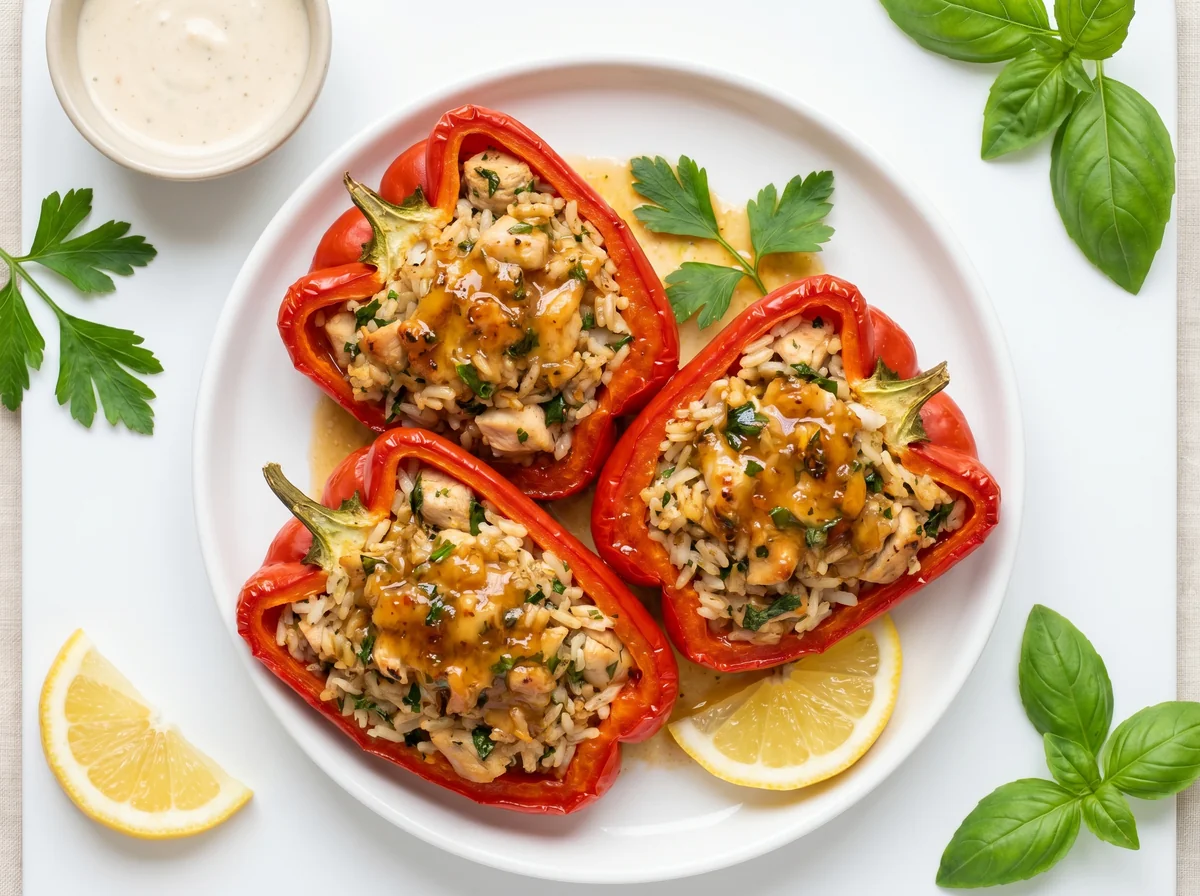
Stuffed peppers are a beloved home dish on Arab tables, but the traditional version often relies on concentrated tomato sauce, cheese, and wholegrain rice — all sources that kidney patients need to be cautious about.
We redesigned the dish to preserve its warmth and colour with a simple filling of minced chicken breast, white rice, and onion, cooked in water and lemon rather than heavy sauces. The result is a satisfying main dish that is gentle on the kidneys without losing its Arabic kitchen character.
Preparation Steps
Parboil the rice
Parboil the white rice in 400 ml of boiling water over medium heat for 8 minutes until half-cooked and firm when pressed between the fingers, then drain. Parboiling ensures the rice cooks through inside the filling without overcooking, and draining the water reduces some of the dissolved potassium.
Prepare the peppers
Slice off the top of each pepper and keep it as a lid. Remove the seeds and white membranes until the cavity is clean. Removing the membranes prevents any bitterness and leaves enough space for the filling.
Sweat the onion and chicken
Heat the olive oil in a pan over medium heat and sweat the onion and garlic for two minutes until softened and translucent without browning — this releases their sweet flavour and keeps the filling pale.
Cook the chicken
Add the minced chicken breast and stir over medium-high heat for 5 minutes until the colour changes completely to white and the meat breaks apart — a sign it has started to cook. It will finish cooking in the oven.
Season the filling
Add the cumin, black pepper, baharat (Gulf spice blend), coriander, and salt to taste, then fold in the parboiled rice and stir for one minute until the spices are evenly distributed. Seasoning at this stage is easier than correcting after stuffing.
Stuff the peppers
Fill each pepper three-quarters full only and leave a gap at the top, as the rice expands slightly as it finishes cooking, then replace the lid on each pepper.
Bake
Stand the peppers upright in a baking tray, add 100 ml of hot water and the lemon juice to the base, and cover the tray with foil. Bake in a preheated oven at 190°C for 30 minutes, then uncover for the final 5 minutes. Chicken is safe when its internal temperature reaches 74°C — check with a thermometer at the centre of the filling before serving.
Rest and serve
Leave the stuffed peppers to rest for 5 minutes so the filling sets, then serve warm. Resting allows moisture to redistribute so the filling does not crumble when cut.
Blood Sugar Impact
The glycemic index (GI) measures how quickly a food raises blood sugar, while the glycemic load (GL) measures how much a full serving raises it. Together they give the complete picture.
Glycemic Index
GI
60Medium
Low0–55Medium56–69High70+
A low value (≤55) means a gradual rise in blood sugar — the most suitable range for diabetes and insulin resistance.
Glycemic Load
GL
22High
Low0–10Medium11–19High20+
Glycemic load reflects the impact of the full serving. To lower it: take half a serving, or pair the recipe with a source of protein and fiber.
Nutritional Information
Per ServingMakes 4 servings · one serving is about 430 g of raw ingredients
Calories372 kcal19%of Daily Value*
Protein27 g54%of Daily Value*
Carbohydrates41 g15%of Daily Value*
Fat10 g13%of Daily Value*
Fiber4 g14%of Daily Value*
Sodium249 mg11%of Daily Value*
Potassium643 mg14%of Daily Value*
Phosphorus292 mg23%of Daily Value*
* Percent Daily Values are based on a 2,000-calorie diet per FDA food-label reference values — your daily needs may be higher or lower. Values are derived from the recipe's ingredients via the USDA database.
Troubleshooting
The most common problems when preparing Red Pepper Stuffed with Chicken and White Rice — Kidney-Friendly, and how to fix them:
The filling crumbles when cut
The peppers were not rested after the oven. Rest them for a full five minutes before cutting so the rice sets with the residual heat.
The rice is still hard at the centre
Either the rice was not parboiled to half-done before stuffing, or the oven time was too short. Return covered for an extra ten minutes with a splash of hot water at the base.
The peppers will not stand upright in the tray
Slice a very thin sliver from the base of each pepper without piercing it to give it a flat footing — the cavity will not leak.
The filling is dry on the outside
The foil was removed too early. Keep the foil on throughout the thirty minutes and only uncover for the final five minutes.
The flavour is bland despite the spices
The salt was too restricted. Compensate by increasing the lemon juice, cumin, and fresh coriander to lift the flavour without extra sodium.
Storage and Make-Ahead
Refrigerator (4°C)
Store in an airtight container after it has cooled completely, for up to 3 days at 4°C or below. Do not leave out of refrigeration for more than two hours (danger zone rule).
Reheating
Reheat in the oven at 165°C covered until the internal temperature reaches 74°C, or in the microwave with a splash of water to prevent drying out.
Freezer
Freeze after cooking for up to two months in an airtight container. Thaw overnight in the refrigerator before reheating to preserve the pepper's texture.
Tested Ingredient Substitutions
Original Ingredient
Tested Substitute
Ratio
Flavor Difference
Minced chicken breast
Minced turkey breast
1:1
An equivalent low-phosphorus protein alternative — suitable for those who prefer variety in white meats.
White rice
Parboiled rice with part of its starch removed
1:1
Remains low in potassium. Avoid substituting brown rice as its bran raises phosphorus and potassium.
Chopped onion
White part of leek, chopped
1:1
A milder-flavoured option with relatively low potassium — suitable for those on a strict potassium restriction.
Baharat (Gulf spice blend)
Blend of cumin, dried coriander, and cinnamon
1:1
Ensures the seasoning is free of any added salt or allergens that may be in ready-made blends.
Olive oil
Canola oil
1:1
A neutral-flavour alternative with monounsaturated fats — suitable for those who prefer a lighter taste.
How Much Does It Make? Scaling Guide
Ingredient
4 servings
8 servings
12 servings
Red pepper
4 pieces
8 pieces
12 pieces
Minced chicken breast
400 g
800 g
1200 g
White rice
150 g
300 g
450 g
Chopped onion
120 g
240 g
360 g
Olive oil
30 ml
60 ml
90 ml
EEINA Nutrition Tip
If your doctor has set a strict potassium limit, parboil the rice in plenty of water and drain it — a step that reduces potassium further. Be sure to weigh your chicken portion according to what your dietitian has prescribed, as even high-quality excess protein burdens the kidneys.
Add This Recipe to Your Plan
The EEINA app saves your favorite recipes, calculates them from their real ingredients, and shows your daily numbers toward your goal. Try it free now.
It is designed to be lower in potassium, phosphorus, and sodium than the traditional version, but final safety depends on your disease stage and serving size. Do not include it in your diet without approval from your nephrologist and renal dietitian.
Why white rice and not brown rice here?
Brown rice bran holds most of the phosphorus and potassium, so white rice is preferred for kidney patients even though brown rice is the healthier choice for the general population. This is an example of how dietary recommendations change depending on the condition.
Can I use minced red meat instead of chicken?
Yes, but chicken breast and turkey are better choices for kidney patients due to their lower saturated fat and phosphorus compared to red meat. Avoid processed meats as their added phosphate is more readily absorbed.
How do I reduce the potassium further?
Parboil the rice in plenty of water and drain it, use sweet red pepper which is one of the lowest-potassium vegetables, and avoid adding tomatoes or potatoes. Portion size remains the most important factor.
Is the recipe suitable for someone with diabetes?
It combines protein with moderate carbohydrates and no added sugar, making it a reasonable choice within a balanced meal. Monitor the rice portion and include it in your carbohydrate count as directed by your dietitian.