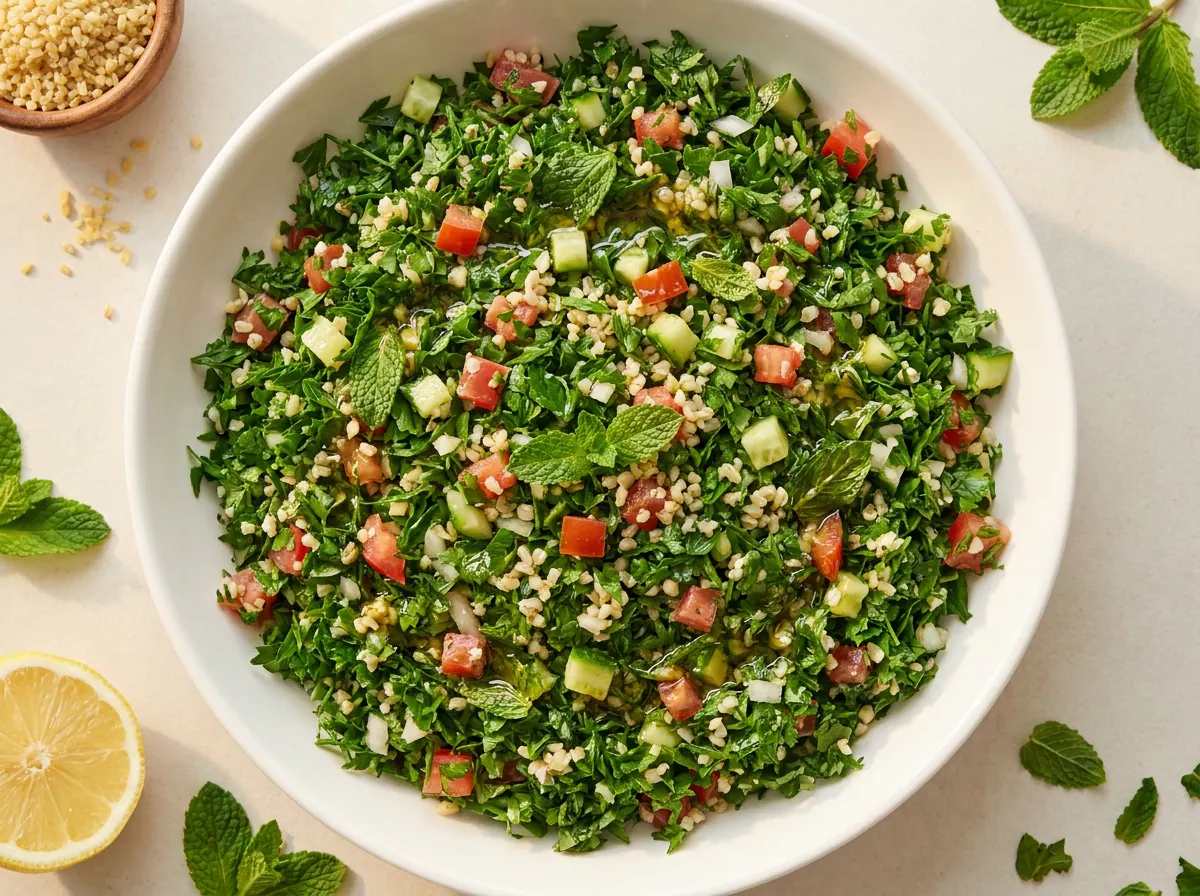
The original Lebanese tabbouleh · 3/4 parsley and 1/4 bulgur (not the other way around). The most famous herb salad, GI 26, rich in vitamin K and iron.
True tabbouleh is a parsley salad, not a bulgur salad. The Lebanese take pride in this — in Lebanon bulgur is merely an addition that gives texture, not the base.
Its nutritional value is remarkable: a cup of parsley = twice the vitamin C of an orange and 3 spoonfuls of vitamin K (for bone health). With whole bulgur = high fiber.
Preparation Steps
Soak the bulgur
Soak the bulgur in lukewarm water for ten minutes, then drain it well so no water remains, because excess water ruins the texture of the tabbouleh.
Chop the parsley
This is the most important step: chop the parsley very finely with a sharp knife, not in a blender, so it does not release its bitterness, and leave no thick stems.
Chop the mint
Chop the mint finely, and keep it less than the parsley at a ratio of one to four so it stays refreshing rather than overpowering.
Dice the tomatoes
Cut the tomatoes into very small pieces about five millimeters, and leave them in a strainer for two minutes to drain their excess water.
Mix and season
In a wide bowl combine the parsley, mint, green onion, bulgur, and tomatoes, then season them with the mixture of olive oil, lemon, sumac, and salt, and toss gently. Leave it for ten minutes before serving so the flavors meld.
Blood Sugar Impact
The glycemic index (GI) measures how quickly a food raises blood sugar, while the glycemic load (GL) measures how much a full serving raises it. Together they give the complete picture.
Glycemic Index
GI
25Low
Low0–55Medium56–69High70+
A low value (≤55) means a gradual rise in blood sugar — the most suitable range for diabetes and insulin resistance.
Glycemic Load
GL
4Low
Low0–10Medium11–19High20+
Glycemic load reflects the impact of the full serving. To lower it: take half a serving, or pair the recipe with a source of protein and fiber.
Nutritional Information
Per ServingMakes 4 servings · one serving is about 260 g of raw ingredients
Calories206 kcal10%of Daily Value*
Protein5 g10%of Daily Value*
Carbohydrates25 g9%of Daily Value*
Fat11 g14%of Daily Value*
Fiber7 g25%of Daily Value*
Sodium417 mg18%of Daily Value*
* Percent Daily Values are based on a 2,000-calorie diet per FDA food-label reference values — your daily needs may be higher or lower. Values are derived from the recipe's ingredients via the USDA database.
Troubleshooting
The most common problems when preparing Tabbouleh with Green Bulgur, and how to fix them:
The tabbouleh came out brown, not green
The proportion of parsley is too low, or it was chopped in a blender so its color oxidized. Tabbouleh is by nature a parsley salad, so the green leaves are the most visually dominant in the dish, and the bulgur is a supporting element in a small amount. Chopping is done with a sharp knife on a wooden board, in short quick motions. The electric blender crushes the leaves and releases the green juice that oxidizes within minutes.
The tabbouleh is watery at the bottom
The tomatoes were not drained, and the bulgur was not squeezed after soaking. For an immediate fix: lift the mixture with a slotted spoon into the serving bowl and leave the liquid behind. For the next batch: cut the tomatoes small (5 mm) and put them in a strainer for ten minutes with a light pinch of salt, and squeeze the bulgur in your palm after soaking so not a drop drips.
The bulgur did not soften and stayed hard under the tooth
You used cold water or less soaking time than needed. Fine green bulgur needs lukewarm water and at least ten minutes, until it folds easily between finger and thumb. If it stays hard after ten minutes: add two extra spoonfuls of lukewarm water and wait five more. Do not use boiling water, as the bulgur swells too much and becomes pasty.
The taste is very salty even though the salt is little
You added the salt early, so the tomatoes released their water and the salt concentrated at the bottom. Tabbouleh is salted only ten minutes before serving, not an hour before. To fix: add half a cup of chopped parsley and a quarter cup of fresh mint, as they absorb the saltiness and restore the balance.
The dressing is flat with no sour edge
The lemon is too little, and the sumac is missing. The ratio from experience: two fresh lemons for every four servings (about a quarter cup of juice), and a tablespoon of fine sumac. Sumac adds depth and a light pink color, and is sprinkled cold just before serving because its anthocyanin compounds are heat-sensitive [1]. It is not replaced by vinegar, as its taste is entirely different.
The parsley wilted after an hour in the fridge
You mixed all the ingredients with the dressing early. The acid and salt wilt the leaves. For hosting: keep the chopped vegetables in a container, the dressing in a glass, and the soaked bulgur in another container. Mix the three only ten minutes before serving, enough for the flavors to meld without losing the crunch.
Storage and Make-Ahead
Refrigerator (4°)
Mixed tabbouleh: two days maximum in a sealed container. It loses its crunch after twenty-four hours but stays safe to eat. Unmixed vegetables: three days in the fridge, wrapped in a paper bag that absorbs moisture.
Freezer (-18°)
Not suitable at all. The parsley, mint, and tomatoes turn into a watery paste after thawing. Tabbouleh is a same-day dish only.
Make ahead
Chopping the parsley and mint: two hours before serving, kept in a paper bag in the fridge (not plastic, as it traps moisture). Soaking and squeezing the bulgur: an hour before, kept in a dry container. The dressing: an hour before in a glass, shaken before adding. The final mixing: only ten minutes before serving.
Serving
A cold dish that is not heated. For late meals: leave it on the table five minutes before serving to let the excess chill go. Do not leave it out of the fridge for more than two hours.
Tested Ingredient Substitutions
Original Ingredient
Tested Substitute
Ratio
Flavor Difference
Fine green bulgur
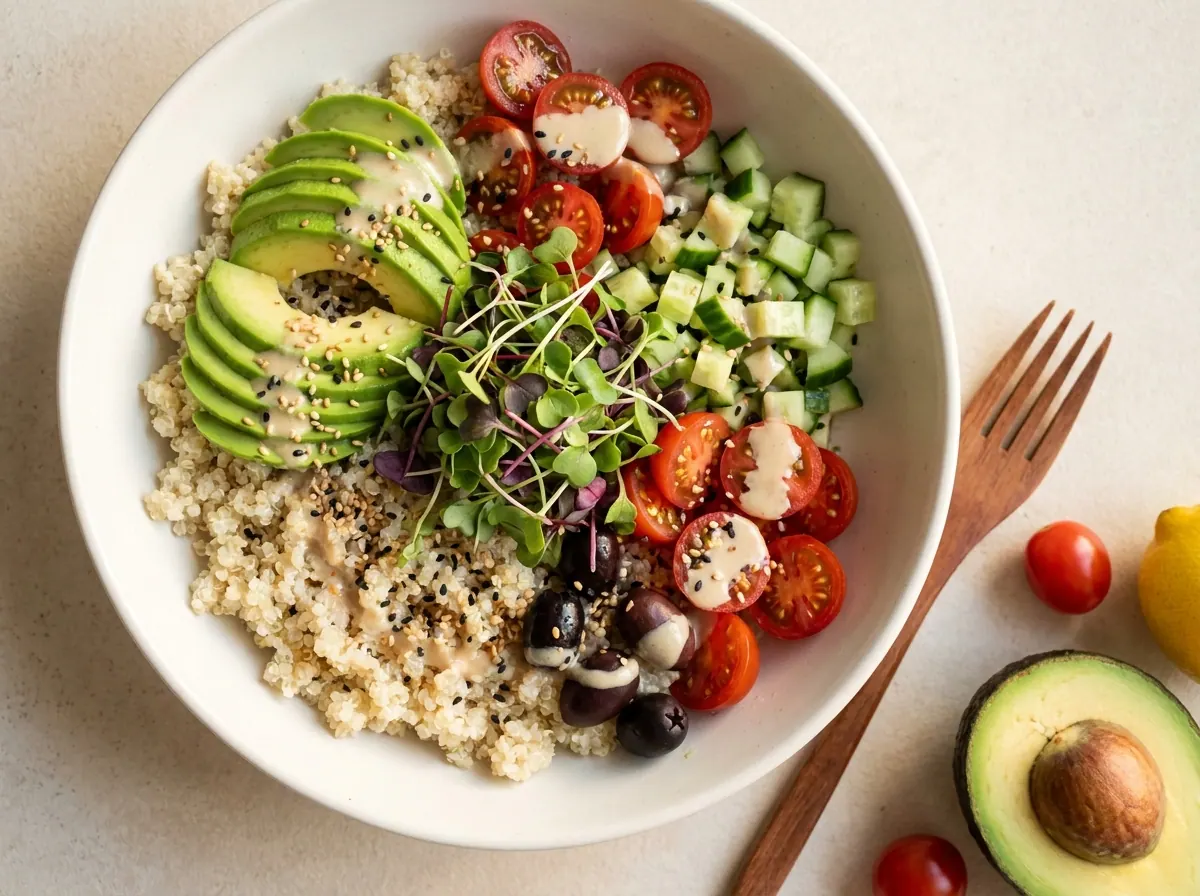
Cooked and cooled quinoa
same amount
Gluten-free [2], finer texture, neutral flavor
Parsley alone
Parsley and cilantro with more parsley
same total amount
Deeper and sharper flavor than parsley alone
Sumac
Extra lemon juice
Add a little more lemon juice
Clearer sourness, loses the light pink color
Green onion
Finely chopped small red onion
half the amount
Sharper, more intense, needs a pinch of sugar to soften it
Regular tomatoes
Cherry tomatoes halved
same weight
Higher sweetness, less water, nicer look for hosting
How Much Does It Make? Scaling Guide
Number of servings
Chopped parsley
Fine bulgur
Tomatoes
Lemon
2 (single × 2)
two cups
quarter cup
one large
half a lemon
4 (the base)
four cups
half cup
two
one whole lemon
8 (large family)
eight cups
one cup
four
two lemons
12 (hosting)
twelve cups
one and a half cups
six
three lemons
EEINA Nutrition Tip
The ratio of parsley to bulgur is the secret of the dish: tabbouleh is a parsley salad, so its correct color is entirely green. Bulgur is a supporting element, not a base, and every increase in it turns the color from green to brown and changes the nature of the dish.
Add This Recipe to Your Plan
The EEINA app saves your favorite recipes, calculates them from their real ingredients, and shows your daily numbers toward your goal. Try it free now.