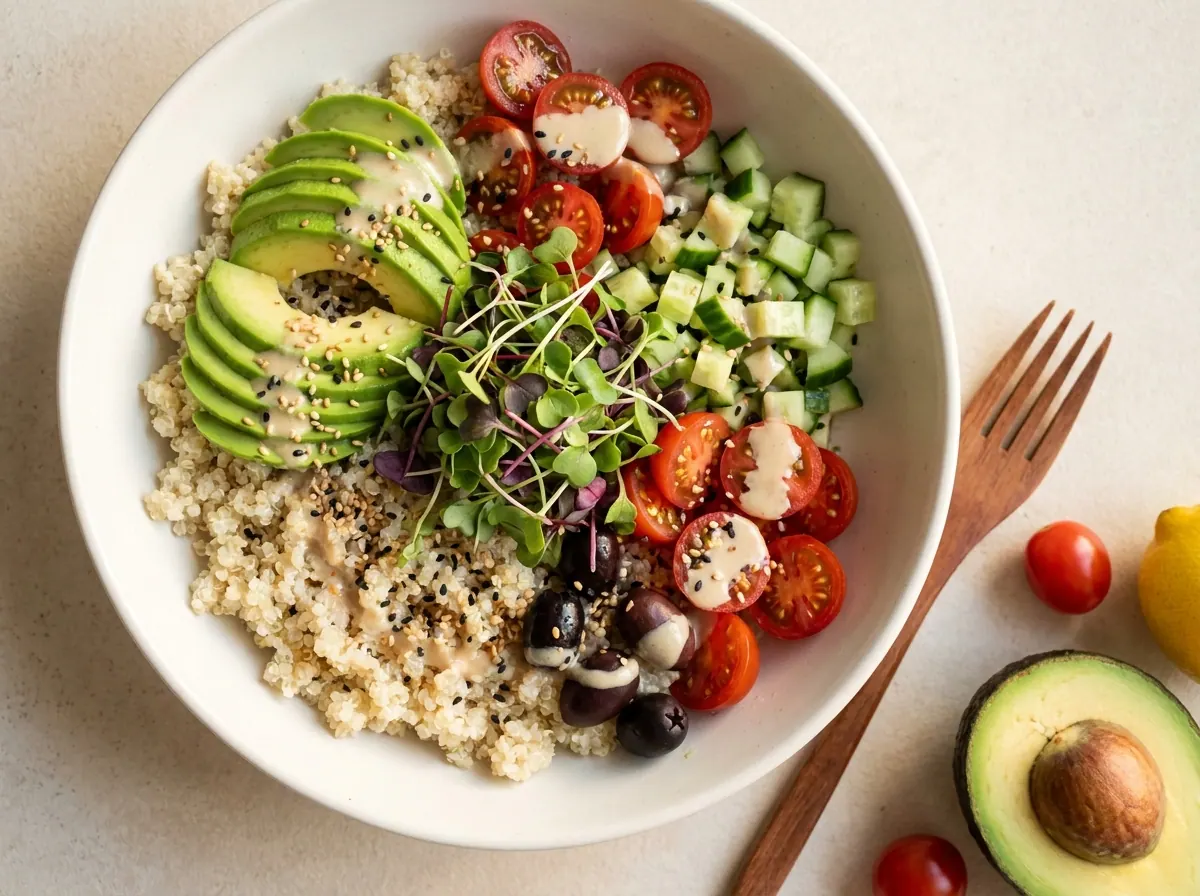
Quinoa is an ancient grain from the Inca mountains of Peru. It is called "the gold grain" because its nutritional value far exceeds that of wheat and rice.
NASA considered it an ideal food for space travel. Unlike rice and wheat, quinoa contains a complete protein (it does not need to be combined with anything else). With avocado rich in MUFA = a very balanced meal.
Preparation Steps
Rinse the quinoa
Rinse the quinoa well under cold water for about thirty seconds, as this step is important to remove the bitter layer on its surface (saponin).
Cook the quinoa
In a small pot, put the quinoa, broth, and a pinch of salt, bring it to a boil, then lower the heat to its minimum, and cover it for twelve to fifteen minutes until it absorbs all the liquid. Leave it for five minutes without opening so it finishes cooking with the steam.
Prepare the avocado
Open the avocado, remove the pit, and cut it into cubes, then sprinkle it with lemon juice right away so its color does not change.
Chop the vegetables
Chop the cherry tomatoes, cucumber, and onion, and finely chop the herbs, and put them all in a large bowl.
Assemble and serve
Add the warm—not hot—quinoa to the vegetables, season it with the mix of olive oil, lemon and its zest, cumin, salt, and pepper, then add the avocado at the end carefully so it does not get mashed, and sprinkle the ground pistachios.
Blood Sugar Impact
The glycemic index (GI) measures how quickly a food raises blood sugar, while the glycemic load (GL) measures how much a full serving raises it. Together they give the complete picture.
Glycemic Index
GI
46Low
Low0–55Medium56–69High70+
A low value (≤55) means a gradual rise in blood sugar — the most suitable range for diabetes and insulin resistance.
Glycemic Load
GL
27High
Low0–10Medium11–19High20+
Glycemic load reflects the impact of the full serving. To lower it: take half a serving, or pair the recipe with a source of protein and fiber.
Nutritional Information
Per ServingMakes 2 servings · one serving is about 545 g of raw ingredients
Calories635 kcal32%of Daily Value*
Protein16 g32%of Daily Value*
Carbohydrates73 g27%of Daily Value*
Fat35 g45%of Daily Value*
Fiber15 g54%of Daily Value*
Sodium926 mg40%of Daily Value*
Potassium1248 mg27%of Daily Value*
Phosphorus479 mg38%of Daily Value*
* Percent Daily Values are based on a 2,000-calorie diet per FDA food-label reference values — your daily needs may be higher or lower. Values are derived from the recipe's ingredients via the USDA database.
Troubleshooting
The most common problems when preparing Quinoa and Avocado Salad, and how to fix them:
The quinoa tastes bitter or earthy
It was not rinsed before cooking. Quinoa is naturally coated with a layer of bitter protective saponins. Rinse it in a fine strainer under cold running water until the water runs clear (about half a minute), then cook it. This is a step not to be skipped.
The quinoa is doughy and clumped
Too much water, or it was overcooked. The moderate ratio: one cup of quinoa to two cups of water, cooked over low heat covered until the water is absorbed and the grains appear translucent with small rings. If water remains: lift the lid and leave it on the heat for two minutes until it evaporates.
The avocado blackened quickly after cutting
Exposure to air oxidizes the avocado's flesh. For an immediate fix: sprinkle lemon or lime on the pieces right after cutting, as the acidity slows oxidation. To store leftovers: leave the pit in the saved half, and cover it with cling film touching the avocado's surface directly.
The avocado is not ripe and the salad failed
You chose a hard fruit. To pick a ripe one: press gently with the palm of your hand (not your finger, which leaves a mark); it should give a little without collapsing. To speed up the ripening of a hard fruit: put it in a paper bag with an apple for a day or two at room temperature.
The salad is bland with no flavor
Too little lemon, or the olive oil is refined and tasteless. Extra virgin olive oil contains polyphenols that give a pungent fruity flavor [1]. Choose it for cold salads. Add a pinch of fine sea salt and freshly ground black pepper, which open up the flavors.
The salad is watery at the bottom of the bowl
The quinoa was added hot, so it released steam that condensed. Leave it to cool on an open tray for ten minutes before mixing, so the grains separate and lose the excess moisture. The cucumber and tomatoes too: chop them and leave them in a strainer for a few minutes before adding.
Storage and Make-Ahead
Refrigerator (4°C)
The mixed salad: one day only, the vegetables wilt and the avocado oxidizes. The cooked quinoa separately: four days in an airtight container.
Freezer (-18°C)
The salad: not suitable. The avocado and vegetables turn into a paste after thawing. The cooked quinoa separately: up to two months in an airtight container, thawed overnight in the fridge.
Make ahead
Cooking the quinoa: a day ahead in a container in the fridge. Chopping the firm vegetables (cucumber, tomato): two hours ahead, covered in the fridge. The avocado: cut only minutes before serving, with an immediate sprinkle of lemon. The final mix: five minutes before serving.
Serving
A cold dish that is not heated. Do not leave it out of the fridge for more than two hours per the general USDA recommendation for cold foods [2].
Tested Ingredient Substitutions
Original Ingredient
Tested Substitute
Ratio
Flavor Difference
Quinoa
Fine green bulgur
Same cooked amount
A deeper wheat flavor, cheaper, contains gluten
Quinoa
Cooked freekeh
Same amount
A light smoky flavor, a stronger texture
Avocado
Low-fat feta cheese
Half the amount
A creamy salty texture, higher protein, less fat
Extra virgin olive oil
Avocado oil
Same amount
A neutral taste, a higher smoke point, better for those who like neutral
Fresh lemon
Lime
Same amount
A softer aroma, less acidity, a Caribbean flavor
How Much Does It Make? Scaling Guide
Number of servings
Quinoa (dry)
Avocado
Cucumbers
Tomatoes
2 (individual × 2)
0.5 cup
1 large fruit
1 small
1 medium
4 (base)
1 cup
2 large fruits
2 small
2
8 (large family)
2 cups
4 fruits
4
4
12 (entertaining)
3 cups
6 fruits
6
6
EEINA Nutrition Tip
To preserve the avocado: add it at the end and sprinkle it with lemon. If you are storing leftovers, leave the pit in the salad (it slows oxidation for 24 hours).
Add This Recipe to Your Plan
The EEINA app saves your favorite recipes, calculates them from their real ingredients, and shows your daily numbers toward your goal. Try it free now.