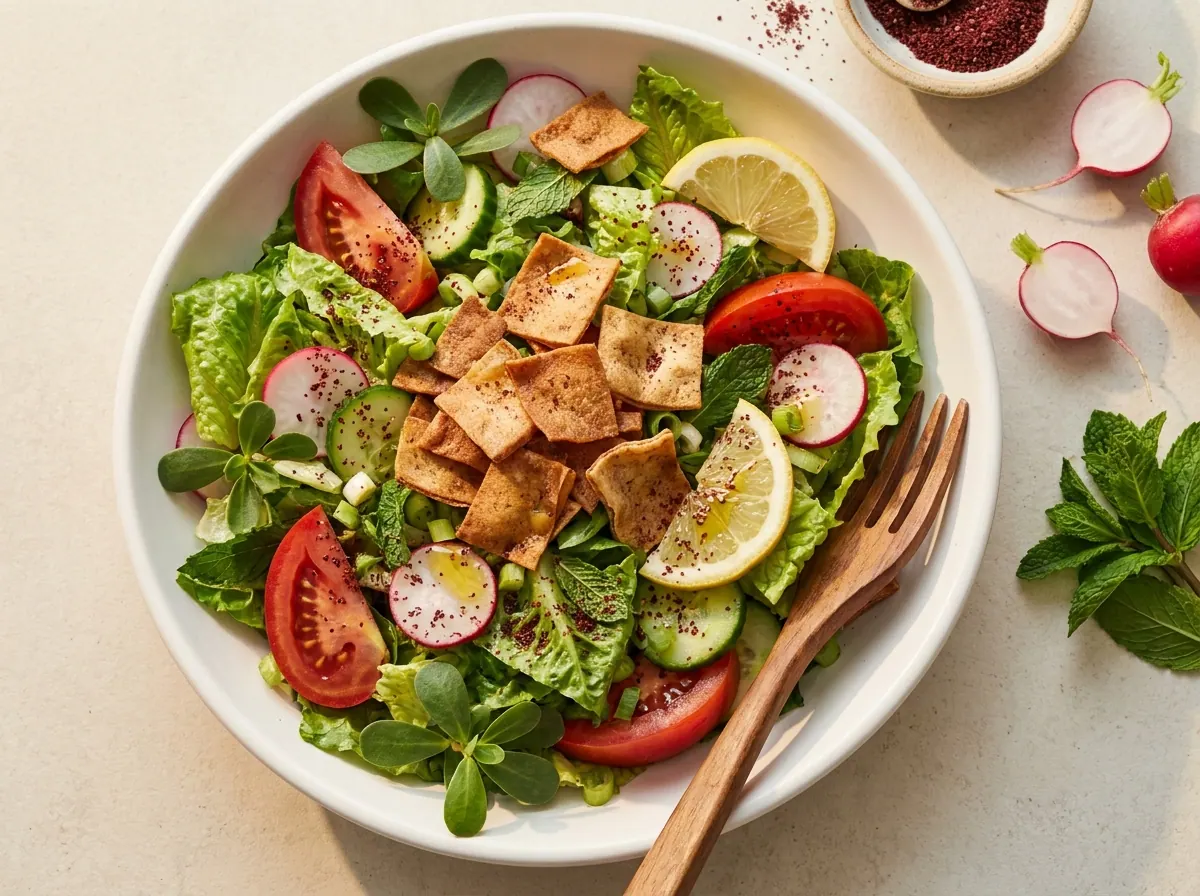
The lightest of Levantine salads — Fattoush (toasted-bread salad) · only 283 calories and 6 g fiber. The secret is whole-wheat bread toasted (not fried) and genuine pomegranate molasses.
Fattoush (toasted-bread salad) is a Lebanese village dish — born from the idea of 'never waste stale bread.' Toast it, toss it with seasonal vegetables, and add pomegranate molasses for its sweet-sour flavour.
The classic version uses fried bread (which adds 120 calories). Our version toasts it in the oven — same crunch, minus 120 calories.
Preparation Steps
Toast the bread
Cut the bread into cubes and place in an oven at 180°C for 5–7 minutes until crisp — no oil needed.
Chop the vegetables
Cut all the vegetables into medium — not tiny — pieces. Fattoush (toasted-bread salad) likes big chunks that keep their crunch.
Chop the herbs
Finely chop the parsley and mint so they release their aromatic oils.
Make the dressing
In a small bowl, whisk together the olive oil, lemon juice, pomegranate molasses, and sumac (tart purple spice) with a pinch of salt and pepper until emulsified.
Assemble the Fattoush
In a large bowl, place the lettuce first, then the vegetables, then the herbs. Pour over the dressing and add the toasted bread at the very last moment before serving to keep it crunchy. Toss gently and scatter extra sumac on top.
Blood Sugar Impact
The glycemic index (GI) measures how quickly a food raises blood sugar, while the glycemic load (GL) measures how much a full serving raises it. Together they give the complete picture.
Glycemic Index
GI
32Low
Low0–55Medium56–69High70+
A low value (≤55) means a gradual rise in blood sugar — the most suitable range for diabetes and insulin resistance.
Glycemic Load
GL
9Low
Low0–10Medium11–19High20+
Glycemic load reflects the impact of the full serving. To lower it: take half a serving, or pair the recipe with a source of protein and fiber.
Nutritional Information
Per ServingMakes 4 servings · one serving is about 565 g of raw ingredients
Calories283 kcal14%of Daily Value*
Protein9 g18%of Daily Value*
Carbohydrates40 g15%of Daily Value*
Fat12 g15%of Daily Value*
Fiber12 g43%of Daily Value*
Sodium123 mg5%of Daily Value*
* Percent Daily Values are based on a 2,000-calorie diet per FDA food-label reference values — your daily needs may be higher or lower. Values are derived from the recipe's ingredients via the USDA database.
Troubleshooting
The most common problems when preparing Light Lebanese Fattoush (toasted-bread salad), and how to fix them:
Toasted bread lost its crunch quickly
You added the toasted bread before serving and it absorbed the dressing and wilted. Add the bread only at the moment of serving, after pouring the dressing and molasses over the vegetables. For quick desk lunches: keep the toasted bread in a separate dry container and add it to your bowl just before eating.
Sumac flavour disappeared and left no trace
You added the sumac to hot vegetables, or heated it with the dressing. The anthocyanin compounds in sumac (tart purple spice) are heat-sensitive and lose both colour and flavour when warmed [1]. Add it cold, scattered over the salad just a few minutes before serving.
Vegetables wilted before reaching the table
The vegetables were washed but not dried, and the dressing was added too early. Water clinging to leaves dissolves the salt and wilts the salad. Wash leafy greens (lettuce, mint, parsley), then dry them in a salad spinner or on a cotton towel. Add the dressing only 5 minutes before serving.
Fattoush looks pale without its signature pink
Too little sumac. Sumac (tart purple spice) is what gives Fattoush its distinctive pinkish hue. Use at least 1 tablespoon for every 4 servings, scattered right after tossing. If you do not have enough: add a spoonful of fresh pomegranate molasses to compensate for both the acidity and the colour.
Dressing separates and pools at the bottom
The oil was not properly blended with the acid before pouring. Make the Levantine dressing in a small glass: olive oil, lemon juice, pomegranate molasses, salt, and sumac — shake or beat with a fork until combined, then pour over the salad all at once and toss gently.
Bread is hard and burnt outside but soft inside
The oven temperature was too high. Cut the pita into small squares, spray or drizzle with a little olive oil, and toast in a moderate oven until evenly golden. If no oven: a dry pan over medium heat with constant stirring.
Storage and Make-Ahead
Refrigerator (4°C)
Cut vegetables without dressing: 2 days in an airtight container on the middle shelf. Fattoush tossed with dressing: 1 day only — loses crunch but remains safe.
Freezer (−18°C)
Not suitable. Leafy greens, cucumber and tomato turn to watery mush after thawing. Fattoush is a same-day dish.
Make-ahead
Cut vegetables: up to 2 hours before serving, stored covered in the refrigerator. Toast the bread: hours or a day ahead in a dry airtight container. Dressing: up to 1 hour ahead in a sealed jar. Final toss: only 5 minutes before serving.
Serving
Serve cold — do not reheat. Do not leave outside the refrigerator for more than 2 hours, per USDA general cold-food guidance [2].
The flavour secret: genuine Lebanese pomegranate molasses (low sugar content, richly sour). Avoid sweetened substitutes. Two small tablespoons make a big difference in taste.
Add This Recipe to Your Plan
The EEINA app saves your favorite recipes, calculates them from their real ingredients, and shows your daily numbers toward your goal. Try it free now.