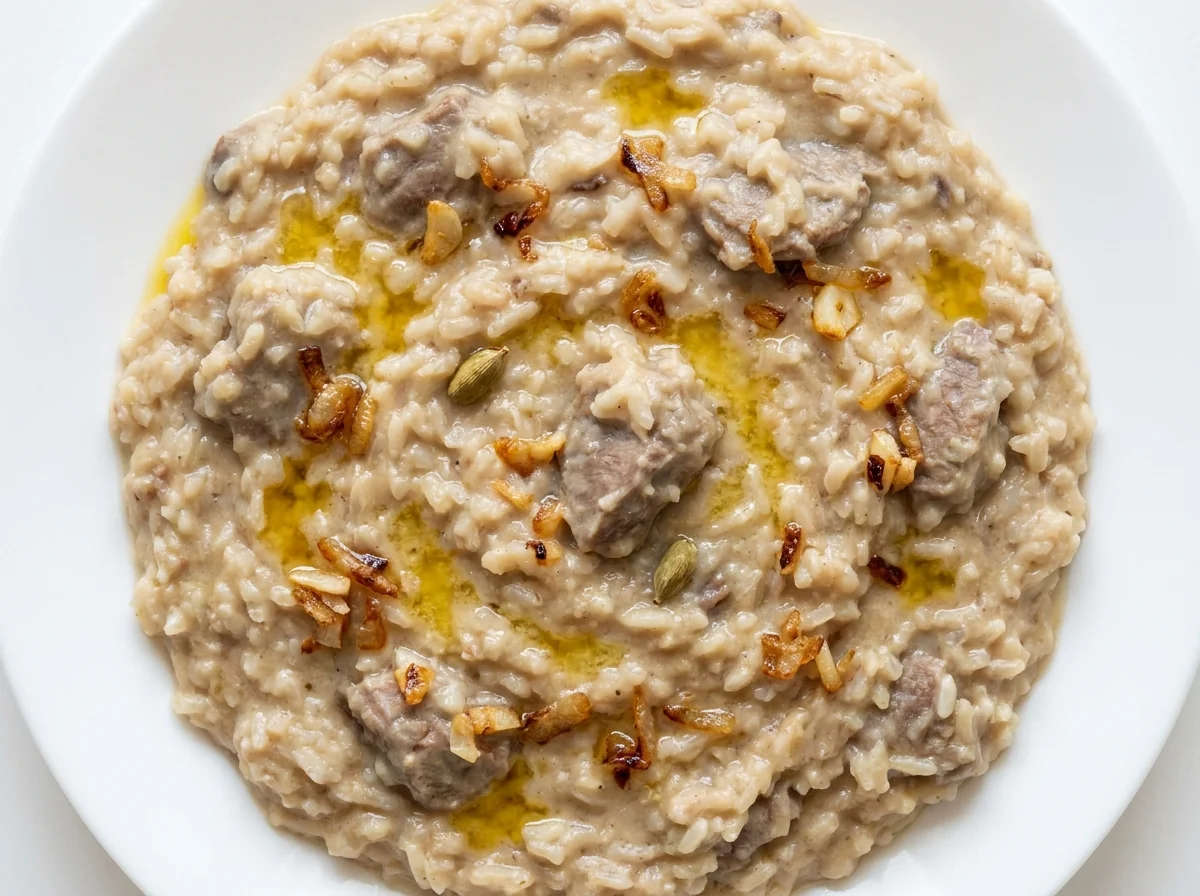
We make arsia the way it is served on the tables of feasts and celebrations in Oman, where the meat and rice are slow-cooked until they melt, then pounded together until they become a single creamy consistency.
It is a dish of hospitality par excellence, topped with a scoop of hot ghee, that we gather around and eat by hand as Omani households have handed it down.
Preparation Steps
Boiling the meat
Place the lamb in a wide pot with half the onion, the garlic, cardamom, cinnamon stick, black pepper, and half the salt, cover it with water, and bring it to a boil over medium heat. Then lower the heat and cook it gently for about an hour and a half until it turns tender and falls apart easily.
Adding the rice
Strain the broth and set it aside, return the meat to the pot with the washed rice, add enough broth to cover the rice by two fingers, and add the remaining salt.
Slow cooking
Cook the rice and meat over low heat for about forty minutes until the rice is fully cooked, absorbs the broth, and becomes very soft, adding hot broth whenever it dries out so the consistency stays moist.
Pounding
Mash the rice and meat together with a wooden pestle or the back of a sturdy spoon until they blend into a smooth, cohesive paste resembling porridge; the more you pound, the more cohesive the consistency becomes.
Serving
Spread the arsia on a wide plate, make a well in its center, and pour the hot melted ghee into it. Serve it warm, eaten by hand by dipping, alongside raisin sauce (tursha) for those who like it.
Blood Sugar Impact
The glycemic index (GI) measures how quickly a food raises blood sugar, while the glycemic load (GL) measures how much a full serving raises it. Together they give the complete picture.
Glycemic Index
GI
70High
Low0–55Medium56–69High70+
A low value (≤55) means a gradual rise in blood sugar — the most suitable range for diabetes and insulin resistance.
Glycemic Load
GL
50High
Low0–10Medium11–19High20+
Glycemic load reflects the impact of the full serving. To lower it: take half a serving, or pair the recipe with a source of protein and fiber.
Nutritional Information
Per ServingMakes 4 servings · one serving is about 655 g of raw ingredients
Calories846 kcal42%of Daily Value*
Protein32 g64%of Daily Value*
Carbohydrates73 g27%of Daily Value*
Fat46 g59%of Daily Value*
Fiber2 g7%of Daily Value*
Sodium578 mg25%of Daily Value*
Potassium507 mg11%of Daily Value*
Phosphorus355 mg28%of Daily Value*
* Percent Daily Values are based on a 2,000-calorie diet per FDA food-label reference values — your daily needs may be higher or lower. Values are derived from the recipe's ingredients via the USDA database.
Troubleshooting
The most common problems when preparing Omani Arsia (Pounded Lamb and Rice), and how to fix them:
The arsia is dry and too stiff
Add hot broth a spoonful at a time and keep pounding until the consistency softens, for arsia absorbs liquid and dries out as it cools.
The rice was not well cooked before pounding
Leave it over low heat with extra broth until it is fully tender, for pounding cannot fix half-cooked rice.
The meat stayed firm and does not fall apart
Extend its boiling over low heat until it becomes tender enough to fall apart with a spoon, then pound it, for pounding needs fully cooked meat.
Storage and Make-Ahead
Refrigerator
Keep it in an airtight container for up to two days, and reheat it over low heat with a splash of water or broth until the consistency turns soft again.
Freezing
Freeze it for up to a month in airtight containers, thaw it in the refrigerator, then reheat it gently with some liquid; it is best eaten fresh because its consistency is nicer.
Tested Ingredient Substitutions
Original Ingredient
Tested Substitute
Ratio
Flavor Difference
lamb
goat meat or beef
same weight, 600 g
Goat meat is close to the Omani original, and beef needs slightly longer cooking to become tender
short-grain rice
Egyptian rice or medium-grain rice
same weight, 350 g
Short-grain rice is better suited to pounding because it holds together and gives a creamy consistency
ghee
butter
same weight, 50 g
Ghee is closer to the traditional Omani flavor and more stable under heat
broth
chicken broth or water with a bouillon cube
same amount
The original meat broth is richer in flavor, and the substitute is a little lighter
How Much Does It Make? Scaling Guide
Ingredient
Half amount
Full amount (base)
Double
Lamb
300 g
600 g
1200 g
Short-grain rice
175 g
350 g
700 g
Ghee
25 g
50 g
100 g
Onion
50 g
100 g
200 g
Salt
2.5 g
5 g
10 g
EEINA Nutrition Tip
The secret of arsia lies in continuous pounding and enough broth. The more hot broth we add and the longer we pound, the smoother and more cohesive the consistency becomes, and we keep some broth aside to adjust the consistency at serving.
Add This Recipe to Your Plan
The EEINA app saves your favorite recipes, calculates them from their real ingredients, and shows your daily numbers toward your goal. Try it free now.
What is the origin of arsia and when is it served?
Arsia is a traditional Omani dish served at feasts, weddings, and large occasions, and it is usually cooked in generous quantities because it is a food of gathering and hospitality.
Why do we put ghee on top when serving?
The scoop of hot ghee gives arsia its distinctive flavor and sheen, and it is poured into a well in the center of the plate so it seeps through the mixture as it is eaten; it is a rich dish eaten in moderation.
Can it be made without pounding?
Pounding is what sets arsia apart and gives it its creamy, cohesive consistency; without it, it stays ordinary meat and rice, not arsia.