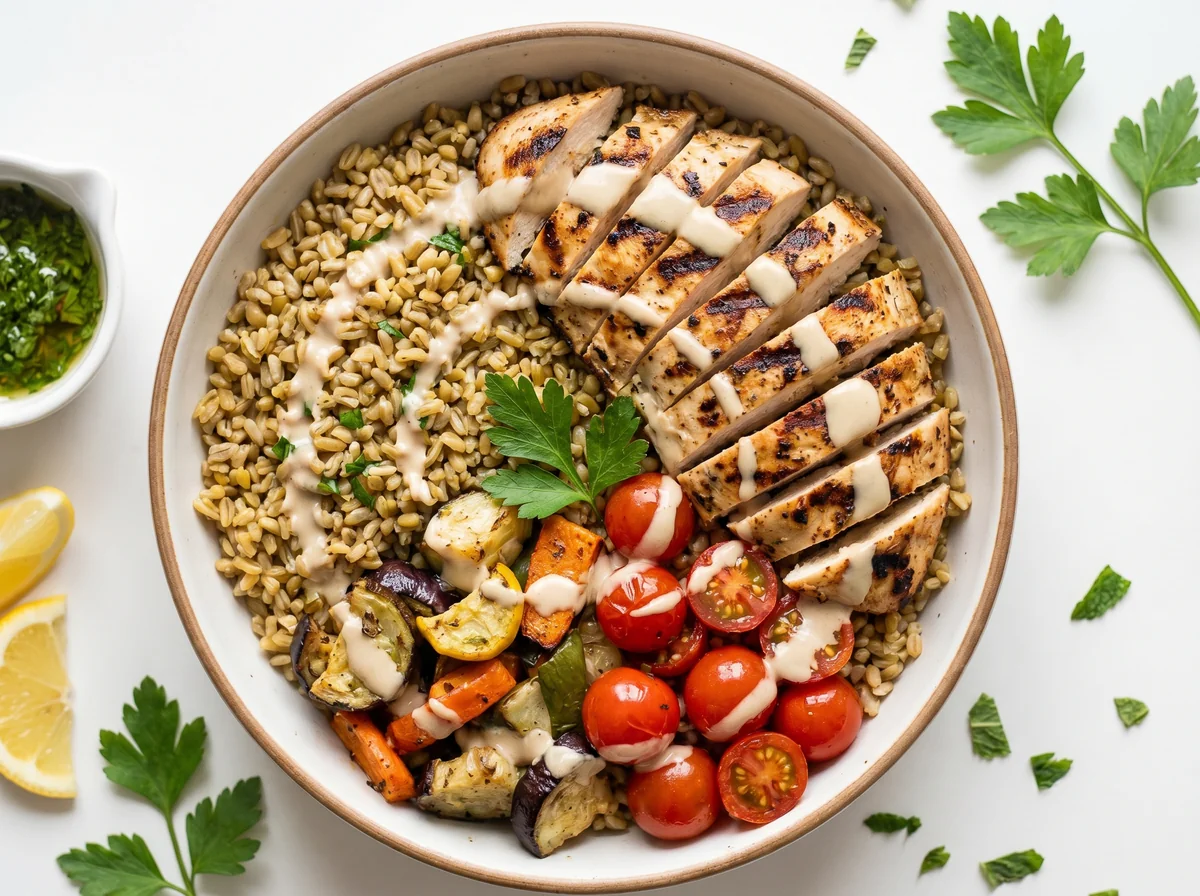
Grilled Chicken and Freekeh Bowl with Roasted Vegetables
A complete, balanced bowl built on a Gulf kitchen spirit — smoky freekeh as the base, grilled chicken breast, roasted vegetables, and a cool mint yogurt sauce, all in one dish.
The balanced bowl concept presents a complete meal in one dish with organized sections — not a random mix — and here it is prepared in the spirit of the Gulf kitchen with smoky freekeh at its heart.
Freekeh is wheat harvested young and green, then its surface is scorched and scraped, giving it a distinctive smoky flavor while remaining a whole grain retaining its bran. When paired with a light grilled chicken breast, roasted vegetables, and a refreshing mint yogurt sauce, the dish becomes a practical lunch that satisfies without heaviness — ideal for those seeking balance between flavor and nutrition on a workday.
Preparation Steps
Marinate the chicken
Mince the garlic and mix it in a bowl with half the lemon juice, one tablespoon of olive oil, the cumin, paprika, black pepper, and a pinch of salt. Toss the chicken breast in the mixture until fully coated on all sides. Let it absorb the marinade for at least 10 minutes at room temperature — the acidic marinade tenderizes the surface and gives deeper flavor.
Soak and rinse the freekeh
Rinse the freekeh in a strainer under running water, rubbing it between your hands until the water runs clear, then soak it in warm water for 10 minutes and drain. This step removes dust and burnt husks and speeds up cooking.
Cook the freekeh
Heat a tablespoon of oil in a pot over medium heat. Add the drained freekeh and stir for 2 minutes until its toasted aroma rises, then pour in the boiling broth, cover the pot, and reduce the heat. Cook gently for 25–30 minutes until the freekeh has absorbed the liquid and the grains are tender with a light bite. If it dries out before becoming tender, add a little hot water.
Roast the vegetables
Cut the zucchini, bell peppers, carrots, and onion into medium equal-sized pieces and toss with a tablespoon of oil and a pinch of salt and black pepper. Spread on a baking tray and roast in an oven preheated to 200°C for 20–25 minutes until softened and the edges are golden. Roasting concentrates their natural sugars and creates a warm, deep flavor without deep-frying.
Grill the chicken
Heat a grill pan or griddle over medium-high heat. Place the marinated chicken breast on it without moving for 4–5 minutes per side until grill marks form. Verify the internal temperature has reached 74°C with a meat thermometer — this temperature guarantees the chicken is fully cooked and safe.
Rest the chicken and slice
Transfer the chicken to a cutting board, cover loosely with foil, and let it rest for 5 minutes before slicing. Resting allows the juices to redistribute inside the meat, keeping the slices moist rather than dry.
Make the mint yogurt sauce
Mix the Greek yogurt with the chopped mint, the remaining lemon juice, and a pinch of salt until smooth. Adjust the consistency with a tablespoon of water if you want a lighter texture. Serve it cold over the bowl.
Build the bowl and serve
Divide the freekeh between two deep bowls, then arrange the roasted vegetables, sliced chicken, and a handful of arugula in separate sections on top. Drizzle the mint yogurt sauce over everything and serve warm immediately, while the chicken stays tender and the vegetables hold their texture.
Blood Sugar Impact
The glycemic index (GI) measures how quickly a food raises blood sugar, while the glycemic load (GL) measures how much a full serving raises it. Together they give the complete picture.
Glycemic Index
GI
35Low
Low0–55Medium56–69High70+
A low value (≤55) means a gradual rise in blood sugar — the most suitable range for diabetes and insulin resistance.
Glycemic Load
GL
21High
Low0–10Medium11–19High20+
Glycemic load reflects the impact of the full serving. To lower it: take half a serving, or pair the recipe with a source of protein and fiber.
Nutritional Information
Per ServingMakes 2 servings · one serving is about 925 g of raw ingredients
Calories733 kcal37%of Daily Value*
Protein53 g106%of Daily Value*
Carbohydrates79 g29%of Daily Value*
Fat23 g29%of Daily Value*
Fiber19 g68%of Daily Value*
Sodium353 mg15%of Daily Value*
* Percent Daily Values are based on a 2,000-calorie diet per FDA food-label reference values — your daily needs may be higher or lower. Values are derived from the recipe's ingredients via the USDA database.
Troubleshooting
The most common problems when preparing Grilled Chicken and Freekeh Bowl with Roasted Vegetables, and how to fix them:
Freekeh turned sticky or mushy
Too much liquid was added or it was cooked too long. Stick to roughly 4 parts liquid to 1 part freekeh, uncover the pot at the end to evaporate the excess, and test the grain by biting rather than guessing.
Chicken is dry inside
The internal temperature exceeded 74°C or it was grilled on too high heat. Use a thermometer and stop cooking the moment the temperature is reached, then rest it covered for 5 minutes before slicing.
Vegetables came out soft and watery without browning
The tray was overcrowded so the moisture steamed rather than roasted. Spread them in a single layer with space between pieces, raise the oven to 200°C, and don't stir too often to allow browning to develop.
Dish tastes flat
The flavor needs balanced acidity and salt. Drizzle a squeeze of lemon juice over the freekeh at the end, adjust salt by tasting, and add a little more cumin or paprika to the chicken marinade.
Yogurt sauce is too runny
Regular yogurt is thinner than Greek yogurt. Use strained Greek yogurt, or strain regular yogurt through a cloth for half an hour before mixing. Add water one drop at a time only when needed.
Storage and Make-Ahead
Refrigerator
Store the components separately in airtight containers — cooked freekeh and chicken keep for up to 3 days, the sauce up to 2 days. Store within 2 hours of cooking.
Freezer
Cooked freekeh and chicken tolerate freezing for up to 2 months in airtight containers. Do not freeze the yogurt sauce or arugula — their textures are ruined by freezing.
Reheating
Reheat the freekeh and chicken with a splash of water over low heat or in the microwave until the internal temperature reaches 74°C. Add the sauce and fresh vegetables after heating.
Advance meal prep
Cook the freekeh and chicken and roast the vegetables ahead of time and store separately. Assemble the bowl and pour the cold sauce at the moment of serving to keep each component at its best texture.
Tested Ingredient Substitutions
Original Ingredient
Tested Substitute
Ratio
Flavor Difference
Freekeh
Coarse bulgur, pearl barley, or quinoa
substitute by equal weight
Bulgur and barley are similar whole grains in texture; quinoa is a gluten-free option for those who need it. Cooking times differ — follow each grain's timing.
Chicken breast
White fish fillet or cooked chickpeas
substitute at about the same weight
Fish fillet should be grilled to an internal temperature of 63°C. Chickpeas are a vegan option that adds fiber. Adjust cooking time according to the substitute.
Greek yogurt
Strained plant-based yogurt or tahini thinned with water and lemon
substitute by equal weight
For dairy allergy. tahini adds a sesame flavor — be aware of sesame as an allergen when using it.
Zucchini, bell pepper, and carrots
Eggplant, broccoli, or butternut squash
substitute by equal weight
Any vegetable that holds up to roasting works. Butternut squash adds sweetness, broccoli adds color — choose by season and availability.
How Much Does It Make? Scaling Guide
Ingredient
2 servings
4 servings
6 servings
Chicken breast
300 g
600 g
900 g
Freekeh
150 g
300 g
450 g
Water or broth
600 ml
1200 ml
1800 ml
Vegetables (total)
550 g
1100 g
1650 g
Greek yogurt
120 g
240 g
360 g
EEINA Nutrition Tip
Don't cook the freekeh until it falls apart completely — its beauty lies in a grain that has chew. And let the chicken rest after grilling before slicing immediately; those five minutes preserve its juices and prevent dryness, making a real difference between a moist slice and a dry one.
Add This Recipe to Your Plan
The EEINA app saves your favorite recipes, calculates them from their real ingredients, and shows your daily numbers toward your goal. Try it free now.
What is the difference between freekeh and bulgur?
Freekeh is wheat harvested young and green, then the surface is scorched, giving it a smoky flavor. Bulgur is mature wheat that is boiled, dried, and cracked. Freekeh has a deeper flavor and firmer texture; bulgur cooks faster and has a lighter taste.
Is this dish suitable for people with diabetes?
The dish combines the fiber of freekeh and vegetables with the protein of chicken, and this combination generally supports stable blood sugar after meals. However, individual responses vary, and portion control along with follow-up with a doctor or dietitian remains essential.
Can I prepare it ahead for the week's meals?
Yes, and it is ideal for that. Cook the freekeh and chicken and roast the vegetables, then store them separately in the refrigerator for up to 3 days. Assemble the bowl and pour the cold sauce at the moment of serving.
Is it suitable for vegetarians?
Yes by swapping the chicken for cooked chickpeas or grilled tofu, and replacing the yogurt sauce with plant-based yogurt or tahini. The freekeh and vegetables remain as a balanced base.
How can I make the freekeh more flavorful without a lot of fat?
Toast it for 2 minutes in the pot before adding the liquid to bring out its smoky flavor, cook it in low-sodium chicken broth instead of water, and add a squeeze of lemon juice and chopped parsley at the end.