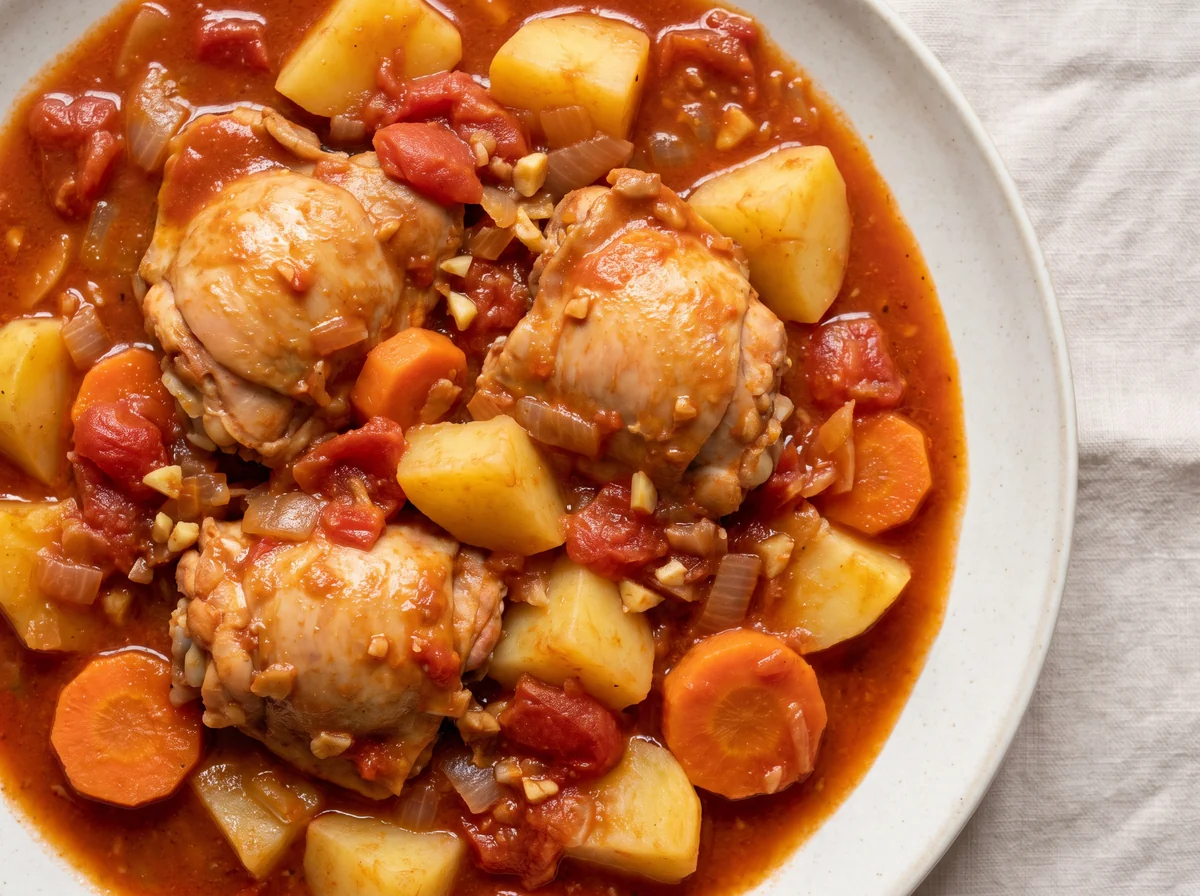
A Gulf chicken Salona (Gulf-style stew) of skinless thighs simmered in a tomato and loomi (dried black lime) broth with potatoes and carrots, seasoned with coriander and ginger. The chicken member of the Salona family: quicker-cooking than the lamb version and heartier than the fish one, with a single tablespoon of olive oil and salt at its minimum.
The original is the chicken Salona recipe from Sayidaty Kitchen, already among the lightest Salonas: a single tablespoon of olive oil, a quarter teaspoon of salt, and gentle spicing of coriander and ginger.
We kept that lightness and removed the thigh skin as an open adjustment, set the salt at three grams — relying on the loomi and tomatoes for acidity and depth — and ordered the steps along Gulf stew principles: sauté, then brown, then a broth that simmers at its own pace.
Preparation Steps
Sauté the onion and garlic
Heat the olive oil in a wide pot over medium heat and stir the onion for 5 to 6 minutes until golden, then add the garlic for a minute until fragrant.
Add the firm vegetables
Add the potatoes and carrots and toss them with the onion for 3 minutes until coated in the oil with their edges glistening — this sauté is what keeps them intact in the broth.
Brown the chicken with the spices
Add the skinless chicken thighs with the salt, coriander, ginger, cardamom, and black pepper, and stir over medium-high heat for 5 minutes until the chicken changes color on all sides and the spices coat it.
Build the tomato broth
Add the chopped tomatoes, tomato paste, and pierced loomi and stir for 3 minutes until the paste darkens, the tomatoes lose their raw smell, and the mixture thickens slightly.
Cover with water and simmer gently
Pour in the hot water gradually until it covers the ingredients, let it come to a boil, then lower the heat and cover the pot for 30 minutes until the chicken is done — its meat pulling easily off the bone — the potatoes soften without falling apart, and the broth reaches a medium body.
Remove the loomi and serve
Lift out the two loomi so their bitterness does not take over, then taste the broth and adjust the spices. Serve the Salona hot with white or brown rice or regag bread; for a lighter meal, the Salona and a salad are enough on their own.
Blood Sugar Impact
The glycemic index (GI) measures how quickly a food raises blood sugar, while the glycemic load (GL) measures how much a full serving raises it. Together they give the complete picture.
Glycemic Index
GI
48Low
Low0–55Medium56–69High70+
A low value (≤55) means a gradual rise in blood sugar — the most suitable range for diabetes and insulin resistance.
Glycemic Load
GL
11Medium
Low0–10Medium11–19High20+
Glycemic load reflects the impact of the full serving. To lower it: take half a serving, or pair the recipe with a source of protein and fiber.
Nutritional Information
Per ServingMakes 4 servings · one serving is about 590 g of raw ingredients
Calories323 kcal16%of Daily Value*
Protein31 g62%of Daily Value*
Carbohydrates28 g10%of Daily Value*
Fat9 g12%of Daily Value*
Fiber5 g18%of Daily Value*
Sodium473 mg21%of Daily Value*
* Percent Daily Values are based on a 2,000-calorie diet per FDA food-label reference values — your daily needs may be higher or lower. Values are derived from the recipe's ingredients via the USDA database.
Troubleshooting
The most common problems when preparing Gulf Chicken Salona with Vegetables, and how to fix them:
The potatoes fell apart and dissolved into the broth
The cubes were too small or the cooking ran long. Cut them into medium cubes and sauté them before the water so their surfaces set, and turn off the heat as soon as a fork slides in.
The chicken came out tough
The boil was too violent. Salona needs a gentle, covered simmer — lower the heat to its minimum after the first boil and give the thighs their full half hour.
The broth is watery, with no body
Too much water, or it was not given time. Uncover for the last 10 minutes so some liquid evaporates, and an extra spoonful of tomato paste gives body and color without starch.
The flavor is flat, missing the Gulf soul
The loomi was not pierced, or was missing. Pierce it with a knife before adding so its smoky acidity seeps into the broth — it is the Salona's signature, what sets it apart from any other stew.
Storage and Make-Ahead
Refrigerator (4°C)
Keep in an airtight container for up to 3 days; the loomi flavor is deeper and finer the next day.
Freezer (-18°C)
Freeze in single portions for up to 2 months; the potatoes may soften slightly after thawing, which is normal in stews.
Reheating
Reheat covered over low heat until the broth simmers gently and the chicken is hot through to the center, with 2 tablespoons of water if the broth has thickened.
Food safety
Do not leave it at room temperature for more than 2 hours. Cool quickly, then refrigerate, in keeping with the two-hour rule.
Tested Ingredient Substitutions
Original Ingredient
Tested Substitute
Ratio
Flavor Difference
Chicken thighs
Chicken breast, in large cubes
Same weight, 800 g
Less fat and more protein — add them only in the last 20 minutes so they do not dry out.
Potatoes
Cubed zucchini
Same weight, 300 g
Cuts the dish's carbohydrates considerably — add it in the last 10 minutes, as it cooks faster.
Ground ginger
Fresh grated ginger
1 teaspoon instead of the quarter
A sharper, more fragrant flavor — sauté it with the garlic at the start.
Black loomi
Fresh lemon juice
2 tablespoons added at the end of cooking
A cleaner acidity, but the Salona's signature smoky note is lost.
How Much Does It Make? Scaling Guide
Servings
Chicken
Potatoes
Tomatoes
Water
2 servings
400 g
150 g
150 g
375 ml
4 servings
800 g
300 g
300 g
750 ml
6 servings
1200 g
450 g
450 g
1125 ml
EEINA Nutrition Tip
Skinless chicken thighs are the Salona's point of balance: more tender than breast in long cooking and lighter than thighs with their skin. Add the water hot, not cold, so the simmer never stalls and toughens the chicken, and lift out the loomi as soon as the stew is done — its bitterness sharpens the longer it sits in the broth.
Add This Recipe to Your Plan
The EEINA app saves your favorite recipes, calculates them from their real ingredients, and shows your daily numbers toward your goal. Try it free now.
How does it differ from the lamb and vegetable Salona in the EEINA library?
That one cooks lamb for a full hour with zucchini and the bzar spice blend; this one uses skinless chicken thighs done in half the time with the gentler coriander and ginger — the weekday choice when there is no time for a lamb stew.
And how does it differ from fish Salona?
In fish Salona the fillet pieces are browned and then simmer for only minutes in a broth with fresh ginger and no potatoes; this one is chicken simmered for half an hour with potatoes and carrots, giving a richer, more filling stew.
Should the chicken be boiled before the Salona?
No need — boiling actually strips its flavor. Browning with the spices and then the slow simmer in the tomato broth is what builds the Salona's taste, and the broth itself becomes the essence of the dish.
How do we serve it as a lighter meal?
Skip the rice and serve it in a deep dish with a green salad — the potatoes and carrots stand in for the starches, and a little brown bread for dipping in the broth for those who want it.