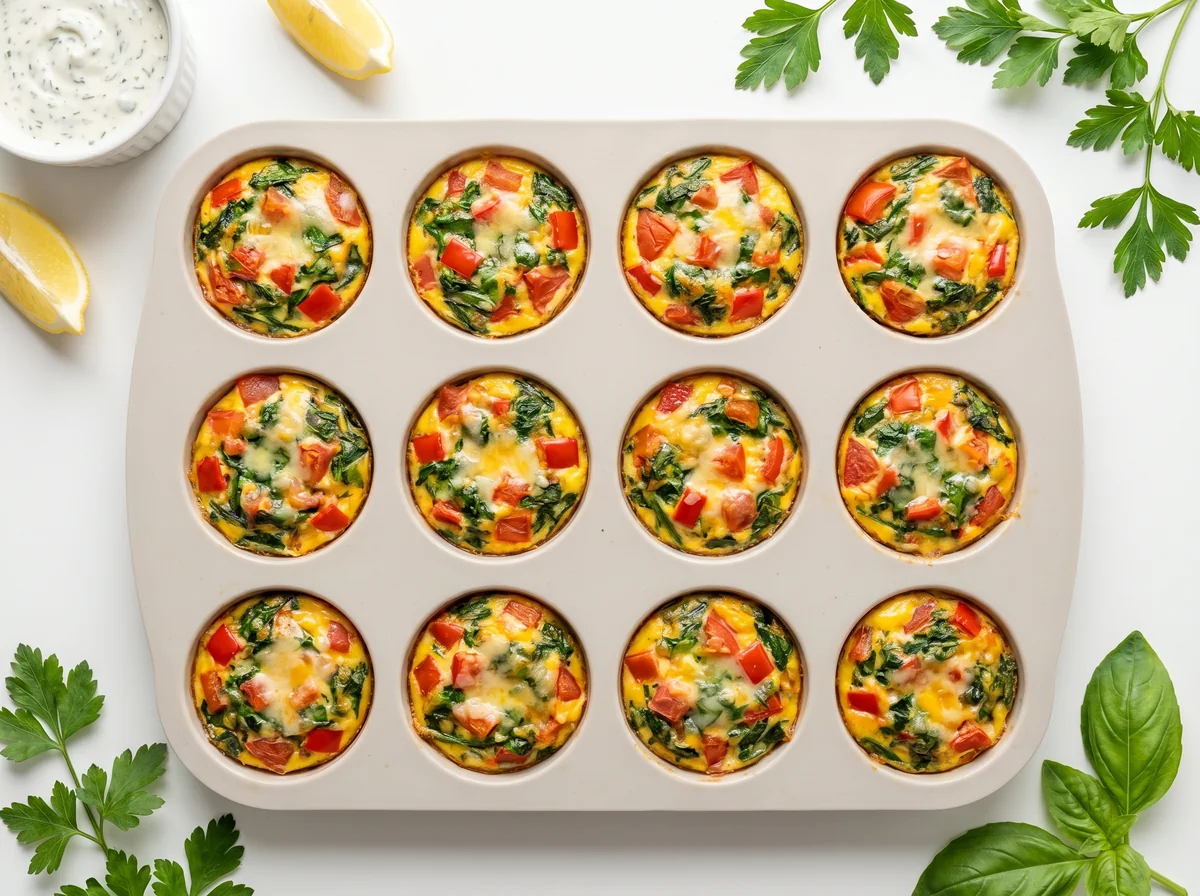
When the week starts busy, breakfast is usually the first thing we sacrifice — we head out on an empty stomach or grab something quick that barely satisfies. These cups are a quiet solution for those mornings: baked all at once in a muffin tin on Sunday evening, they leave you six ready portions waiting in the fridge.
Each cup has a tender egg-and-cottage-cheese core stuffed generously with spinach, colourful bell pepper, and tomato for colour and flavour. Warm two cups in under a minute and you leave the house with a warm, protein-rich breakfast instead of an empty promise to eat later. This is a recipe that rewards the planner and restores breakfast to its rightful place — without stealing time.
Preparation Steps
Preheat the oven and prepare the tin
Preheat the oven to 180 °C (top and bottom heat), and brush 12 cavities of a muffin tin with olive oil. Each cavity should gleam with a thin layer of oil — this prevents the egg from sticking and makes the cups easy to remove.
Wilt the vegetables
Heat a skillet over medium heat for 2 minutes, then add the spinach, bell pepper, and green onion. Stir for 3 minutes until the spinach wilts and releases its moisture. The goal is to drive off excess water before baking so the egg cups don't turn watery. Remove from heat and let cool for 5 minutes.
Whisk the egg mixture
Crack the eggs into a bowl, add the milk, black pepper, cumin, and salt, and whisk with a fork for 1 minute until the colour is uniform and the texture is smooth. Whisking incorporates a little air, giving the cups a tender crumb after baking.
Fold in the vegetables and cheese
Add the drained tomatoes and wilted vegetables, then crumble the cottage cheese over the mixture and stir until evenly distributed. The vegetables should be spread throughout without clumping — this ensures consistent flavour in every cup.
Fill the tin
Divide the mixture among the 12 cavities, filling each about three-quarters full. The egg puffs during baking and needs room — leave a small gap at the top so nothing overflows.
Bake
Place the tin in the centre of the oven and bake for 20 to 22 minutes until the centres are set and do not jiggle when the tin is moved. To confirm the eggs have reached the safe internal temperature of 74 °C, insert a toothpick into the centre — it should come out clean with no liquid.
Cool and unmould
Remove the tin and rest for 5 minutes so the egg cups shrink slightly from the sides. Then run a thin knife around each cup and lift it out. A successful cup holds its shape with lightly golden edges and does not crumble.
Blood Sugar Impact
The glycemic index (GI) measures how quickly a food raises blood sugar, while the glycemic load (GL) measures how much a full serving raises it. Together they give the complete picture.
Glycemic Index
GI
10Low
Low0–55Medium56–69High70+
A low value (≤55) means a gradual rise in blood sugar — the most suitable range for diabetes and insulin resistance.
Glycemic Load
GL
0Low
Low0–10Medium11–19High20+
Glycemic load reflects the impact of the full serving. To lower it: take half a serving, or pair the recipe with a source of protein and fiber.
Nutritional Information
Per ServingMakes 6 servings · one serving is about 160 g of raw ingredients
Calories151 kcal8%of Daily Value*
Protein12 g24%of Daily Value*
Carbohydrates6 g2%of Daily Value*
Fat9 g12%of Daily Value*
Fiber1 g4%of Daily Value*
Sodium383 mg17%of Daily Value*
Potassium297 mg6%of Daily Value*
Phosphorus196 mg16%of Daily Value*
* Percent Daily Values are based on a 2,000-calorie diet per FDA food-label reference values — your daily needs may be higher or lower. Values are derived from the recipe's ingredients via the USDA database.
Troubleshooting
The most common problems when preparing Baked Egg and Veggie Cups, and how to fix them:
The cups came out watery and didn't hold together
The vegetables weren't dry enough. Wilt the spinach and pepper until their liquid has evaporated, seed and drain the tomatoes before folding them in, and extend the baking time by 2 minutes until the centre is fully set.
The egg stuck to the tin and crumbled when removed
Grease each cavity thoroughly with oil or use silicone liners, and let the cups rest for 5 minutes before running a thin knife around the edges.
The tops puffed up a lot and then collapsed after removal
This is normal — egg puffs with heat then shrinks as it cools. Fill each cavity only three-quarters full and lower the temperature by 10 °C if your oven runs hot.
The texture is dry and rubbery
You overbaked them or the heat was too high. Remove the tin as soon as the centre is set, and add an extra tablespoon of milk to the mixture for a softer texture.
The flavour is bland
Eggs need more seasoning than you might expect. Season the mixture directly with salt and pepper, add a pinch of cumin or za'atar (thyme-sumac-sesame blend), and make sure the vegetables are fully cooked before folding them in to concentrate their flavour.
Storage and Make-Ahead
Refrigerator
Store the cups in an airtight container once completely cool. They keep for 4 days. Reheat in the microwave for 30 seconds per 2 cups, or in a warm oven for 5 minutes.
Freezer
Wrap each cup individually then place them together in a sealed freezer bag. Keeps for up to 1 month. Thaw overnight in the fridge before reheating, or microwave from frozen for 1.5 minutes.
Cool before storing
Never close the container over hot cups — steam condenses and makes them soggy. Let them cool on a wire rack for 10 minutes first to preserve their texture and limit moisture build-up.
Tested Ingredient Substitutions
Original Ingredient
Tested Substitute
Ratio
Flavor Difference
Low-fat cottage cheese
Low-sodium feta cheese
1:1
Feta is saltier, so reduce the added salt. Look for a low-sodium variety if you are monitoring blood pressure.
Fresh spinach
Frozen spinach, thawed
80 g fresh equals about 50 g frozen, squeezed dry
Squeeze thawed frozen spinach very well — it holds much more water than fresh.
Bell pepper and tomatoes
Grated squeezed zucchini or sliced mushrooms
1:1 by weight
Wilt and drain the substitute vegetables so they don't make the mixture too wet.
2 whole eggs (from the 8)
4 egg whites
Each whole egg equals roughly 2 egg whites
Raises protein and lowers fat while keeping the texture firm, though the colour will be slightly paler.
Low-fat milk
Unsweetened plant-based milk
1:1
Makes the milk portion lactose-free, but the cottage cheese still contains dairy so the recipe is not fully dairy-free.
How Much Does It Make? Scaling Guide
Ingredient
6 servings (12 cups)
3 servings (6 cups)
12 servings (24 cups)
Eggs
8
4
16
Cottage cheese
150 g
75 g
300 g
Chopped spinach
80 g
40 g
160 g
Bell pepper
120 g
60 g
240 g
Tomatoes
120 g
60 g
240 g
Low-fat milk
60 ml
30 ml
120 ml
EEINA Nutrition Tip
Drain the tomatoes of their seeds and liquid, and squeeze the wilted spinach well before folding everything together — excess moisture is the number-one reason egg cups turn watery and won't hold their shape. If you want to boost protein further without added fat, swap two whole eggs for four egg whites.
Add This Recipe to Your Plan
The EEINA app saves your favorite recipes, calculates them from their real ingredients, and shows your daily numbers toward your goal. Try it free now.
Yes — that is their whole point. Bake a full batch, refrigerate for up to 4 days or freeze for up to 1 month, then warm whatever you need each morning in under a minute.
Are they suitable for a low-carb diet?
Yes. The base is eggs, cheese, and low-carb vegetables, so they have a very modest impact on blood sugar. For those with diabetes, monitor your readings and consult your doctor.
How do I raise the protein further?
Swap two whole eggs for four egg whites, or increase the cottage cheese to 200 g. Either raises protein without adding much fat.
Why do my cups keep turning out watery?
The most common reason is excess moisture in the vegetables. Wilt the spinach and pepper until dry, seed and drain the tomatoes, and make sure the centre is fully set before removing the tin.
Are these suitable for children?
Yes — they are finger-food-sized, easy to hold, and rich in protein and vegetables. Reduce salt and pepper for young children and make sure the egg is fully cooked for safety.