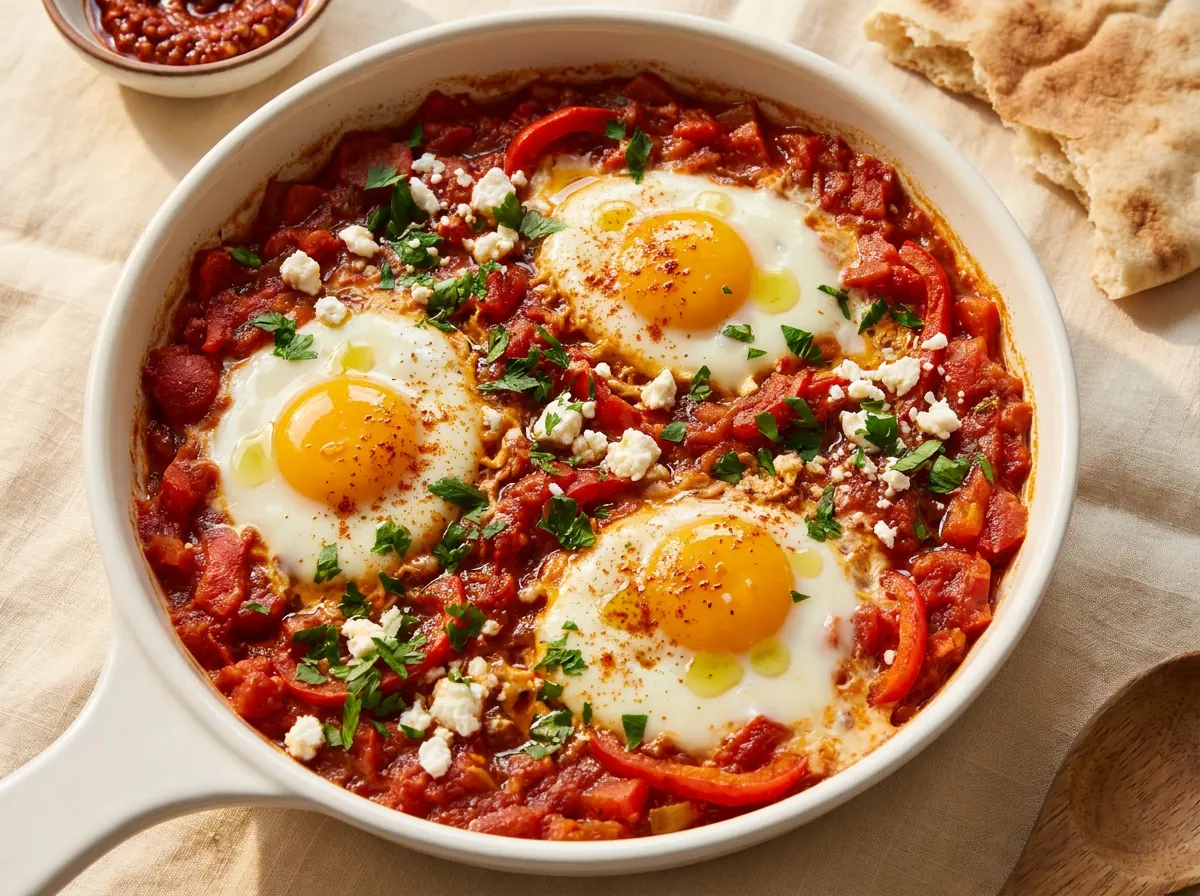
A warm breakfast shakshuka — eggs in a sauce of tomato, pepper, and onion, cooked to the doneness you choose, served with Arabic bread or oat bread. 18 g of protein keeps you full for four hours. Perfect for a calm start to the day.
Shakshuka is a North African dish that has spread across the entire Middle East. Its name means 'mixture' in Berber — because it truly is a simple and delicious mix of tomatoes and eggs.
Its nutritional value is excellent: eggs = complete protein, tomatoes = lycopene (a powerful antioxidant), olive oil = healthy fats. A meal everyone loves.
Preparation Steps
Chop the vegetables and prepare them
Start by preparing the ingredients so they are ready at hand: finely dice the onion, mince the garlic, cut the red and green peppers into small cubes, and grate or dice the tomatoes. Having everything prepped in advance makes the cooking smooth and fast.
Sauté the onion, garlic, and peppers
Heat the olive oil in a wide pan over medium heat, then add the onion and stir it until it softens and turns translucent, and add the garlic and peppers and sauté them for about two minutes until fragrant and the peppers soften. Be careful not to burn the garlic or it will turn bitter.
Cook the sauce
Add the tomatoes, cumin, and paprika with a pinch of salt and black pepper, and let the sauce cook for about seven to ten minutes until it thickens, deepens in color, and the oil separates on the surface. This is shakshuka in the moderate Saudi style; if you like it spicy, add a finely chopped hot green chili. Note: if it dries out before it is cooked, add a little warm water.
Add the eggs to your liking
Make four wells in the sauce and crack an egg into each one, then cover the pan over low heat. The egg doneness is up to you: for a runny yolk leave it about three minutes, and for those who prefer it fully set leave it six to eight minutes until both the white and the yolk are firm.
Serve it hot
Scatter the chopped parsley and, for those who like it, a sprinkle of crumbled feta cheese, then serve it hot in the pan itself with Arabic bread or oat bread as the case may be, since oat bread is higher in fiber and better suited for those watching their blood sugar or weight.
Blood Sugar Impact
The glycemic index (GI) measures how quickly a food raises blood sugar, while the glycemic load (GL) measures how much a full serving raises it. Together they give the complete picture.
Glycemic Index
GI
12Low
Low0–55Medium56–69High70+
A low value (≤55) means a gradual rise in blood sugar — the most suitable range for diabetes and insulin resistance.
Glycemic Load
GL
2Low
Low0–10Medium11–19High20+
Glycemic load reflects the impact of the full serving. To lower it: take half a serving, or pair the recipe with a source of protein and fiber.
Nutritional Information
Per ServingMakes 2 servings · one serving is about 535 g of raw ingredients
Calories381 kcal19%of Daily Value*
Protein18 g36%of Daily Value*
Carbohydrates25 g9%of Daily Value*
Fat24 g31%of Daily Value*
Fiber6 g21%of Daily Value*
Sodium358 mg16%of Daily Value*
Potassium961 mg20%of Daily Value*
Phosphorus315 mg25%of Daily Value*
* Percent Daily Values are based on a 2,000-calorie diet per FDA food-label reference values — your daily needs may be higher or lower. Values are derived from the recipe's ingredients via the USDA database.
Troubleshooting
The most common problems when preparing Shakshuka (eggs in tomato), and how to fix them:
The egg doneness is not what you wanted (too runny or too firm)
Doneness depends on time and coverage. If you want it runny, add the eggs to a warm, not very hot, sauce and cover the pan for two to three minutes; if you want it fully set, leave it six to eight minutes covered. Both are correct, and the choice is your taste.
The sauce is watery and will not thicken
The tomatoes were not cooked enough, or their water did not evaporate. Cook the tomatoes over medium heat without a lid for 15–20 minutes until the texture concentrates and clings slightly to the spoon. This concentration stage cannot be shortened.
The white spread out and sank into the sauce
The heat was low when the eggs were added, or the sauce was cold. Make sure the sauce is gently bubbling (small bubbles appear on the surface) before cracking the eggs. Make a small well with the spoon before placing each egg in it so the white stays gathered.
The flavor is bland without pepper sharpness
The red pepper was not roasted before adding it, or smoked paprika was missing. Deep shakshuka needs roasted red pepper (over a direct flame or in the oven) before peeling and adding it to the sauce. Sweet or smoked paprika adds depth without the sharpness of heat.
The bottom burned and the sauce is bitter
The heat was too high, or the pan has thin walls. Use a heavy pan (cast iron or thick stainless steel) over medium to low heat. If the bottom starts to stick: lift the pan off the heat, stir with a wooden spoon to release the layer from the bottom, then return it to a gentler flame.
The eggs taste undercooked and there is a safety concern
The eggs were not cooked enough. Per USDA food safety guidance [1], the white must be completely firm (not translucent or runny) for healthy adults. Pregnant women, children, and the elderly need a firm yolk as well. Leave the pan covered for an extra minute or two.
Storage and Make-Ahead
Refrigerator (4°C)
Shakshuka with eggs: two days maximum in an airtight container. The eggs lose their texture after 24 hours. The sauce alone without eggs: five days, add fresh eggs when preparing.
Freezer (-18°C)
Sauce only (without eggs): three months in a freezer container. Thaw in the refrigerator, reheat, then crack fresh eggs over it. With eggs: not suitable, cooked eggs change texture after thawing.
Advance preparation
The sauce: a day or two ahead, kept in the refrigerator in an airtight container. Chopping the vegetables (onion, pepper, garlic): a day ahead. Cracking the eggs: at the moment of cooking only, eggs are cracked fresh.
Reheating
In a dry pan over very gentle heat covered, or in a moderate oven for 10 minutes. Avoid the microwave, since it dries the eggs and separates the sauce.
Tested Ingredient Substitutions
Original Ingredient
Tested Substitute
Ratio
Flavor Difference
Fresh tomatoes
Ready-made canned tomato sauce
a 400 g can ≈ 4 medium tomatoes
Less varied flavor, a big time saving
Red bell pepper
Yellow or orange bell pepper
same amount
Higher sweetness, a lighter color for the dish
Sweet paprika
Smoked paprika
half the amount
A rich smoky taste, a deep flavor similar to grilled food
Eggs
Soft tofu pieces (for vegetarians)
each egg ≈ 50 g tofu
Similar texture, cholesterol-free, neutral flavor
Olive oil
Local ghee (samn)
half the amount
A warm Saudi flavor, better suited to a winter breakfast
How Much Does It Make? Scaling Guide
Number of servings
Tomatoes
Red bell pepper
Eggs
Pan
2 (individual × 2)
2
0.5
4 eggs
medium 24 cm
4 (base)
4
1
8 eggs
large 28 cm
8 (large family)
8
2
12 eggs
In two batches, in two pans
12 (entertaining)
12
3
18 eggs
In 3 batches
EEINA Nutrition Tip
The egg doneness is up to your taste: for a runny yolk about three minutes, and for fully set six to eight minutes. Serve it with Arabic bread, or oat bread if you are watching your blood sugar or weight, since it is higher in fiber and slower to absorb. And to reduce sodium, cut back the salt and rely on cumin, paprika, and parsley for flavor.
Add This Recipe to Your Plan
The EEINA app saves your favorite recipes, calculates them from their real ingredients, and shows your daily numbers toward your goal. Try it free now.