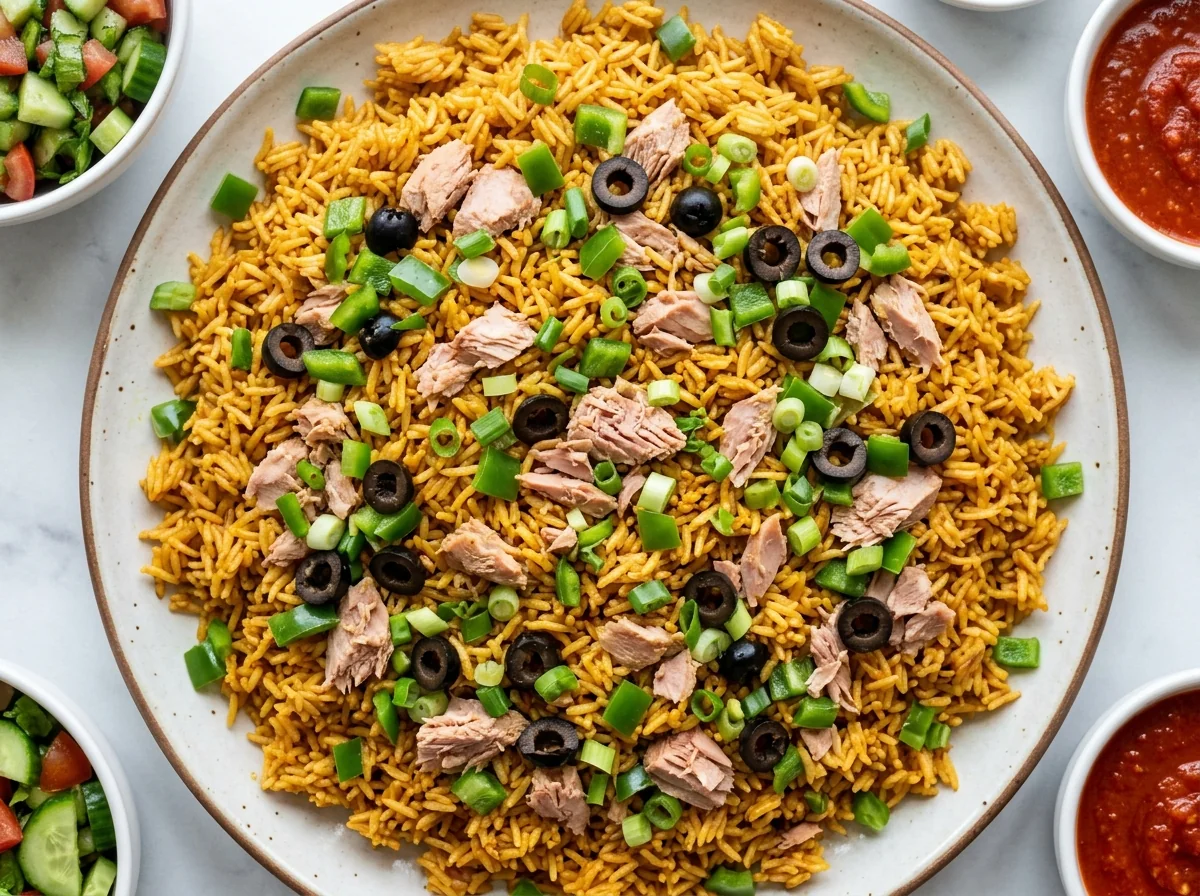
A quick, budget-friendly Kabsa (Saudi spiced rice dish) made with canned tuna, layer-style: the tuna mixed with olives, green pepper, and lemon at the bottom of the pot, basmati rice over it, then curry-spiced water bringing the dish together in twenty minutes. The end-of-month dinner that gives up nothing of Kabsa's flavor.
The original is the tuna Kabsa recipe from Atyab Tabkha, kept in its layered method as is: the tuna, olive, and lemon mixture at the bottom, the rice over it, curry water poured over both, and the pot flipped at serving.
We kept the quantities and steps to the original and adjusted two things: the salt became a gram-measured minimum instead of "to taste," and the servings became six instead of four so the rice portion stays within a sensible bound for an everyday rice dish.
Preparation Steps
Make the tuna mixture
In the bottom of a medium pot, mix the drained flaked tuna with the garlic, olives, green onion, bell pepper, lemon juice, thyme, black pepper, half the curry powder, and half the salt, and stir two minutes until the mixture is uniform and the lemon coats the tuna, softening its smell.
Spread the rice in a layer over the tuna
Spread the soaked, drained rice over the tuna mixture in an even layer using the back of a spoon, without any mixing — keeping the two layers separate before cooking is what stops the tuna from crumbling into the rice and keeps the Kabsa's heart tidy at serving.
Spice the water and pour it in
In a jug, mix the boiling water with the remaining curry powder, remaining salt, onion powder, and olive oil, and pour it slowly down the side of the pot so it covers the rice without digging into the layers, the water taking on the curry's yellow color.
Cook the Kabsa
Set the pot over high heat two minutes until the boil returns, then lower the heat to its gentlest, cover, and cook 20 minutes until the rice absorbs all the water, small steam holes appear on its surface, and the grains separate.
Flip and serve
Turn off the heat and let the pot rest 5 minutes covered, then place the serving platter over the pot and flip it in one steady motion so the tuna and vegetables become the face of the Kabsa. Serve hot with a green salad or daggus (Gulf tomato-chili sauce).
Blood Sugar Impact
The glycemic index (GI) measures how quickly a food raises blood sugar, while the glycemic load (GL) measures how much a full serving raises it. Together they give the complete picture.
Glycemic Index
GI
69Medium
Low0–55Medium56–69High70+
A low value (≤55) means a gradual rise in blood sugar — the most suitable range for diabetes and insulin resistance.
Glycemic Load
GL
39High
Low0–10Medium11–19High20+
Glycemic load reflects the impact of the full serving. To lower it: take half a serving, or pair the recipe with a source of protein and fiber.
Nutritional Information
Per ServingMakes 6 servings · one serving is about 320 g of raw ingredients
Calories377 kcal19%of Daily Value*
Protein21 g42%of Daily Value*
Carbohydrates58 g21%of Daily Value*
Fat6 g8%of Daily Value*
Fiber2 g7%of Daily Value*
Sodium589 mg26%of Daily Value*
* Percent Daily Values are based on a 2,000-calorie diet per FDA food-label reference values — your daily needs may be higher or lower. Values are derived from the recipe's ingredients via the USDA database.
Troubleshooting
The most common problems when preparing Tuna Kabsa, and how to fix them:
The canned-tuna smell dominates the dish
The tuna was not drained well, or the lemon fell short. Press the tuna in the strainer until all the can liquid is out, and keep to the half cup of lemon juice — it is the one tasked with softening the smell, together with the thyme.
The rice mixed with the tuna and the dish came out scattered
The water was poured too hard, or the pot was stirred during cooking. Pour the water slowly down the side of the pot — over the back of a spoon if needed — and never stir after spreading the rice; the layers set on their own with the steam.
The rice cooked but the bottom stuck
The heat stayed too high after the boil. Two minutes only on high, then the lowest possible setting — and a heavy-bottomed pot protects the tuna layer from sticking and burning.
The flavor lacks depth
Too little curry powder, or an old jar that lost its aroma. Divide the curry in half as the method says: half with the tuna and half in the water, so the aroma spreads through both layers instead of sitting in one.
Storage and Make-Ahead
Refrigerator (4°C)
Keep in an airtight container up to two days only — seafood dishes have a shorter life than meat and chicken Kabsas.
Freezer (-18°C)
Not preferred: flaked tuna gets drier with freezing and reheating. Better to cook the amount eaten today and tomorrow.
Reheating
Reheat with a sprinkle of water, covered, over low heat just until hot — and one reheat only, no more.
Food safety
Cooked rice must not sit at room temperature more than two hours; chill it quickly, following the two-hour rule.
Tested Ingredient Substitutions
Original Ingredient
Tested Substitute
Ratio
Flavor Difference
Canned tuna
Canned salmon, drained
Same weight, 400 g
A richer flavor and more omega-3, and the dish stays a budget-friendly canned-seafood meal.
White basmati rice
Brown basmati, soaked an hour
Same weight, 400 g, with 150 ml more water
More fiber and a gentler effect on blood sugar; needs 15 extra minutes of cooking.
Onion powder
A small grated onion sauteed in the oil first
80 g in place of 6 g powder
A flavor closer to fresh at the cost of one sauteing step, and it slightly raises the dish's vegetables.
Black olives
Omit them
No substitute
Lowers the dish's sodium; the bell pepper and green onion make up for their presence in the texture.
How Much Does It Make? Scaling Guide
Servings
Tuna
Rice
Water
3 servings (half amount)
200 g
200 g
375 ml
6 servings (base)
400 g
400 g
750 ml
9 servings (1.5x)
600 g
600 g
1125 ml
EEINA Nutrition Tip
Water-packed canned tuna is lighter than oil-packed and spares fat the dish does not need — its flavor comes from the curry, lemon, and olives, not the can's oil. And squeeze the lemon fresh at prep time, not earlier; that fresh acidity is what cuts the canned-tuna smell.
Add This Recipe to Your Plan
The EEINA app saves your favorite recipes, calculates them from their real ingredients, and shows your daily numbers toward your goal. Try it free now.
How does it differ from the fish Kabsa in the EEINA library?
The fish Kabsa uses fresh fillet slices seasoned and oven-grilled separately over rice cooked in a tomato and loomi (dried black lime) sauce; this one uses canned tuna cooked with the rice in one pot in layers, in half the time and at a lower cost, its flavor built on curry, lemon, and olives rather than the red Kabsa sauce.
Does oil-packed tuna work instead of water-packed?
It works after a thorough press in the strainer, but water-packed is lighter and leaves the flavor space to the curry and lemon. With oil-packed tuna you can drop the tablespoon of olive oil from the cooking water.
Why cook in layers instead of mixing?
Flaked tuna is too fragile to survive stirring with the rice; the layers keep it whole at the bottom until it becomes the face of the dish at flipping. It is the source's own method, and we tested it — the Kabsa comes out tidy, not mashed.
Half a cup of lemon juice — is that not too much?
It is the pillar of the flavor here, not just a seasoning: the acidity spreads through the tuna and rice together and its sharpness cooks off, leaving a fresh rather than biting trace. Anyone who prefers it milder starts with a quarter cup and adds more at serving.