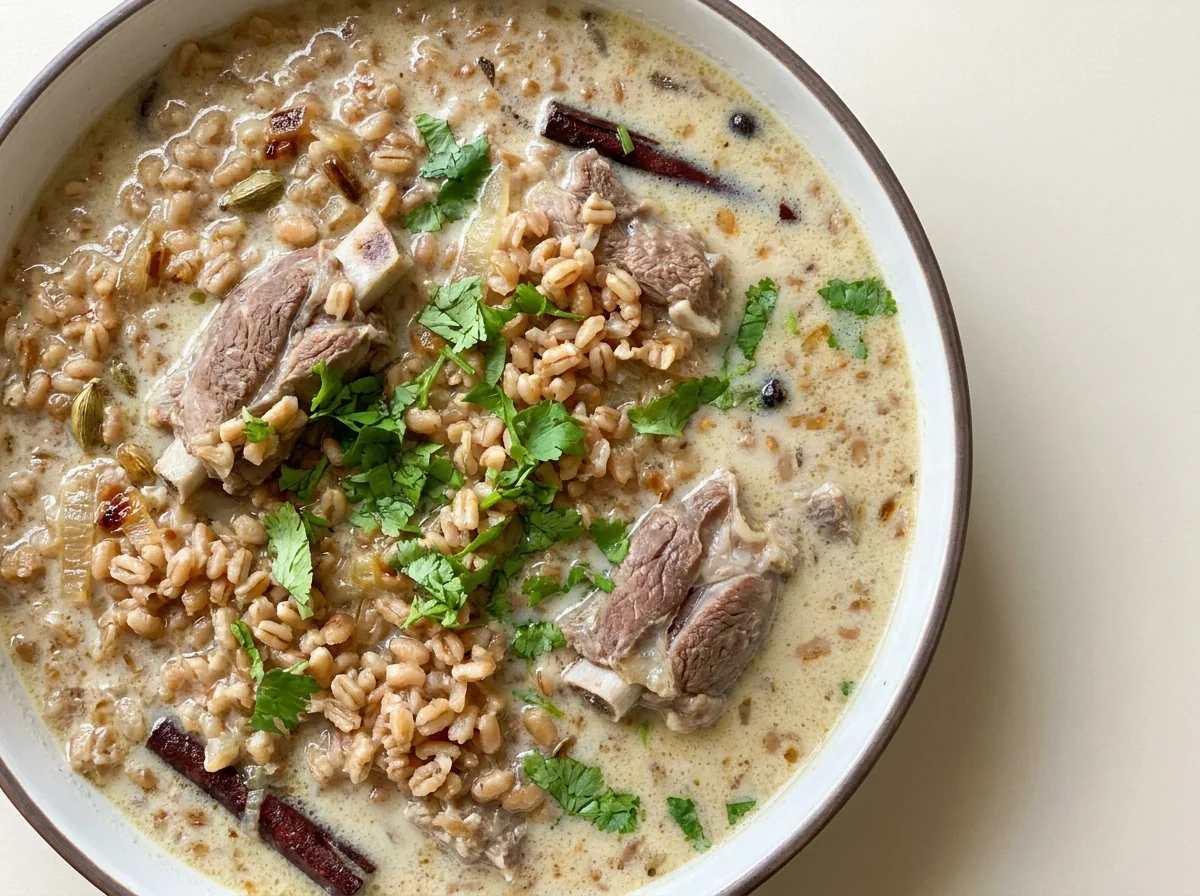
Wheat soup is one of the most venerable soups of Najd and Qassim, cooked from whole wheat grains with meat and whole spices, then finished with milk that gives it its whiteness and consistency.
It is hardly ever absent from a Qassimi iftar table in Ramadan.
Preparation Steps
Boil the wheat at a Najdi pace
In a wide pot, place the soaked wheat with a liter and a half of water and the whole spices, bring it to a boil, then lower the heat for a full hour until the wheat grains burst open and soften. Qassimi households know that wheat is not to be rushed.
Add the meat to cook with the wheat
In a side pan, brown the onion in the ghee until golden, and stir the meat pieces with it until they sear, then transfer everything to the wheat pot. The two finish cooking together for forty minutes until the meat falls off its bone and the broth absorbs its flavor.
Pick out the whole spices
With a slotted spoon, pick out the cinnamon stick, cardamom pods, and cloves. They have given their aroma and we do not want them as a harsh surprise under the tooth in the bowl.
Pour in the milk. The Qassim touch
Lower the heat to its gentlest setting and pour in the milk while stirring, and let it warm for five minutes without reaching a boil. The soup's color turns to a warm creamy white and it gains a smoothness that is this dish's signature.
Adjust and serve with cilantro
Taste and adjust the salt and cumin, pour the soup into deep bowls, and scatter the fresh cilantro. It is served hot at the start of iftar so it warms the stomach and prepares it.
Blood Sugar Impact
The glycemic index (GI) measures how quickly a food raises blood sugar, while the glycemic load (GL) measures how much a full serving raises it. Together they give the complete picture.
Glycemic Index
GI
43Low
Low0–55Medium56–69High70+
A low value (≤55) means a gradual rise in blood sugar — the most suitable range for diabetes and insulin resistance.
Glycemic Load
GL
10Low
Low0–10Medium11–19High20+
Glycemic load reflects the impact of the full serving. To lower it: take half a serving, or pair the recipe with a source of protein and fiber.
Nutritional Information
Per ServingMakes 6 servings · one serving is about 145 g of raw ingredients
Calories308 kcal15%of Daily Value*
Protein14 g28%of Daily Value*
Carbohydrates27 g10%of Daily Value*
Fat16 g21%of Daily Value*
Fiber4 g14%of Daily Value*
Sodium349 mg15%of Daily Value*
* Percent Daily Values are based on a 2,000-calorie diet per FDA food-label reference values — your daily needs may be higher or lower. Values are derived from the recipe's ingredients via the USDA database.
Troubleshooting
The most common problems when preparing Qassimi Wheat and Milk Soup, and how to fix them:
The wheat stayed tough after an hour
It was not soaked enough. Soak it overnight, or extend the cooking by half an hour with extra hot water.
The milk separated and curdled
It boiled over high heat. Add it last over the gentlest heat, and for more safety mix it with a spoon of the warm broth before pouring it in.
The soup is heavy like porridge
The wheat soaked up all the water. Loosen it with hot water or warm milk gradually until it returns to a pourable soup.
The flavor is bland
Usually too little salt or missing whole spices. An extra pinch of cumin with the correction revives the bowl.
Storage and Make-Ahead
Right away
Hot the moment the call to prayer is heard. The warmth of the start.
In the fridge
Three days, and it thickens a lot. Loosen it with milk or water when reheating.
In the freezer
A month before adding the milk; thaw and reheat it, then finish it with fresh milk.
Tested Ingredient Substitutions
Original Ingredient
Tested Substitute
Ratio
Flavor Difference
Lamb
Chicken on the bone
1:1
A lighter broth and a third less time
Whole milk
Low-fat milk
1:1
A lighter version with the same whiteness
Wheat grains
Whole-grain oats (oat groats)
1:1
Faster cooking and a close flavor
Ghee
Olive oil
1:1
Healthier fats with a slightly different aroma
How Much Does It Make? Scaling Guide
Ingredient
6 servings
3 servings
12 servings
Wheat grains
200 g
100 g
400 g
Meat
300 g
150 g
600 g
Milk
250 ml
125 ml
500 ml
EEINA Nutrition Tip
The milk always goes in at the end of cooking and over low heat. If it boils vigorously with the acidity of the broth, it separates and curdles. Anyone who wants a thicker consistency mashes a ladle of the wheat and returns it to the pot instead of any other addition.
Add This Recipe to Your Plan
The EEINA app saves your favorite recipes, calculates them from their real ingredients, and shows your daily numbers toward your goal. Try it free now.
Harees is mashed until it becomes a uniform paste and its meat is pounded into it; wheat soup stays a pourable soup with visible wheat grains and milk. Two independent dishes from the same wheat.
Why does it suit iftar after fasting?
A warm liquid that hydrates, and whole wheat with slow-digesting fiber alongside the protein of meat and milk. A start that fills you up gently and does not shock the stomach.
Where do I find wheat grains in Saudi Arabia?
In any grocery or supermarket under the name 'harees wheat' or 'coarse cracked wheat', and it is one of the cheapest and most available grains.
Can it be cooked in a pressure cooker?
Yes, and it cuts the time in half: the wheat and meat together for twenty-five minutes of whistling, then the milk over low heat after opening the pot.