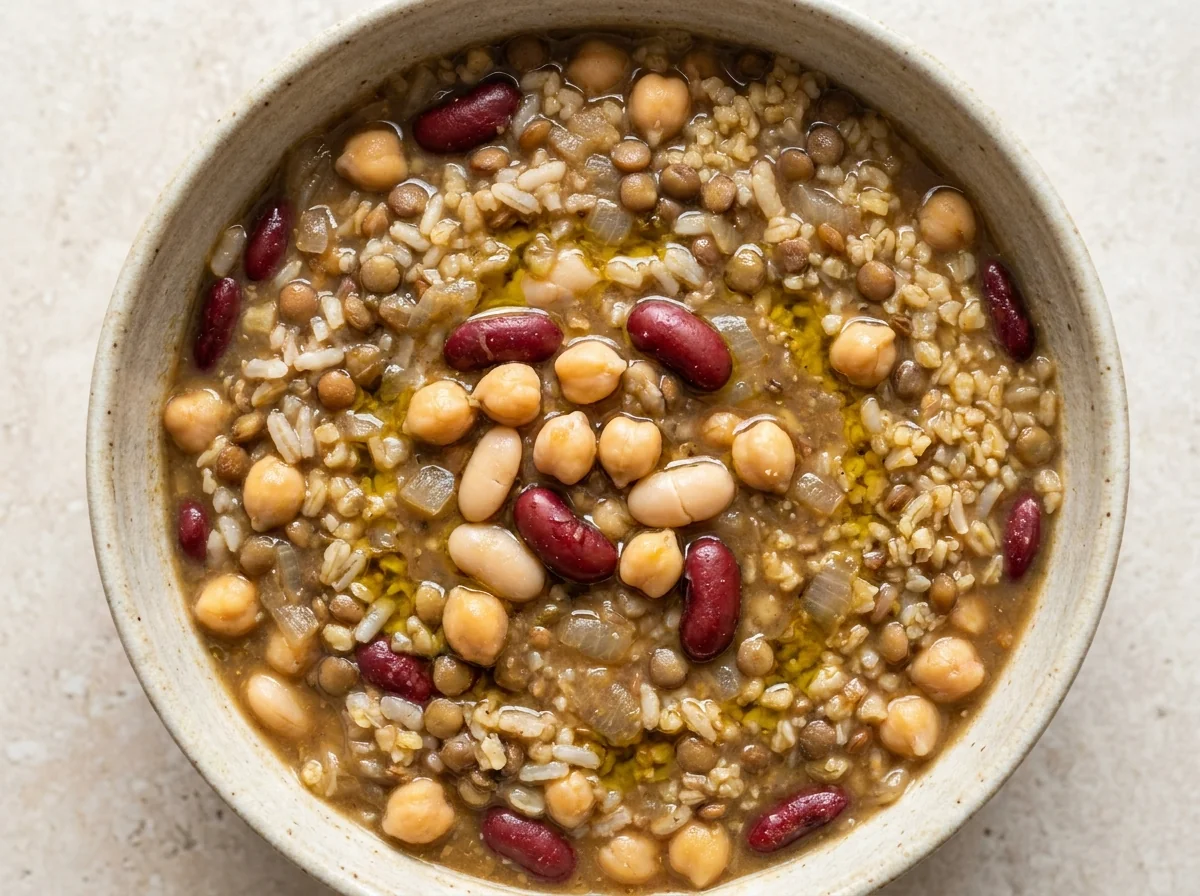
Makhlouta is a Lebanese winter dish that brings legumes and grains together in a single pot, and it is known as the seven grains for the variety of its ingredients.
We present it here plant-based as it is in its origin, relying on caramelized onion and pomegranate molasses to build a deep flavor without meat stock.
Preparation Steps
Soak the legumes
Soak the chickpeas and the red and white beans in plenty of water overnight, and soak the bulgur separately in twice its volume of water, because soaking softens the skin, shortens the cooking time, and makes the texture uniform.
Drain what was soaked
Drain and rinse the soaked legumes, and set the lentils and rice aside without soaking, as they cook quickly and do not need a long soak.
Caramelize the onion
Heat the olive oil in a wide pot and stir the onion over medium heat until it turns deep golden, as caramelizing gives the makhlouta its foundational depth of flavor.
Boil the legumes
Add the drained legumes, 1600 ml of water, the salt, and the spices, bring the mixture to a boil, then lower the heat, cover the pot, and let the mixture cook for a full hour until the beans soften.
Add the grains and molasses
Add the bulgur, rice, lentils, 800 ml of water, and the pomegranate molasses, cover the pot, and cook for 45 minutes, stirring from time to time, until the consistency thickens and the grains set.
Adjust and serve
Taste and adjust the salt, and serve the makhlouta warm, as it thickens further after resting and can be thinned with a little hot water when reheating.
Blood Sugar Impact
The glycemic index (GI) measures how quickly a food raises blood sugar, while the glycemic load (GL) measures how much a full serving raises it. Together they give the complete picture.
Glycemic Index
GI
38Low
Low0–55Medium56–69High70+
A low value (≤55) means a gradual rise in blood sugar — the most suitable range for diabetes and insulin resistance.
Glycemic Load
GL
15Medium
Low0–10Medium11–19High20+
Glycemic load reflects the impact of the full serving. To lower it: take half a serving, or pair the recipe with a source of protein and fiber.
Nutritional Information
Per ServingMakes 6 servings · one serving is about 510 g of raw ingredients
Calories338 kcal17%of Daily Value*
Protein15 g30%of Daily Value*
Carbohydrates52 g19%of Daily Value*
Fat9 g12%of Daily Value*
Fiber13 g46%of Daily Value*
Sodium313 mg14%of Daily Value*
* Percent Daily Values are based on a 2,000-calorie diet per FDA food-label reference values — your daily needs may be higher or lower. Values are derived from the recipe's ingredients via the USDA database.
Troubleshooting
The most common problems when preparing Lebanese Mixed-Bean Soup (Makhlouta), and how to fix them:
The consistency is more watery than needed
Uncover the pot and cook over medium heat for a few extra minutes, as the bulgur and rice absorb the liquid and thicken the consistency.
The grains are firm after cooking
Usually because the salt or acid was added early or the soak was short, so continue cooking with hot water until they fully soften.
The molasses taste faded
Add an extra teaspoon of pomegranate molasses at the end, as long cooking drives off its acidity.
Storage and Make-Ahead
Refrigerator
Keep it in an airtight container for up to 4 days, and add hot water when reheating because it thickens.
Freezing
Freeze it for up to 3 months, and thaw it in the refrigerator, then reheat it over gentle heat with stirring.
Tested Ingredient Substitutions
Original Ingredient
Tested Substitute
Ratio
Flavor Difference
coarse bulgur
fine bulgur
45 g
An option for those who cannot find the coarse type, but the texture becomes a little smoother
pomegranate molasses
lemon juice
15 ml
An acidity substitute when molasses is absent, with loss of the touch of sweetness
white beans
cannellini beans
100 g
A close substitute in texture and size
olive oil
neutral vegetable oil
45 ml
A practical substitute with the loss of the distinctive olive flavor
How Much Does It Make? Scaling Guide
Ingredient
2 servings
4 servings (base)
8 servings
Dry soaked chickpeas
33 g
100 g
200 g
Soaked red kidney beans
33 g
100 g
200 g
Soaked white beans
33 g
100 g
200 g
Brown lentils
17 g
50 g
100 g
Coarse bulgur
15 g
45 g
90 g
Chopped onion
50 g
150 g
300 g
Water
800 ml
2400 ml
4800 ml
Pomegranate molasses
7 ml
20 ml
40 ml
EEINA Nutrition Tip
Caramelizing the onion to a deep golden color is the key to the flavor, so do not rush it. And the pomegranate molasses is added at the end of cooking so its distinctive sour taste stays clear.
Add This Recipe to Your Plan
The EEINA app saves your favorite recipes, calculates them from their real ingredients, and shows your daily numbers toward your goal. Try it free now.