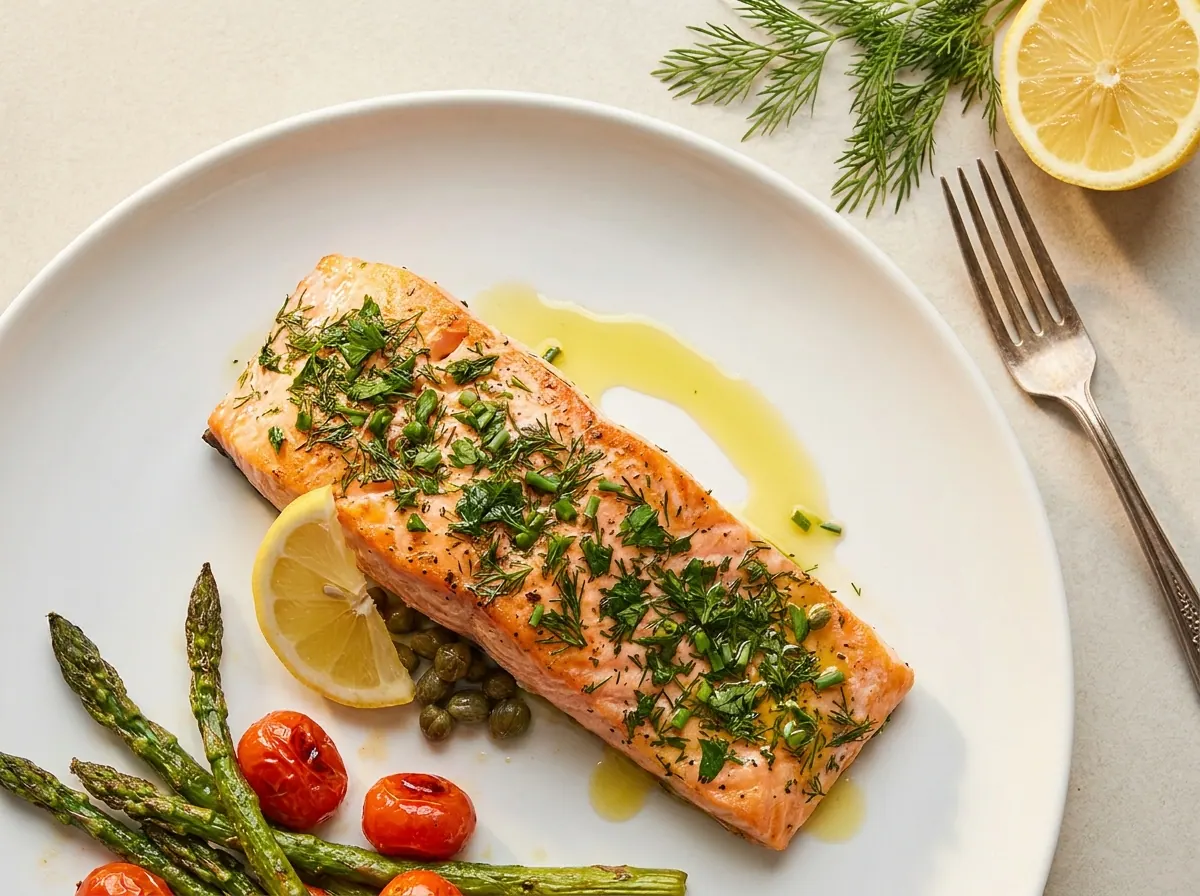
Salmon is one of the best sources of omega-3 on the planet. The American Heart Association recommends eating it twice a week to prevent arterial disease.
Fresh herbs, lemon, and its zest turn the fish from "boring healthy" into a connoisseur's meal. The slow-oven technique preserves its internal moisture.
Preparation Steps
Prepare the aromatic marinade
Start by preparing the marinade: finely mince the garlic, chop the parsley, dill, and thyme, squeeze the lemon, and grate its zest. Combine them in a bowl with the olive oil and a pinch of salt and pepper, and mix well until they blend and become fragrant.
Marinate the salmon
Pat the two salmon fillets dry with a paper towel so the marinade clings to them, then coat them with the mixture on every side until an even layer covers them, and leave them for fifteen minutes so the fish absorbs the flavor. Be careful not to exceed half an hour, as the lemon's acidity starts to cook the surface and soften the texture.
Prepare the oven
While the fish rests, heat the oven to two hundred degrees with the top broiler off, then line a tray with foil and brush it with a little oil so the skin does not stick during cooking.
Put it in the oven
Place the salmon in the tray skin-side down if it has skin, and put it in the oven for ten to twelve minutes depending on its thickness. Be careful: if the fillet is thin, check on it from the eighth minute so it does not dry out.
Check its doneness
You know the salmon is done when it flakes easily at a touch of the fork and its color turns a soft, calm light in the center. Do not leave it longer than that, and if its surface dries out, take it out immediately and sprinkle drops of lemon over it to bring back its moisture.
Serve it warm
Serve it right away with a lemon slice and a light salad of spinach, avocado, or roasted vegetables, and you can add quinoa to make the meal complete and filling.
Blood Sugar Impact
The glycemic index (GI) measures how quickly a food raises blood sugar, while the glycemic load (GL) measures how much a full serving raises it. Together they give the complete picture.
Glycemic Index
GI
13Low
Low0–55Medium56–69High70+
A low value (≤55) means a gradual rise in blood sugar — the most suitable range for diabetes and insulin resistance.
Glycemic Load
GL
1Low
Low0–10Medium11–19High20+
Glycemic load reflects the impact of the full serving. To lower it: take half a serving, or pair the recipe with a source of protein and fiber.
Nutritional Information
Per ServingMakes 2 servings · one serving is about 255 g of raw ingredients
Calories473 kcal24%of Daily Value*
Protein32 g64%of Daily Value*
Carbohydrates10 g4%of Daily Value*
Fat35 g45%of Daily Value*
Fiber3 g11%of Daily Value*
Sodium489 mg21%of Daily Value*
Potassium799 mg17%of Daily Value*
Phosphorus394 mg32%of Daily Value*
* Percent Daily Values are based on a 2,000-calorie diet per FDA food-label reference values — your daily needs may be higher or lower. Values are derived from the recipe's ingredients via the USDA database.
Troubleshooting
The most common problems when preparing Herb-Roasted Salmon, and how to fix them:
The salmon is dry and crumbly
It was overcooked. Salmon dries out quickly when it exceeds the safe temperature. According to USDA, salmon is safe to eat when it reaches 63°C at its deepest point [1]. Use a food thermometer for accuracy, or take it off the heat when the color changes from translucent to opaque pink at the edges only while the center stays slightly rosy.
The skin was not crispy
The pan was not hot enough before placing the salmon, or the skin was not dried. For ideal crispness: dry the skin with a paper towel before marinating, heat the pan over medium to high heat until the oil shimmers, then place the salmon skin-side down and leave it 4-5 minutes without moving until it releases naturally from the pan.
The herbs burned before the salmon was done
The herbs were added early with the high heat. Fresh herbs (thyme · parsley · dill) are sensitive to heat and their flavor burns. Add the herbs in the last minutes of cooking, or sprinkle them on the salmon right after cooking with cold extra virgin olive oil.
The salmon's taste is strong with an unpleasant fishy flavor
The salmon is not fresh, or it was not marinated before cooking. For a fine, fruity flavor: soak the salmon in fresh lemon juice with a pinch of salt for only 10 minutes before cooking. The acidity neutralizes the strong smells without softening the flesh.
The salmon stuck to the pan
It was placed in a cold pan, or moved early. Leave the salmon without moving for 4-5 minutes on the first side; it releases on its own when it is ready to flip. If it sticks: leave it an extra minute, as insisting on flipping tears the flesh.
The salmon releases a white liquid on the surface
This is "albumin," a natural protein that comes out when cooking over sudden high heat. To reduce it: start the salmon in a warm pan (not too hot) and raise the heat gradually, or let it come to room temperature 10 minutes before cooking. Albumin is safe to eat but reduces the beauty of the appearance.
Storage and Make-Ahead
Fridge (4°)
Raw salmon: two days maximum on the bottom shelf in the coldest part of the fridge [2]. Cooked salmon: three days in an airtight container, reheated gently to avoid drying out.
Freezer (-18°)
Fresh raw salmon: two to three months tightly wrapped in a freezer bag. Thawed frozen salmon: is not refrozen. Thawing is in the fridge overnight, not at room temperature.
Make ahead
The marinade: only 30 minutes to an hour before cooking (more than that softens the flesh). Chopping the herbs: 15 minutes before cooking to preserve the aromatic oils. Cooking: at the moment of serving, salmon is a dish of its day.
Reheating
In a medium oven (150°C) covered with foil for only 10 minutes. Avoid the microwave, as it dries out the salmon and ruins its texture. Do not leave it more than two hours out of the fridge after reheating [3].
Tested Ingredient Substitutions
Original Ingredient
Tested Substitute
Ratio
Flavor Difference
Salmon
Fresh tuna (steak)
same weight
Leaner, a deeper and more marine flavor, needs shorter cooking
Salmon
Grouper or naqis (Gulf fish)
same weight
A local Saudi flavor, white-fleshed, needs a stronger marinade
Fresh thyme
Dried Saudi thyme
one third of the amount
A deeper, stronger flavor, added with the oil before cooking
Dill
Green coriander
same amount
A beloved Eastern flavor, added right after cooking
Fresh lemon
Green lime
same amount
A softer aroma, lighter acidity, a distinctive fruity flavor
How Much Does It Make? Scaling Guide
Number of servings
Salmon
Fresh herbs
Olive oil
Cooking time
2 (individual × 2)
300 g (2 pieces)
0.25 cup total
2 tbsp
8–10 min
4 (base)
600 g (4 pieces)
0.5 cup
4 tbsp
10–12 min
8 (large family)
1200 g
1 cup
8 tbsp
In two batches, in two pans
12 (entertaining)
1800 g
1.5 cups
12 tbsp
In the oven, large tray, 15 min
EEINA Nutrition Tip
How do you choose fresh salmon? A bright pink color (not faded), a neutral smell (not strong), firm flesh (springs back after a light press). Its skin is shiny.
Add This Recipe to Your Plan
The EEINA app saves your favorite recipes, calculates them from their real ingredients, and shows your daily numbers toward your goal. Try it free now.