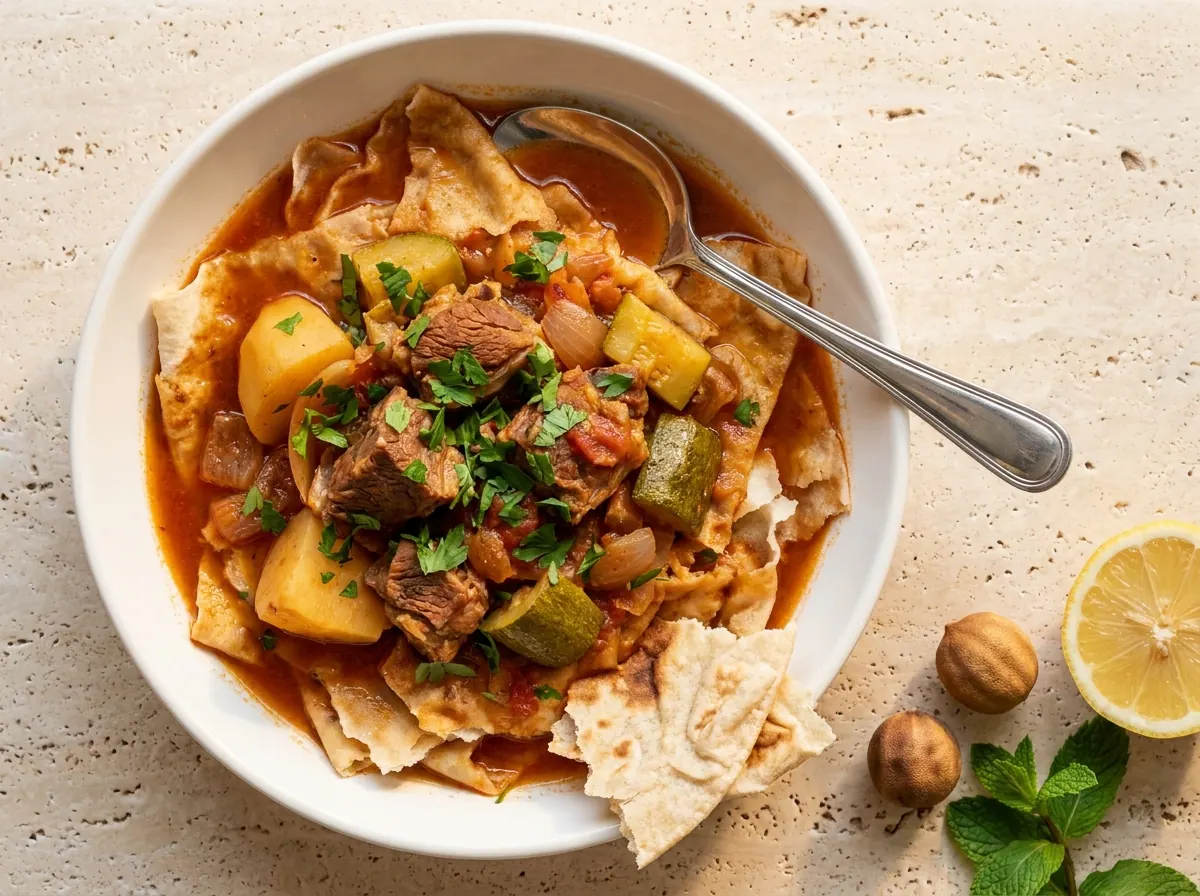
A popular Emirati dish — roqaq flatbread soaked in chicken broth and vegetables. A quick, protein-rich, fiber-rich dinner, ideal for children and adults.
Thareed is one of the most beloved dishes of the Emirates and western Saudi Arabia. It is mentioned in a hadith of the Prophet (peace be upon him): 'The superiority of Aisha over other women is like the superiority of Thareed over all other food.' It became a traditional Ramadan iftar dish.
The modern version uses thin Emirati roqaq flatbread, light chicken broth, and a variety of vegetables. Moderate calories, adequate protein, and good hydration.
Preparation Steps
Prepare the broth
Finely chop the onion and sauté in a little oil, then add the grated tomato and thareed spice blend and cook for two minutes until everything comes together.
Cook the vegetables
Add the diced potatoes, carrots, zucchini, and broth, and cook for about ten minutes until the vegetables are tender.
Prepare the bread
Tear the roqaq flatbread into large pieces and spread them in a deep serving dish.
Assemble
Pour the hot broth with vegetables over the bread until it absorbs, then distribute the shredded chicken pieces on top.
Serve
Scatter fresh coriander on top, squeeze a lemon over it, and serve immediately before the bread absorbs too much and becomes softer than desired.
Blood Sugar Impact
The glycemic index (GI) measures how quickly a food raises blood sugar, while the glycemic load (GL) measures how much a full serving raises it. Together they give the complete picture.
Glycemic Index
GI
62Medium
Low0–55Medium56–69High70+
A low value (≤55) means a gradual rise in blood sugar — the most suitable range for diabetes and insulin resistance.
Glycemic Load
GL
43High
Low0–10Medium11–19High20+
Glycemic load reflects the impact of the full serving. To lower it: take half a serving, or pair the recipe with a source of protein and fiber.
Nutritional Information
Per ServingMakes 4 servings · one serving is about 520 g of raw ingredients
Calories500 kcal25%of Daily Value*
Protein28 g56%of Daily Value*
Carbohydrates75 g27%of Daily Value*
Fat9 g12%of Daily Value*
Fiber6 g21%of Daily Value*
Sodium757 mg33%of Daily Value*
Potassium1034 mg22%of Daily Value*
Phosphorus317 mg25%of Daily Value*
* Percent Daily Values are based on a 2,000-calorie diet per FDA food-label reference values — your daily needs may be higher or lower. Values are derived from the recipe's ingredients via the USDA database.
Troubleshooting
The most common problems when preparing Emirati Thareed with Vegetables, and how to fix them:
The roqaq flatbread dissolved in the broth and turned to dough
The bread was soaked too long, or the broth was too hot. Thareed needs Emirati roqaq flatbread torn by hand, added to the warm broth just minutes before serving so it absorbs the flavor without becoming too soft. If roqaq is unavailable, Saudi tamees bread torn into pieces can be used as a substitute.
The meat is tough and undercooked
Not enough time, or the wrong cut. Thareed needs local lamb from the leg or shoulder, simmered over low heat for two hours until tender. According to USDA, meat is safe to eat when the internal temperature reaches 71°C at the deepest point [1].
The vegetables fell apart and lost their shape
The vegetables were cooked with the meat from the start. The correct approach: cook the meat alone for an hour, then add the firm vegetables (carrots, squash, potatoes) for half an hour, then add the soft vegetables (zucchini, green beans) only in the final fifteen minutes.
The broth is pale and weak in flavor
The spices were not toasted, or the tomato paste was missing. Emirati broth requires toasting the whole spices (cardamom, cinnamon, bay leaf, loomi) in oil at the start of cooking, then adding tomato paste and stirring for two minutes before adding the water.
Bland flavor without that Emirati character
The dried loomi (dried black lime) was missing, or Emirati bzar spice mix was not used. Loomi is the essential difference between Thareed and ordinary soup. Pierce it before adding to the pot so it releases its flavor. Emirati bzar is a spice blend containing coriander, cumin, pepper, and turmeric.
The Thareed is cold when served
The serving dish was cold, or the bread was added too early. Thareed is a hot dish. Warm the serving dish in the oven for 10 minutes at low heat. Add the torn roqaq flatbread to the dish, pour the hot broth with the meat and vegetables on top, and serve immediately.
Storage and Make-Ahead
Fridge (4°C)
The broth with meat and vegetables: three days in a sealed container. The roqaq flatbread: stored separately in a dry container for a week; add it at serving time.
Freezer (-18°C)
Broth only: three months in a freezer container. Thaw overnight in the fridge before reheating. The bread: do not freeze after tearing — it loses its texture.
Advance prep
Meat marinade: the night before in the fridge. Vegetable cutting: an hour before. Broth: can be cooked a day ahead; dilute with hot water when reheating.
Reheating
Broth over low heat with stirring. Tear the bread fresh before serving. Do not leave out of refrigeration for more than two hours after reheating [2].
Tested Ingredient Substitutions
Original Ingredient
Tested Substitute
Ratio
Flavor Difference
Emirati roqaq flatbread
Saudi tamees bread
same quantity
Slightly thinner, similar texture, easier to find in Saudi Arabia
Local lamb
whole chicken
same weight
Lower in fat, cooks faster (one hour only)
Dried loomi (dried black lime)
fresh lemon, sliced
each loomi → half a lemon
Brighter, cleaner flavor — better for those who dislike the slight bitterness of loomi
Emirati squash
pumpkin or butternut squash
same weight
Sweeter flavor, brighter color, similar texture
Emirati bzar spice blend
Saudi Najdi bzar spice blend
same quantity
Similar flavor with minor differences, easier to find
How Much Does It Make? Scaling Guide
Servings
Meat
Total vegetables
Roqaq flatbread
Cooking time
2 (2 individuals)
300 g
2 cups
1 flatbread
1.5 hours
4 (base recipe)
500 g
4 cups
2 flatbreads
2 hours
8 (large family)
1 kg
8 cups
4 flatbreads
2.5 hours
12 (hospitality)
1.5 kg
12 cups
6 flatbreads
3 hours
EEINA Nutrition Tip
An ideal Ramadan dish: hydrating, with moderate carbohydrates and protein. It digests quickly, suitable for Suhoor too. Drink a glass of water before starting to prepare the stomach.
Add This Recipe to Your Plan
The EEINA app saves your favorite recipes, calculates them from their real ingredients, and shows your daily numbers toward your goal. Try it free now.
At large bakeries or Emirati community stores. Saudi substitute: regular oven bread, torn into pieces.
A substitute for the broth?
Vegetable broth for vegetarians, or a bouillon cube dissolved in 3 cups of water (note: may be high in sodium).
Does it keep well?
Best eaten immediately — the bread loses its texture quickly. If you need to prepare it in advance, keep the broth and bread separate and combine them at serving time.
The calories seem very low — is it enough for dinner?
If your activity level is high, add a boiled egg (about 70 calories and 6 g protein) or half a cup of yogurt.