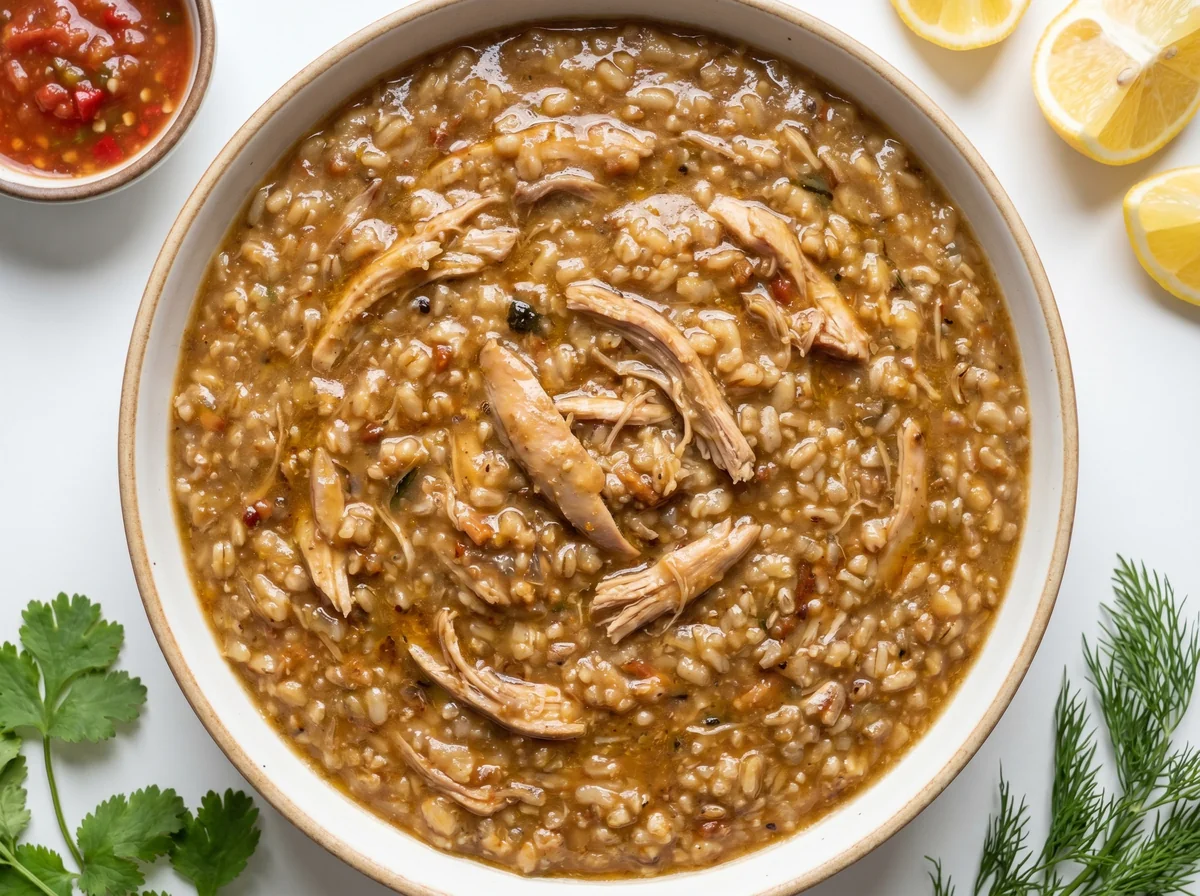
A traditional Gulf seafood dish — fish and rice cooked together with spices and loomi (dried black lime), then beaten (mashed) to a creamy, cohesive texture. A satisfying Ramadan dish with a medium glycaemic load. Contains fish.
Madrooba is a traditional Gulf seafood heritage dish (found in closely related forms in Bahrain, the UAE, and Qatar). Its name comes from the Arabic for beating — the act of vigorously mashing the cooked fish and rice together until they merge into a smooth, creamy, cohesive texture (like a savoury porridge).
It is made with fish (or occasionally chicken), rice, spices, and loomi (dried black lime). It holds a special place during Ramadan — a satisfying, nutritious dish that is gentle on the stomach after a long fast. Madrooba reflects the Gulf's relationship with the sea and the kitchen's skill in transforming fish and rice into a dish with a truly unique texture — it carries an emotional resonance as the food of Ramadan and the warmth of the family table.
Preparation Steps
Build the base
Fry the onion, garlic, and ginger in the ghee until fragrant, then add the baharat (Gulf spice blend), turmeric, coriander, cumin, tomatoes, the pierced loomi (dried black lime), and salt, and stir until aromatic. The loomi and baharat are the soul of Gulf madrooba.
Cook the rice and fish
Add the washed rice and water, bring to the boil, then add the de-boned fish pieces, cover the pot, and cook over a low heat until the rice and fish are cooked through and have absorbed the flavour, about thirty minutes. Make sure all bones are removed from the fish — it will be mashed together with the rice.
Beat (mash)
Once everything is cooked and very soft, beat the mixture vigorously with a masher or a wooden spoon until the fish breaks apart and melds into the rice, forming a smooth, creamy, cohesive texture (like a savoury porridge). The name madrooba comes from this beating action.
Refine the texture
Continue beating and stirring over a low heat until the texture becomes smooth, cohesive, and slightly sticky (no separate rice grains, no fish pieces). Add hot water if it is too dry — the madrooba should have a unified creamy consistency.
Adjust the seasoning
Taste and adjust the salt and baharat. Remember that madrooba thickens as it cools, so leave it slightly wetter on the heat. The desired consistency is creamy and cohesive enough to be scooped with a spoon.
Serve
Pour the madrooba into a serving bowl and optionally drizzle with melted ghee or scatter crispy fried onion over the top. Serve hot. It is a traditional Gulf seafood heritage dish (Bahraini, Emirati, and Qatari), especially beloved during Ramadan (satisfying, nutritious, and easy to digest after a day of fasting), a warm dish cherished at the Gulf family table.
Blood Sugar Impact
The glycemic index (GI) measures how quickly a food raises blood sugar, while the glycemic load (GL) measures how much a full serving raises it. Together they give the complete picture.
Glycemic Index
GI
67Medium
Low0–55Medium56–69High70+
A low value (≤55) means a gradual rise in blood sugar — the most suitable range for diabetes and insulin resistance.
Glycemic Load
GL
21High
Low0–10Medium11–19High20+
Glycemic load reflects the impact of the full serving. To lower it: take half a serving, or pair the recipe with a source of protein and fiber.
Nutritional Information
Per ServingMakes 5 servings · one serving is about 225 g of raw ingredients
Calories260 kcal13%of Daily Value*
Protein26 g52%of Daily Value*
Carbohydrates33 g12%of Daily Value*
Fat2 g3%of Daily Value*
Fiber1 g4%of Daily Value*
Sodium146 mg6%of Daily Value*
Potassium713 mg15%of Daily Value*
Phosphorus254 mg20%of Daily Value*
* Percent Daily Values are based on a 2,000-calorie diet per FDA food-label reference values — your daily needs may be higher or lower. Values are derived from the recipe's ingredients via the USDA database.
Troubleshooting
The most common problems when preparing Gulf Madrooba, and how to fix them:
The texture is not cohesive (separate grains)
It was not beaten enough or the rice is not soft. Cook until the rice and fish are very soft, then beat vigorously (mashing) until they merge into a smooth, unified texture. Good beating is the secret of madrooba — and the source of its name.
Fish bones in the dish
The bones were not removed. Remove all fish bones thoroughly before cooking (or use fillets) — the fish is mashed into the rice so bones cannot be avoided afterwards. Choose a fish low in fine bones.
Too dry and thick
Not enough water or overcooked. Add hot water gradually while beating until the creamy consistency is reached. Remember that it thickens as it cools, so leave it slightly wetter on the heat.
Strong fish smell
The fish was not marinated or not fresh. Marinate the fish with turmeric and lemon, use fresh fish, and the loomi, baharat, and ginger will scent the dish and clean the smell.
Bland and flat
Not enough baharat or loomi. The loomi and baharat (turmeric, coriander, cumin) are the flavour of madrooba — be generous with them, along with the salt. A well-spiced stock permeates the rice and fish through the beating.
Storage and Make-Ahead
Refrigerator (4°C)
Store madrooba in a sealed container in the refrigerator for two to three days. It thickens and firms up when cold, so reheat with a splash of water and stirring to restore the creamy texture. Eat warm.
Freezer
Madrooba can be frozen for a month — thaw and reheat with water and stirring. Its texture tolerates freezing reasonably well (it is already mashed). Practical for preparing a large batch for Ramadan.
Advance preparation
Prepare the spiced stock in advance, then cook the rice and fish and beat them at serving time. Or prepare it completely and reheat with water — it is a practical dish for Ramadan iftar.
Food safety
Cook the fish through completely, use it fresh, remove all bones, and do not leave the dish outside the refrigerator for more than two hours — seafood is sensitive.
Tested Ingredient Substitutions
Original Ingredient
Tested Substitute
Ratio
Flavor Difference
White rice
Brown rice or blend with oats
Same amount
Increases fibre and lowers the medium glycaemic load — adjust cooking time (brown rice takes longer)
Fish
Mashed chicken
Same amount
The chicken version of madrooba is also popular (makes it fish-free for those with a fish allergy) — mashed the same way
Ghee
Oil or reduced ghee
To preference
Reduces saturated fat — ghee is the traditional flavour; olive oil is healthier with a lighter taste
How Much Does It Make? Scaling Guide
Number of servings
Fish
Rice
3 (half recipe)
300 g
0.75 cup
5 (base)
600 g
1.5 cups
10 (gathering)
1200 g
3 cups
EEINA Nutrition Tip
Madrooba is a balanced, satisfying dish: fish is a lean protein rich in omega-3 for the heart, rice provides carbohydrates for energy, the spices (turmeric and coriander) are antioxidants, and the loomi gives acidity with no calories. Its creamy mashed texture is easy to digest (suitable for convalescence, older adults, and children). Its challenges are the rice (medium glycaemic load) and the ghee and sodium. To lighten it: use brown rice, reduce the ghee, and increase the fish at the expense of the rice. A nutritious seafood dish — especially during Ramadan.
Add This Recipe to Your Plan
The EEINA app saves your favorite recipes, calculates them from their real ingredients, and shows your daily numbers toward your goal. Try it free now.
A traditional Gulf seafood dish of fish and rice cooked together with baharat (Gulf spice blend) and loomi (dried black lime), then beaten (mashed) vigorously until they merge into a smooth, creamy, cohesive texture. The name comes from beating. It is especially beloved during Ramadan (satisfying, nutritious, easy to digest) and is a Gulf heritage dish.
Why is it called madrooba?
From the Arabic word for beating — the act of vigorously mashing the cooked fish and rice together (with a masher or spoon) until the fish breaks apart and merges with the rice into a smooth, unified texture. This beating is what creates its distinctive texture and sets it apart from ordinary rice-with-fish dishes.
Is madrooba healthy?
Balanced and satisfying: fish provides protein and omega-3 for heart health, rice provides energy, the spices are antioxidants, and its creamy texture is easy to digest (suitable for convalescence and older adults). Its challenges are the rice (medium glycaemic load) and the ghee. Use brown rice, reduce the ghee, and increase the fish. A nutritious seafood dish — especially at Ramadan.
Why is it served at Ramadan?
Because it is satisfying, nutritious, and easy to digest with its creamy mashed texture (gentle on the stomach after fasting). It combines protein (fish) and energy (rice) in one warm dish. These qualities have made it one of the most beloved Gulf Ramadan dishes on the iftar table.