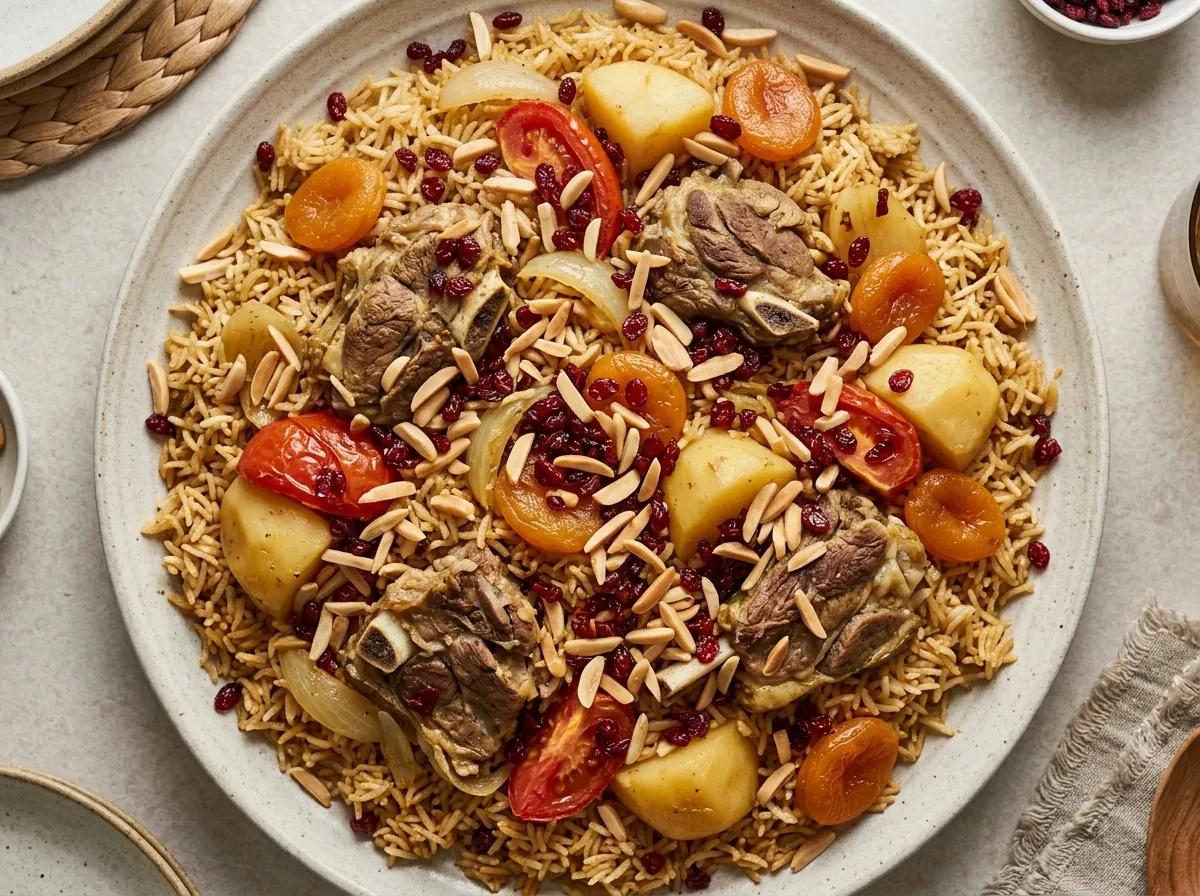
A traditional Emirati dish cooked in layers in one pot: a flatbread lining the bottom, a mixture of browned onion with dried lime and spices over it, then lamb marinated in saffron and lemon with potatoes and dried sour apricots, crowned with parboiled rice that finishes cooking in the steam.
A traditional Emirati dish named after the way it cooks: everything is stacked in layers in one pot and cooked from below.
The moistened flatbread at the bottom is not filler but a heat shield that keeps the layers from burning while soaking up the juices of the meat and spices. The dried lime and sour apricots together give the dish its distinctive tang, and the saffron in rose water is reserved for a single cup of rice that crowns the top with color and aroma.
Preparation Steps
Marinate the meat
Wash the meat well and season it with the lemon juice, the saffron steep, and the salt.
Add the potatoes and rest
Add the potatoes to it and set it aside for two hours.
Make the onion mixture
Meanwhile, prepare the signature mixture of the dish: brown the onion in a deep pot with all the spices and the dried lime, rubbing well until the onion starts to melt down and release its juices.
Line the bottom with bread
Prepare the cooking pot by laying the bread, moistened with a little water, in the bottom.
Stack the layers
Add half the seasoned onion mixture, then the potatoes and the marinated meat with the tomato slices and the apricots, then a final layer of the remaining onion-and-spice mixture with the marinating liquid, and two tablespoons of ghee spread evenly.
Cook on two heats
Seal the pot tightly with foil, set it over high heat for ten minutes, then lower the heat and leave it for about two hours.
Parboil the rice
Meanwhile, boil the rice in water with the cardamom pods, peppercorns, and cloves, then set aside a cup of the white rice and add the saffron-rose water steep to it.
Add the rice
Take the white portion of the rice and add it to the meat pot, then add the saffron-tinted cup on top without stirring, and leave it for thirty to fifty minutes until fully cooked.
Prepare the garnish
In a small pan, heat a tablespoon of oil and fry the dried barberries for a minute until they take on a shine.
Turn out and serve
Turn the rice and meat out onto a serving platter and garnish with the fried barberries and toasted almonds.
Blood Sugar Impact
The glycemic index (GI) measures how quickly a food raises blood sugar, while the glycemic load (GL) measures how much a full serving raises it. Together they give the complete picture.
Glycemic Index
GI
63Medium
Low0–55Medium56–69High70+
A low value (≤55) means a gradual rise in blood sugar — the most suitable range for diabetes and insulin resistance.
Glycemic Load
GL
42High
Low0–10Medium11–19High20+
Glycemic load reflects the impact of the full serving. To lower it: take half a serving, or pair the recipe with a source of protein and fiber.
Nutritional Information
Per ServingMakes 8 servings · one serving is about 470 g of raw ingredients
Calories578 kcal29%of Daily Value*
Protein25 g50%of Daily Value*
Carbohydrates72 g26%of Daily Value*
Fat21 g27%of Daily Value*
Fiber5 g18%of Daily Value*
Sodium1307 mg57%of Daily Value*
* Percent Daily Values are based on a 2,000-calorie diet per FDA food-label reference values — your daily needs may be higher or lower. Values are derived from the recipe's ingredients via the USDA database.
Troubleshooting
The most common problems when preparing Emirati Tahta with Lamb and Rice, and how to fix them:
The bottom burned and stuck
The bread was not moistened, or the high heat ran too long. Moisten the loaf with a little water as in step four, and do not exceed ten minutes on high heat before turning it down.
The rice is cooked but the grains are broken
It was boiled past the halfway point. The sign is a grain that snaps between the fingers with a firm core; it finishes cooking in the steam.
The meat is not tender after two hours
The pieces are large or the heat dropped too low. Extend the cooking half an hour on low heat; the sign is meat that pulls easily off the bone.
The dish is dry at the bottom
The marinating liquid was left out. The source says to add it with the final layer of the onion mixture; it provides the steam the dish cooks in.
Storage and Make-Ahead
Refrigerator (4°C)
Keeps in a sealed container for up to 3 days.
Reheating
By steam, or covered in the oven with a splash of water; the microwave dries out the rice.
Freezing
Freeze the meat in its juices separately from the rice for up to two months; rice loses its texture in the freezer.
Make ahead
Marinate the meat overnight instead of two hours and the saffron and lemon sink in deeper.
Tested Ingredient Substitutions
Original Ingredient
Tested Substitute
Ratio
Flavor Difference
Bone-in lamb
Bone-in beef
1000 g
Less saturated fat, and it needs half an hour longer to grow tender.
White biryani rice
Brown basmati rice
1000 g
More fiber and a lower glycemic index; needs a longer parboil before layering.
Ghee
Olive oil
45 g
Higher in monounsaturated fat, though the heritage flavor fades.
Dried sour apricots
Dried prunes
100 g
An available swap that is slightly sweeter, so the dish loses some tang.
How Much Does It Make? Scaling Guide
Servings
Meat
Rice
Onion
Potatoes
4 servings (half the amount)
500 g
500 g
300 g
300 g
8 servings (base)
1000 g
1000 g
600 g
600 g
16 servings (double)
2000 g
2000 g
1200 g
1200 g
EEINA Nutrition Tip
The rice is parboiled only halfway, no more, because it finishes cooking in the steam above the meat. And adding it without stirring is deliberate: stirring blends the layers and erases the gradient of flavor the whole dish is built on.
Add This Recipe to Your Plan
The EEINA app saves your favorite recipes, calculates them from their real ingredients, and shows your daily numbers toward your goal. Try it free now.
Why is a loaf of bread laid in the bottom of the pot?
It is the origin of the dish and of its name: it separates the layers from the direct heat of the bottom so they do not burn, and during cooking it soaks up the juices of the meat and spices, becoming part of the dish rather than a mere liner.
Why is the rice only parboiled halfway?
Because it finishes cooking in the steam of the pot above the meat for thirty to fifty minutes, as in step eight. Boiling it fully makes it turn doughy in the second stage.
How is it different from majboos or kabsa?
In majboos and kabsa the rice cooks directly in the meat broth after the meat comes out. Here everything is stacked in layers in one pot over a loaf of bread and cooked together from below. The method differs, not just the name.
What is bukhara?
It is the dried sour yellow apricot, as the source defines it, and together with the dried lime it gives the dish its tang.
How long does the whole dish take?
About five hours: two hours marinating the meat, two hours cooking on low heat, then thirty to fifty minutes after the rice goes in.
How many people does it serve?
We estimate it at eight: a kilo of raw rice gives about 125 grams per person, a usual portion. The source says five, which would put the rice at 200 grams raw per person, and that is a large portion. The ingredients and method are exactly as published, with no change; only the estimate is adjusted.
Sources: USDA · University of Sydney · Our methodology · Updated on