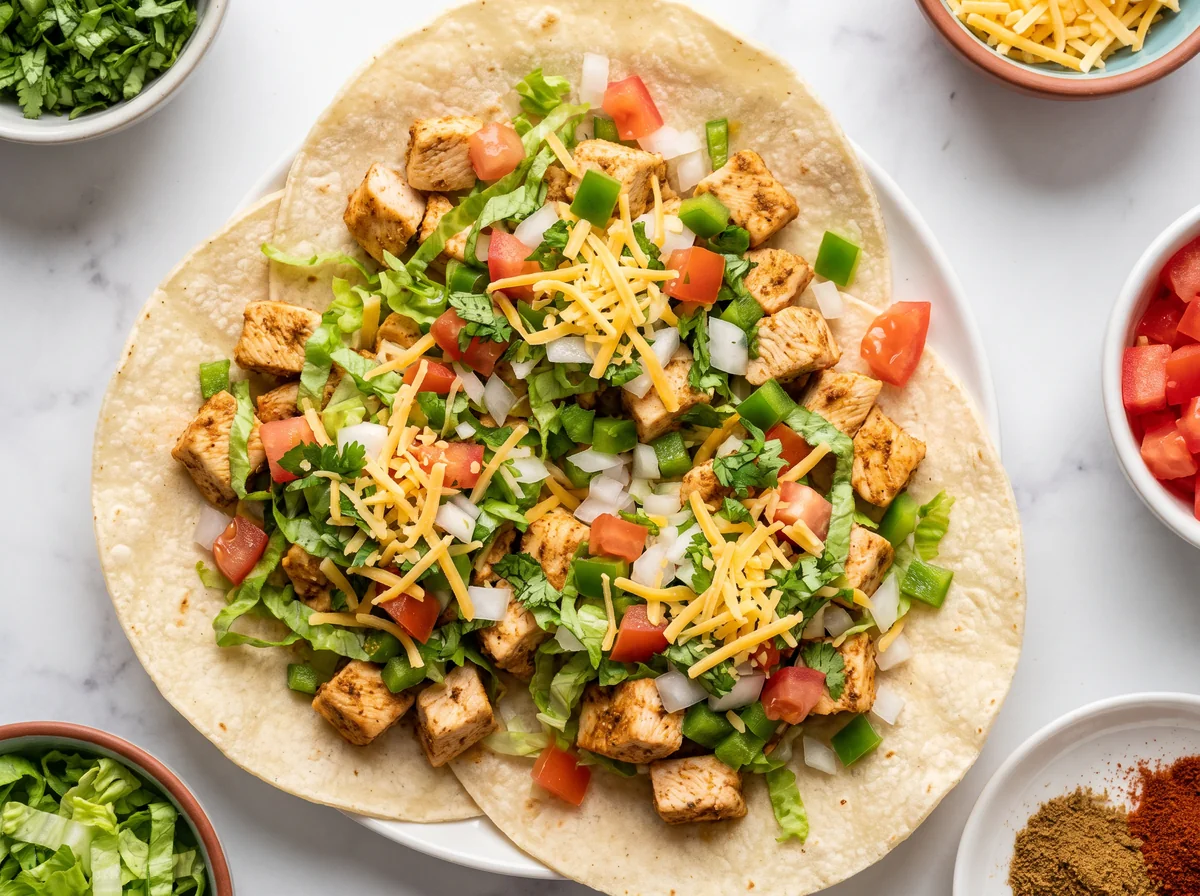
Cubed chicken breast seasoned with a spice blend and pan-cooked until done, placed in taco shells over lettuce with a mixture of tomato, pepper, onion, and coriander, and topped with cheese.
A taco with a single spice blend split in two: half a teaspoon for the vegetables and the rest for the chicken.
That split is what unifies the dish, since the filling and the topping speak the same language instead of each going its own way.
Preparation Steps
Mix the spices
In a small bowl, mix the garlic powder, paprika, cumin, black pepper, and salt and set them aside; mixing them first ensures they spread evenly between the chicken and the vegetables.
Prepare the vegetable mix
In another bowl, put the tomato, pepper, onion, and coriander, season with half a teaspoon of the spice mix, stir, and set it aside so the flavors marry.
Season the chicken
Pour the vinegar over the chicken, season with the rest of the spice mix, and toss until every cube is coated.
Cook the chicken
Heat a little oil in a pan and add the chicken, turning it from time to time until it cooks through and its surface turns golden, then take the pan off the heat.
Build the tacos
Put a little lettuce in a taco shell, then a little chicken, add some of the tomato mixture, and scatter the cheese on top.
Repeat and serve
Repeat the same arrangement until everything is used up, and put the tacos on a serving plate with a green salad.
Blood Sugar Impact
The glycemic index (GI) measures how quickly a food raises blood sugar, while the glycemic load (GL) measures how much a full serving raises it. Together they give the complete picture.
Glycemic Index
GI
59Medium
Low0–55Medium56–69High70+
A low value (≤55) means a gradual rise in blood sugar — the most suitable range for diabetes and insulin resistance.
Glycemic Load
GL
10Low
Low0–10Medium11–19High20+
Glycemic load reflects the impact of the full serving. To lower it: take half a serving, or pair the recipe with a source of protein and fiber.
Nutritional Information
Per ServingMakes 3 servings · one serving is about 265 g of raw ingredients
Calories378 kcal19%of Daily Value*
Protein42 g84%of Daily Value*
Carbohydrates20 g7%of Daily Value*
Fat13 g17%of Daily Value*
Fiber3 g11%of Daily Value*
Sodium418 mg18%of Daily Value*
Potassium772 mg16%of Daily Value*
Phosphorus479 mg38%of Daily Value*
* Percent Daily Values are based on a 2,000-calorie diet per FDA food-label reference values — your daily needs may be higher or lower. Values are derived from the recipe's ingredients via the USDA database.
Troubleshooting
The most common problems when preparing Chicken Taco, and how to fix them:
The chicken is dry
It was turned too long over the heat. Lift it as soon as its surface turns golden and its liquid stops, since it finishes cooking in its own heat.
The taco shell broke
It is cold or overfilled. Warm it a few seconds before filling and do not fill it to the rim.
The lettuce wilted
The tacos were built too early. Build them at serving and put the lettuce as a barrier between the shell and the hot chicken.
The flavor is flat
The spice mix was not distributed evenly. Mix it in a separate bowl first and then divide it, rather than sprinkling it on.
Storage and Make-Ahead
The chicken in the refrigerator
In a sealed container for three days, reheated in a pan over high heat.
The vegetable mixture
Two days in the refrigerator, drained of its liquid before use.
Taco shells
In their sealed pack at room temperature, warmed a few seconds before filling.
Serving
Build the tacos right at serving and do not store them assembled.
Tested Ingredient Substitutions
Original Ingredient
Tested Substitute
Ratio
Flavor Difference
Taco shells
Soft tortillas
190 g
A soft taco that folds without breaking, and the more common form outside Mexico.
Chicken breast
Lean ground beef
500 g
The classic beef taco, and it cooks faster.
Cheddar
Grated white cheese
28 g
Less salty with a gentler flavor.
Vinegar
Lime juice
15 ml
Closer to Mexican taste and more fragrant.
How Much Does It Make? Scaling Guide
Servings
Chicken
Taco shells
Lettuce
Cheese
1.5 servings (half amount)
250 g
39 g
24 g
14 g
3 servings (base)
500 g
77 g
47 g
28 g
6 servings (double)
1000 g
154 g
94 g
56 g
EEINA Nutrition Tip
Set the tomato mixture aside from the start as the source advises, since a quarter of an hour is enough for the pepper, onion, and coriander to trade flavors. And build the tacos right at serving, because the lettuce wilts under the hot chicken within minutes.
Add This Recipe to Your Plan
The EEINA app saves your favorite recipes, calculates them from their real ingredients, and shows your daily numbers toward your goal. Try it free now.
77 grams, based on the 12.9-gram baked shell in the USDA table. The source says six pieces of taco bread with no weight and does not specify whether they are hard shells or soft bread, and we carried the count across as published.
The vinegar is not in the ingredient list, so how much is it?
The steps mention it for marinating the chicken without giving a quantity, so we wrote it without an amount as published rather than estimating one. A tablespoon is enough for half a kilo of chicken.
Should I use vinegar or lemon?
The source uses vinegar. Lime is a closer match to Mexican taste and tenderizes the same way.
How many tacos per serving?
Six pieces for three servings, so two per serving. The nutrition values are calculated on the source's estimate.
Sources: USDA · University of Sydney · Our methodology · Updated on