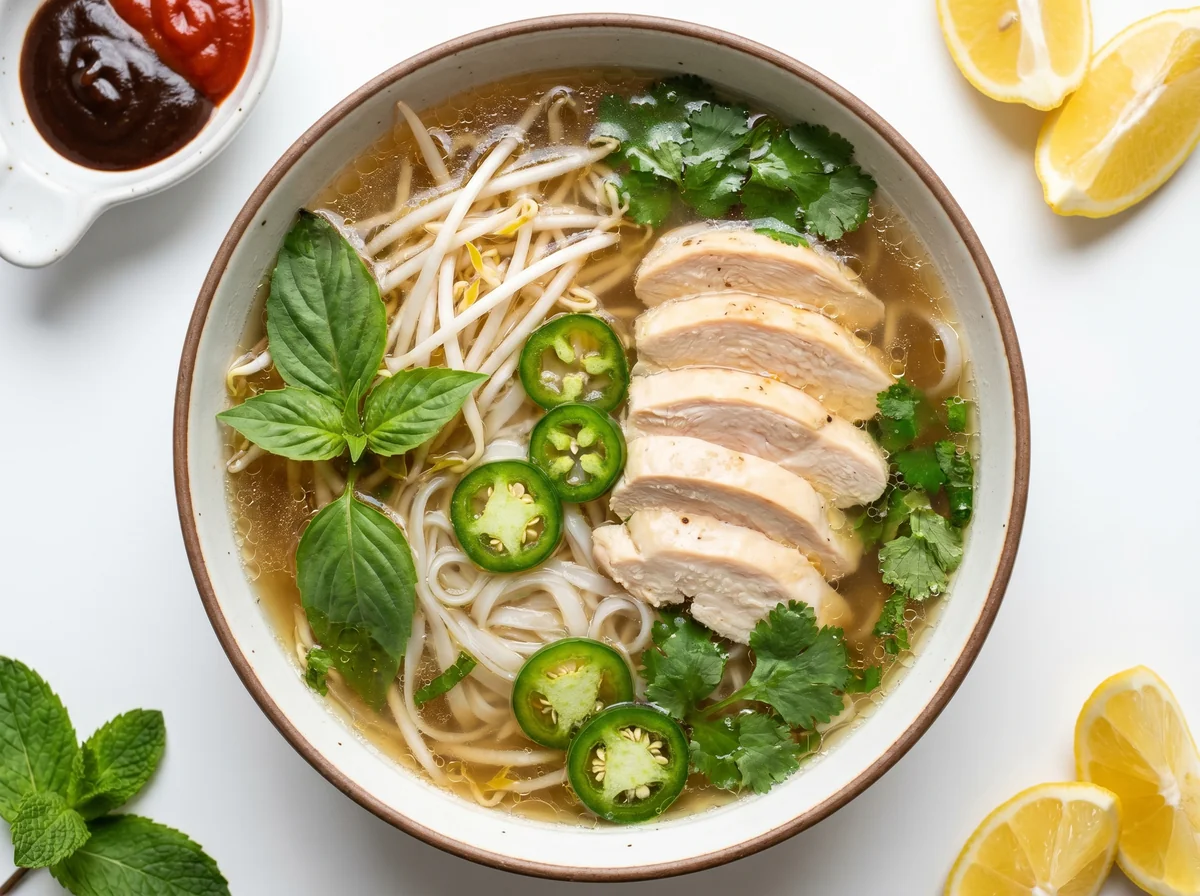
Fragrant chicken broth with star anise, cinnamon, and ginger poured over rice noodles with chicken and fresh herbs — a warm, refreshing Vietnamese soup rich in protein and aromatics.
Pho is Vietnam's national soup: a broth simmered slowly with star anise, cinnamon, and ginger, poured over rice noodles and chicken.
Charring the onion and ginger is the secret to the broth's depth, and the fresh herbs bring it alive.
Preparation Steps
Char the aromatics
Char the onion halves and ginger slices in the pot until lightly blackened, then toast the dry spices for one minute until fragrant. Charring gives the broth a deeper flavour and a richer colour.
Make the broth
Add the water, chicken, spices, and coriander. Simmer gently for about 45 minutes, skimming off any foam, until a clear, fragrant broth has formed.
Strain and season
Lift out the chicken and shred the meat. Strain the broth to remove the spices, then season with fish sauce, sugar, and salt, balancing the salty with the sweet.
Cook the noodles
Cook the thin rice noodles until tender, then drain. Divide them between serving bowls along with the shredded chicken.
Assemble and serve
Ladle the hot broth over the noodles and chicken, then serve with bean sprouts, basil, mint, and a squeeze of lime. A fragrant, refreshing Vietnamese soup.
Blood Sugar Impact
The glycemic index (GI) measures how quickly a food raises blood sugar, while the glycemic load (GL) measures how much a full serving raises it. Together they give the complete picture.
Glycemic Index
GI
55Low
Low0–55Medium56–69High70+
A low value (≤55) means a gradual rise in blood sugar — the most suitable range for diabetes and insulin resistance.
Glycemic Load
GL
20High
Low0–10Medium11–19High20+
Glycemic load reflects the impact of the full serving. To lower it: take half a serving, or pair the recipe with a source of protein and fiber.
Nutritional Information
Per ServingMakes 6 servings · one serving is about 535 g of raw ingredients
Calories426 kcal21%of Daily Value*
Protein40 g80%of Daily Value*
Carbohydrates39 g14%of Daily Value*
Fat11 g14%of Daily Value*
Fiber2 g7%of Daily Value*
Sodium781 mg34%of Daily Value*
* Percent Daily Values are based on a 2,000-calorie diet per FDA food-label reference values — your daily needs may be higher or lower. Values are derived from the recipe's ingredients via the USDA database.
Troubleshooting
The most common problems when preparing Vietnamese Chicken Pho Soup, and how to fix them:
Broth is cloudy
Boiling was too vigorous. Simmer very gently over low heat after the initial boil. Charring the onion first also helps produce a cleaner broth.
Broth lacks depth of flavour
Spices were not toasted, or the broth was not simmered long enough. Toast the dry spices for a full minute and let the broth simmer gently for the full 45 minutes.
Noodles clumped together
Noodles sat too long after cooking. Cook them just before serving and rinse with warm water after draining to prevent sticking.
Storage and Make-Ahead
Refrigerator (4°C)
Three days in an airtight container after cooling. Heat fully before serving. Store the broth and noodles separately for best results.
Freezer (-18°C)
One to two months in individual portions. Thaw in the refrigerator before reheating. Freeze the broth and chicken only — cook fresh noodles when serving.
Prep ahead
Make the broth and shred the chicken in advance. At serving time, cook the noodles and ladle over the hot broth — ready in minutes.
Reheating
Over low heat with a splash of water, or in a medium oven until hot. Do not leave cooked food out of the refrigerator for more than two hours [2].
Tested Ingredient Substitutions
Original Ingredient
Tested Substitute
Ratio
Flavor Difference
Chicken
Turkey or firm tofu
Same weight
A leaner or plant-based alternative
Oil / fat
Extra-virgin olive oil
Same quantity
Monounsaturated fats that are better for the heart
Salt
Herbs, spices, and lemon juice
To taste
Reduces sodium while keeping plenty of flavour
How Much Does It Make? Scaling Guide
Servings
Ratio
2 (single × 2)
1/2 the quantities
4 (base)
Quantities as listed
6 (family)
1 1/2 times the quantities
8 (hosting)
Double the quantities
EEINA Nutrition Tip
We reduced the fish sauce to manage the sodium. A broth made from bone-in chicken gives depth and nutrition without high-sodium stock cubes. Rice noodles are starchy, so keep the portion moderate and add more protein, herbs, and vegetables.
Add This Recipe to Your Plan
The EEINA app saves your favorite recipes, calculates them from their real ingredients, and shows your daily numbers toward your goal. Try it free now.
With caution — its glycaemic index is medium and the protein and fibre slow sugar absorption. Stick to a moderate noodle portion, add more vegetables and protein, and avoid large amounts of white starchy sides alongside.
How do I store leftovers?
In an airtight container in the refrigerator for a few days, or in the freezer in individual portions (broth and chicken only). Cook fresh noodles when serving. Reheat fully once only.
Can I adapt it to my diet?
Yes — refer to the substitutions table: you can swap the protein, make it dairy-free or gluten-free, or reduce the salt without losing the flavour.
Sources: USDA · University of Sydney · Gulf GSO · Our methodology · Updated on