Chicken Mandi (Yemeni-Saudi smoked meat and rice) with Basmati
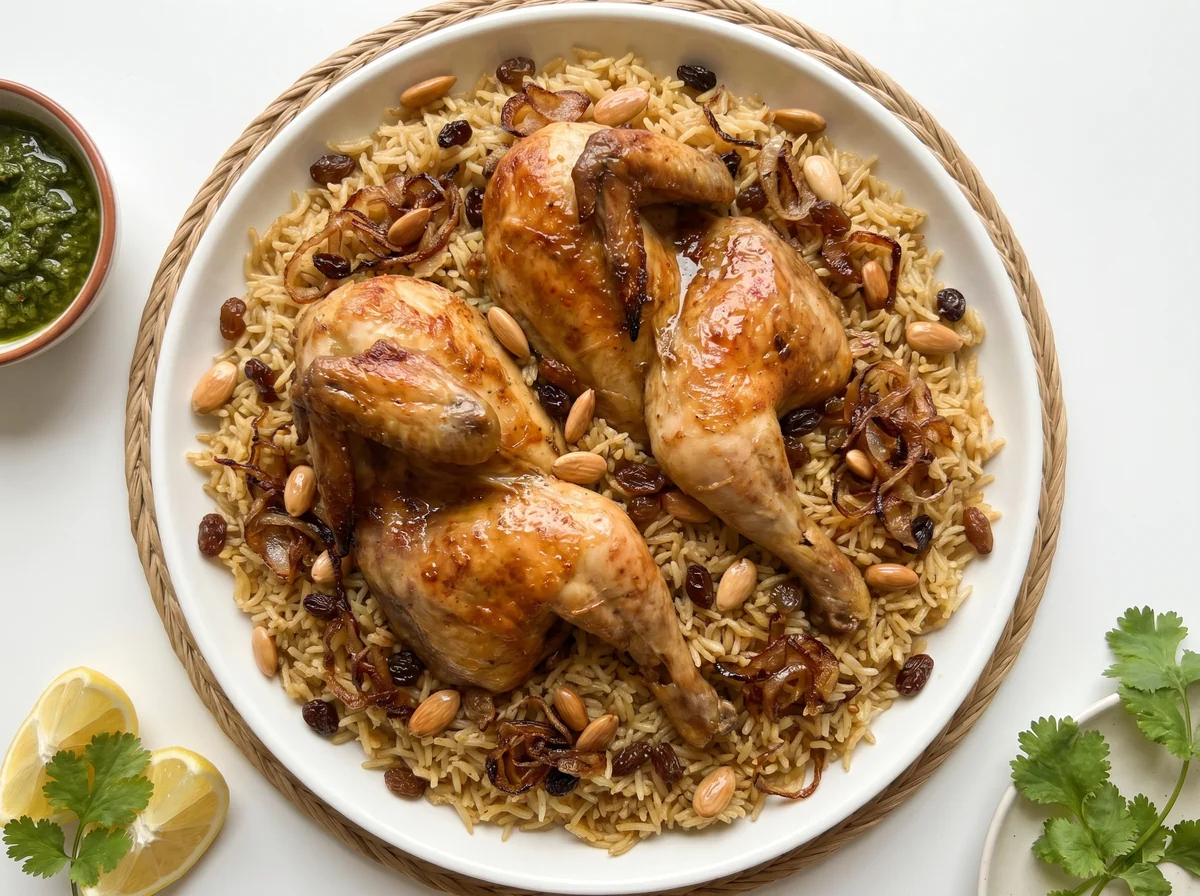
Mandi (Yemeni-Saudi smoked meat and rice) — Yemeni in origin, Saudi at heart. Skinless chicken marinated in Mandi spices and loomi (dried black lime) over smoky basmati rice. Eeina's version is lower in fat with a controlled rice portion, but with the full authentic Mandi flavour.
Mandi (Yemeni-Saudi smoked meat and rice) has Hadrami origins and travelled from Yemen to become a pillar of Saudi feasts.
Its secret is cooking the meat or chicken in an underground pit (the word Mandi comes from the word for pit) with a gentle smoke that gives it its distinctive aroma. Eeina's version brings that same flavour home: skinless chicken to reduce the fat, a controlled rice portion, and optional charcoal smoking to mimic the pit without the effort.
Preparation Steps
Marinate the chicken
Rub the skinless chicken pieces with the Mandi spices, crushed garlic, half the oil, and a pinch of salt. Leave to marinate for at least 15 minutes (or one hour in the refrigerator for deeper flavour). Removing the skin cuts the saturated fat without touching the spice flavour.
Prepare the broth
In a wide pot, heat the remaining oil and brown the chopped onion until soft and golden, then add the grated tomatoes and loomi (dried black lime). Pour in the hot water with a pinch of salt and bring to the boil.
Poach the chicken
Submerge the chicken pieces in the boiling broth, reduce the heat, and cover the pot. Cook for about 35 minutes until the chicken is fully cooked and reaches an internal temperature of 74°C [1]. Lift out the chicken and reserve the strained broth for cooking the rice.
Cook the rice in the broth
Rinse the basmati rice and soak for 10 minutes then drain. Measure double its volume in hot strained broth, add the steeped saffron, and cook the rice over low heat, covered, for about 15 minutes until the broth is absorbed and the rice is cooked. Cooking the rice in the broth is the secret to Mandi's flavour.
Grill the chicken
Arrange the poached chicken pieces on a baking tray, brush with a little broth, and place under the overhead grill for 5 to 8 minutes until the surface is golden and browned. This step gives a golden crust without frying.
Smoke and serve
For the Mandi smoke (optional): place a piece of lit charcoal in a small metal cup in the centre of the rice, drizzle a drop of oil over it, and cover the pot for just two minutes then remove. Spread the rice on a serving platter, place the chicken on top, and serve hot with daqqous (tomato sauce) and salad.
Blood Sugar Impact
The glycemic index (GI) measures how quickly a food raises blood sugar, while the glycemic load (GL) measures how much a full serving raises it. Together they give the complete picture.
Glycemic Index
GI
68Medium
Low0–55Medium56–69High70+
A low value (≤55) means a gradual rise in blood sugar — the most suitable range for diabetes and insulin resistance.
Glycemic Load
GL
32High
Low0–10Medium11–19High20+
Glycemic load reflects the impact of the full serving. To lower it: take half a serving, or pair the recipe with a source of protein and fiber.
Nutritional Information
Per ServingMakes 5 servings · one serving is about 440 g of raw ingredients
Calories576 kcal29%of Daily Value*
Protein45 g90%of Daily Value*
Carbohydrates49 g18%of Daily Value*
Fat21 g27%of Daily Value*
Fiber2 g7%of Daily Value*
Sodium513 mg22%of Daily Value*
Potassium507 mg11%of Daily Value*
Phosphorus323 mg26%of Daily Value*
* Percent Daily Values are based on a 2,000-calorie diet per FDA food-label reference values — your daily needs may be higher or lower. Values are derived from the recipe's ingredients via the USDA database.
Troubleshooting
The most common problems when preparing Chicken Mandi (Yemeni-Saudi smoked meat and rice) with Basmati, and how to fix them:
Rice became sticky and clumped
Too much water or the rice was not soaked. Soak the rice for 10 minutes and drain, use a ratio of exactly double the volume in broth, and cook covered over low heat without stirring.
Chicken is dry after grilling
Cooked too long or left under the grill too long. Poach only to 74°C then just 5 to 8 minutes under the grill to brown the surface.
Flat flavour
Not enough spices or the loomi was left out. loomi (dried black lime) is the soul of Mandi, and marinating for at least 15 minutes in advance deepens the flavour.
Broth is greasy and heavy
The skin fat melted into the broth. Remove the skin before cooking, and skim the fat layer floating on the broth with a spoon before cooking the rice in it.
Smoke smell is too strong
The charcoal was left in for more than two minutes. Two minutes is enough for a pleasant light fragrance — longer and the smoke becomes overpowering and bitter.
Storage and Make-Ahead
Refrigerator (4°C)
Three days in an airtight container. Store the chicken and rice separately for better reheating.
Freezer (-18°C)
One month, with chicken and rice stored separately. Thaw in the refrigerator before reheating.
Prep ahead
Prepare the broth and poached chicken in advance, then cook the rice and grill the chicken at serving time for the best flavour.
Reheating
Sprinkle a little water over the rice and cover, then reheat to 74°C. Do not leave cooked food out of the refrigerator for more than two hours [2].
Tested Ingredient Substitutions
Original Ingredient
Tested Substitute
Ratio
Flavor Difference
Whole chicken, cut up
Lean leg of lamb
Same weight
The classic lamb Mandi version — needs a longer poach time
White basmati rice
Brown basmati rice
Same weight
Lowers the glycaemic load and adds fibre — needs more broth and a longer cook
A widely available substitute — the acidity is lighter than dried loomi
Charcoal smoking
A couple of drops of food-grade liquid smoke
2 drops
A quick and safe alternative — add sparingly as the flavour is concentrated
How Much Does It Make? Scaling Guide
Servings
Chicken
Rice
Water
Pot
2 (single × 2)
320 g
110 g
1¼ cups
small pot
5 (base)
800 g
280 g
3 cups
large pot
8 (family)
1.3 kg
450 g
5 cups
big pot
12 (banquet)
2 kg
700 g
7 cups
banquet pot
EEINA Nutrition Tip
Removing the chicken skin alone cuts roughly a third of the fat and calories without changing the taste. White rice raises the glycaemic load, so Chicken Mandi is an occasion dish rather than an everyday one for anyone watching their blood sugar. To lighten it further, replace a third of the rice with brown basmati, and add plenty of green salad alongside to slow sugar absorption.
Add This Recipe to Your Plan
The EEINA app saves your favorite recipes, calculates them from their real ingredients, and shows your daily numbers toward your goal. Try it free now.
What is the difference between Mandi, Kabsa (Saudi spiced rice dish), and Madhbi?
All three are rice with meat or chicken, but in Mandi the meat is steam-cooked or poached with a light smoking so it comes out tender; in Kabsa (Saudi spiced rice dish) everything cooks together in one pot; and in Madhbi the meat is grilled on a hot stone or griddle. Each has its own distinctive flavour.
Is Chicken Mandi suitable for people with diabetes?
With white rice the glycaemic load is relatively high, so it is an occasion dish rather than a daily one for anyone monitoring their blood sugar. Swap part of the rice for brown, control the portion, and serve with plenty of salad.
How do I get the Mandi flavour without a pit?
Cooking the rice in the spiced chicken broth delivers most of the flavour, and a piece of lit charcoal in the centre of the rice for two minutes mimics the traditional smoking easily at home.
Why remove the chicken skin?
The skin is the source of most of the saturated fat and calories. Removing it cuts the fat by roughly a third, and the spices and broth keep the flavour completely intact.
What is loomi and where do I find it?
loomi (dried black lime) is a black dried lime sold in spice shops and markets. It gives Mandi its distinctive acidity and aroma. Pierce it before cooking so it releases its flavour, or substitute with lemon zest and juice.
Sources: USDA · University of Sydney · Our methodology · Updated on