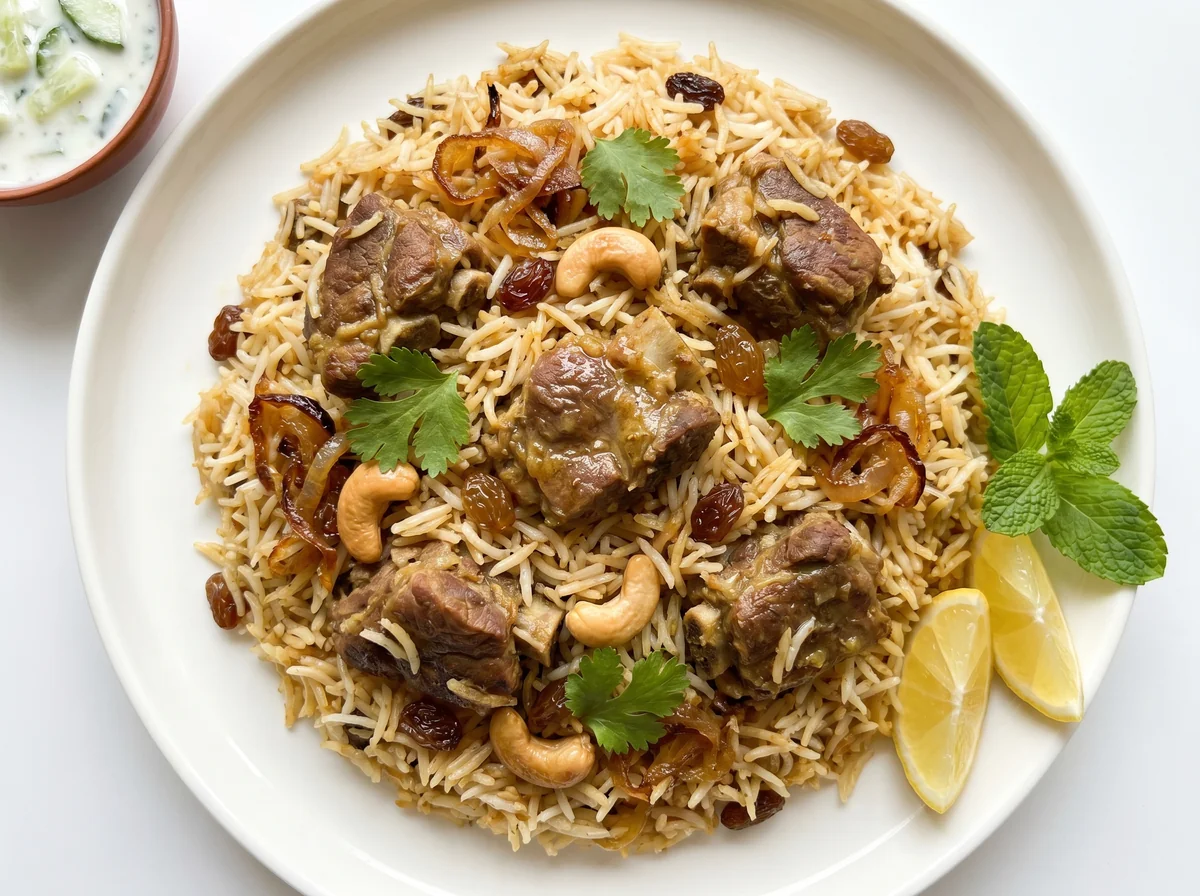
Indian-Gulf lamb biryani — lamb cooked in a rich baharat (Gulf spice blend) and yogurt sauce, layered with saffron-perfumed basmati rice and finished with the dum method. The EEINA version uses lean lamb and a controlled rice portion, preserving all the richness and flavor of biryani.
Biryani is a venerable Indian dish that the Gulf has adopted, making it a staple on its tables — especially in the Eastern regions. Its defining features are lamb cooked in a rich yogurt and baharat (Gulf spice blend) sauce, layered with parboiled saffron-perfumed rice and finished by dum.
It differs from Kabsa (Saudi spiced rice dish) in the richness of the sauce, the layering technique, and the saffron. The EEINA version uses lean lamb and a controlled rice portion, so biryani retains its richness and flavor with a lighter load.
Preparation Steps
Marinate the lamb in yogurt
Rub the lamb pieces with yogurt, half the baharat (Gulf spice blend), garlic, and a pinch of salt, and leave to marinate for 30 minutes. The yogurt tenderizes the lamb and gives the biryani its rich flavor.
Brown the onion
Heat the oil and fry the chopped onion until it turns deep golden, then set half aside for garnish. Deeply browned onion is a fundamental element in biryani's flavor and color.
Cook the lamb sauce
In the same pot, add the marinated lamb, grated tomatoes, and remaining baharat (Gulf spice blend), stir, then add a little water, cover, and cook for 50 to 60 minutes until the lamb is tender and the sauce thickens into a rich gravy.
Parboil the rice
Boil the soaked rice in salted water until half-cooked (the surface softens but the center stays firm), then drain. Parboiling is essential so the rice finishes cooking by dum steam on top of the lamb.
Layer the pot
Over the lamb sauce in the pot, spread a layer of parboiled rice, then drizzle the steeped saffron and scatter the browned onion and fresh coriander. The layers and saffron give biryani its interleaved colors and flavors.
Finish by dum and serve
Cover the pot tightly and cook on the lowest heat for 15 minutes (the dum method) until the rice finishes cooking and absorbs the flavor of the lamb from below. Gently stir from the bottom and serve hot with yogurt and salad.
Blood Sugar Impact
The glycemic index (GI) measures how quickly a food raises blood sugar, while the glycemic load (GL) measures how much a full serving raises it. Together they give the complete picture.
Glycemic Index
GI
65Medium
Low0–55Medium56–69High70+
A low value (≤55) means a gradual rise in blood sugar — the most suitable range for diabetes and insulin resistance.
Glycemic Load
GL
33High
Low0–10Medium11–19High20+
Glycemic load reflects the impact of the full serving. To lower it: take half a serving, or pair the recipe with a source of protein and fiber.
Nutritional Information
Per ServingMakes 5 servings · one serving is about 415 g of raw ingredients
Calories571 kcal29%of Daily Value*
Protein29 g58%of Daily Value*
Carbohydrates53 g19%of Daily Value*
Fat27 g35%of Daily Value*
Fiber2 g7%of Daily Value*
Sodium561 mg24%of Daily Value*
Potassium715 mg15%of Daily Value*
Phosphorus336 mg27%of Daily Value*
* Percent Daily Values are based on a 2,000-calorie diet per FDA food-label reference values — your daily needs may be higher or lower. Values are derived from the recipe's ingredients via the USDA database.
Troubleshooting
The most common problems when preparing Lamb Biryani, and how to fix them:
Rice is clumped or too soft
It was over-boiled. Boil it to only half-cooked then drain — it finishes cooking by dum on top of the lamb.
Lamb is tough
Not cooked long enough. Cook the marinated lamb for 50 to 60 minutes on low heat until tender before layering the rice.
Color is dull
Not enough saffron or browned onion. Brown the onion until deep golden, steep the saffron, and spread it over the rice.
Bottom burned
Heat too high during dum. Cook on the lowest possible heat and place a heat diffuser under the pot if needed.
Flavor not interleaved
Not enough dum time. Leave the pot tightly covered for at least 15 minutes so the rice absorbs the lamb's flavor from below.
Storage and Make-Ahead
Refrigerator (4°C)
3 days in an airtight container. Reheat covered with a splash of water.
Freezer (-18°C)
1 month. Thaw in the refrigerator and reheat covered until hot.
Meal prep
Cook the lamb sauce and parboil the rice in advance, then assemble the layers and do the dum at serving time.
Reheating
Covered with a splash of water until hot. Do not leave cooked food out of the refrigerator for more than 2 hours [2].
Tested Ingredient Substitutions
Original Ingredient
Tested Substitute
Ratio
Flavor Difference
Lamb
Skinless chicken
same weight
The faster chicken biryani version — sauce cooks in about 30 minutes
White basmati rice
Brown basmati rice
same weight
Lowers glycemic load — needs longer parboiling before dum
Plain yogurt
Greek yogurt
same amount
Thicker consistency and tenderizes the lamb well
Ready biryani baharat
Homemade blend: cardamom, cinnamon, cloves, cumin, coriander, black pepper
same amount
Fresher and free from additives
Olive oil
ghee
same amount
Richer flavor — higher saturated fat
How Much Does It Make? Scaling Guide
Number of servings
Lamb
Rice
Yogurt
Pot
2 (individual × 2)
240 g
110 g
0.25 cup
small pot
5 (base)
600 g
280 g
0.5 cup
wide pot
8 (family)
1 kg
450 g
1 cup
large pot
12 (banquet)
1.5 kg
700 g
1.5 cups
banquet pot
EEINA Nutrition Tip
Marinating the lamb in yogurt tenderizes it and reduces the need for fat. Choose lean lamb and trim visible fat. Biryani is rich in beneficial spices, but white rice raises the glycemic load — make it an occasional dish served with yogurt and salad.
Add This Recipe to Your Plan
The EEINA app saves your favorite recipes, calculates them from their real ingredients, and shows your daily numbers toward your goal. Try it free now.
What is the difference between biryani and Kabsa (Saudi spiced rice dish)?
Biryani is of Indian origin — the lamb is cooked in a yogurt and rich baharat (Gulf spice blend) sauce, layered with parboiled saffron-perfumed rice then finished by dum. Kabsa (Saudi spiced rice dish) is Gulf in origin — all ingredients are cooked together in a single tomato broth without yogurt or layering.
What is the dum method?
Dum is cooking the parboiled rice on top of the lamb in a tightly covered pot on the lowest heat — the rice finishes cooking in the steam and absorbs the lamb's flavor from below. It gives biryani its layers and distinctive texture.
Is biryani suitable for diabetics?
White rice raises the glycemic load, so make it an occasional dish. Replace some of the white rice with brown rice, control the portion size, and serve with more yogurt and salad.
Why parboil the rice?
So it finishes cooking by dum on top of the lamb without becoming mushy or clumped. Fully boiling the rice before layering makes it too soft — parboiling ensures separate, firm grains.
Can I make it with chicken?
Yes, chicken biryani is very popular. Use skinless chicken and reduce the sauce cooking time to about 30 minutes as chicken cooks faster than lamb.
Sources: USDA · University of Sydney · Gulf GSO · Our methodology · Updated on