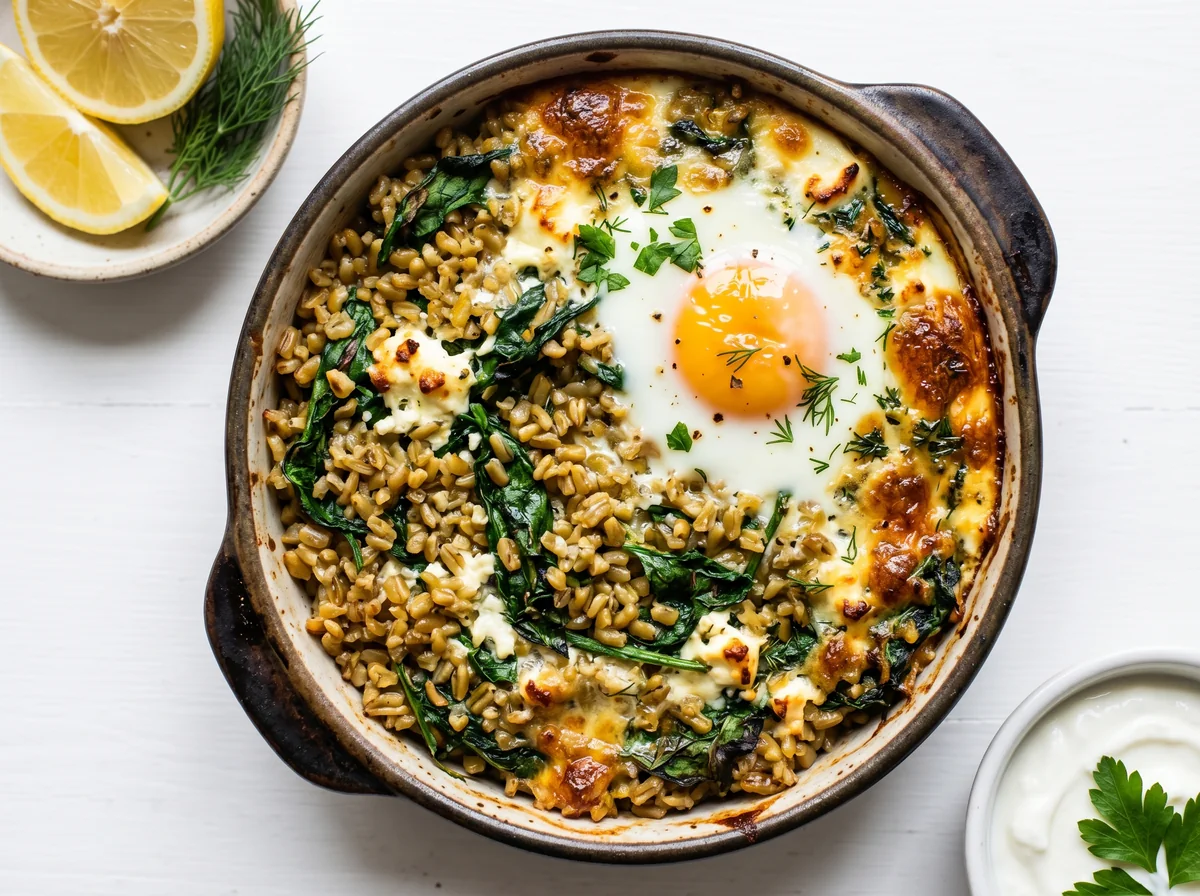
A Levantine-inspired oven tray of cooked freekeh and wilted spinach with baked eggs nestled on top — a complete one-pan meal of whole grain, protein, and greens.
Freekeh is one of the oldest grains in the Levantine and Arab kitchen: wheat harvested while still young and green, then fire-roasted so the surface chars, giving it its distinctive dark golden color and smoky flavor — the roasting is the origin of its name.
People have long known it cooked with chicken or lamb at feasts, but this tray takes it in a lighter, faster direction: a bed of freekeh and spinach and tomatoes, with eggs cracked into it and the whole thing placed in the oven at once. The idea is close to the baked egg dishes spread around the Mediterranean, but it rests here on an authentic Arab grain instead of bread or potatoes, making it a complete meal in one pan — whole grain, protein, and vegetables — with no complexity and no extra washing up.
Preparation Steps
Rinse and soak the freekeh
Rinse the coarse freekeh in a fine-mesh strainer under cold running water until the water runs clear, then soak in cold water for 10 minutes. Rinsing removes dust and charred husks from the roasting process; soaking shortens the cooking time and produces a more tender grain.
Sauté the onion and garlic
Heat 2 tablespoons of olive oil in a saucepan over medium heat for one minute until shimmering but not smoking. Add the onion and cook for 6 minutes until translucent and golden at the edges. Add the garlic, cumin, and black pepper and stir for one minute until fragrant. Do not let the garlic colour — burned garlic turns bitter.
Cook the freekeh
Drain the freekeh, add it to the saucepan with a pinch of salt, and stir for 2 minutes to coat it in the spiced oil. Pour in the water or stock, raise the heat to a boil, then reduce to low, cover the pan, and cook for 25 minutes until the grain is tender with a slight chew and most of the liquid has been absorbed. The cooked grain should open slightly and soften without becoming mushy.
Add the spinach and tomatoes
Add the chopped spinach and diced tomatoes to the freekeh and stir over medium heat for 3 minutes until the spinach has wilted and the tomatoes have released some of their liquid. Wilted spinach is the signal that the mixture is ready; raw spinach left in the mixture will release excess water and make the tray wet.
Prepare the tray
Preheat the oven to 200°C. Grease a medium baking tray with the remaining tablespoon of olive oil. Spread the freekeh and spinach mixture evenly in the tray to a depth of roughly one finger — about 2 cm. An even layer ensures uniform baking and gives each egg a stable nest.
Crack in the eggs and bake
Make 6 small wells in the freekeh mixture using the back of a spoon, evenly spaced. Crack one egg into each well and season lightly with salt. Bake in the preheated 200°C oven for 10–12 minutes until the egg whites are fully set and opaque, and the centre of the tray reaches 74°C on a food thermometer. Fully opaque, non-translucent whites indicate the egg is safely cooked. The yolk can remain runny or be cooked through according to preference. Garnish with the chopped parsley and serve the tray hot.
Blood Sugar Impact
The glycemic index (GI) measures how quickly a food raises blood sugar, while the glycemic load (GL) measures how much a full serving raises it. Together they give the complete picture.
Glycemic Index
GI
36Low
Low0–55Medium56–69High70+
A low value (≤55) means a gradual rise in blood sugar — the most suitable range for diabetes and insulin resistance.
Glycemic Load
GL
11Medium
Low0–10Medium11–19High20+
Glycemic load reflects the impact of the full serving. To lower it: take half a serving, or pair the recipe with a source of protein and fiber.
Nutritional Information
Per ServingMakes 4 servings · one serving is about 395 g of raw ingredients
Calories399 kcal20%of Daily Value*
Protein18 g36%of Daily Value*
Carbohydrates41 g15%of Daily Value*
Fat19 g24%of Daily Value*
Fiber10 g36%of Daily Value*
Sodium448 mg19%of Daily Value*
* Percent Daily Values are based on a 2,000-calorie diet per FDA food-label reference values — your daily needs may be higher or lower. Values are derived from the recipe's ingredients via the USDA database.
Troubleshooting
The most common problems when preparing Baked Egg, Freekeh, and Spinach Oven Tray, and how to fix them:
Base of tray is wet and mixture is watery
Usually because the spinach did not wilt enough, or the tomatoes had too much water. Return the mixture to medium heat for 2 more minutes before spreading in the tray to evaporate the excess. Choose firm tomatoes and remove their watery core.
Freekeh stayed hard and undercooked
Not enough liquid, or the heat was too high so it evaporated before the grain was cooked. Add a quarter cup of hot water, cover the pan, and cook on low for 5 more minutes. Pre-soaking for 10 minutes reduces this problem.
Egg white set but yolk became too firm
The egg continues cooking on its residual heat after being removed from the oven. Take the tray out the moment the whites are set with a faint gloss still on the yolk — it will firm up slightly while resting. Reduce the time by 2 minutes next time.
Egg cooked before the freekeh mixture was hot
Spread the freekeh while it is still hot from the stovetop, not cold. A hot base cooks from below while the oven heat works from above, so everything finishes together. If the mixture has cooled, put the tray in the oven for 5 minutes without the eggs to reheat it, then add the eggs.
Slight bitter note in the dish
Garlic likely burned during sautéing. Lower the heat when adding the garlic and stir for only one minute until just fragrant — do not let it turn deep brown.
Freekeh is sticky and paste-like
Avoid constant stirring during cooking and do not use too much liquid. Excessive stirring breaks the grain and releases starch. Cook covered with minimal stirring to keep the grains separate.
Storage and Make-Ahead
Refrigerator
Store leftover portions in a sealed container in the refrigerator for up to 3 days. Refrigerate within 2 hours of cooking per food safety guidelines.
Reheating
Reheat a portion in a moderate oven or a covered pan until fully hot in the centre. Baked egg reheated this way becomes slightly firmer — best eaten fresh.
Advance prep
Cook the freekeh and spinach mixture ahead and refrigerate for up to 2 days. When ready to serve, reheat it, spread in the tray, crack in fresh eggs, and bake — closer to fresh-cooked result.
Freezing
The freekeh and spinach base freezes well in a sealed container for up to one month. Do not freeze the dish once the eggs have been added and baked — cooked egg texture changes on thawing.
Tested Ingredient Substitutions
Original Ingredient
Tested Substitute
Ratio
Flavor Difference
coarse freekeh
coarse bulgur wheat
1:1 by weight
Bulgur is also whole wheat but cooks faster — reduce the cooking time to about 15 minutes and monitor the liquid. The distinctive smoky flavor of freekeh will not be present.
fresh spinach
frozen spinach, thawed and squeezed dry
half the weight — 100 g
Frozen spinach is partially cooked and concentrated, so half the weight gives the same volume. Squeeze out all the water before adding or the tray will be wet.
eggs
egg whites only
2 egg whites per 1 whole egg
Lowers saturated fat and dietary cholesterol for those who need it. Egg whites set faster and stay lighter in color — watch the timing.
olive oil
canola oil or neutral vegetable oil
1:1
Functions equally well technically, but you lose the flavor of olive oil and its heart-healthy monounsaturated fats.
cumin
seven-spice (baharat)
same amount
Gives a warm, deep Levantine character. Start with half the amount and taste — blends vary in intensity.
How Much Does It Make? Scaling Guide
Ingredient
2 servings
4 servings
6 servings
Dried freekeh
90 g
180 g
270 g
Water or broth
240 ml
480 ml
720 ml
fresh spinach
100 g
200 g
300 g
large eggs
3
6
9
olive oil
2 tbsp
3 tbsp
4 tbsp
EEINA Nutrition Tip
Season the freekeh mixture — not over the eggs — and taste before baking. This way you distribute less salt for a clearer flavor, which suits those monitoring sodium for blood pressure or heart health. And if you want to reduce saturated fat further, replace 2 of the 6 eggs with 2 extra egg whites.
Add This Recipe to Your Plan
The EEINA app saves your favorite recipes, calculates them from their real ingredients, and shows your daily numbers toward your goal. Try it free now.
Yes, in moderation within a calculated portion. Freekeh is a whole grain wheat rich in fiber, and the post-meal rise in blood sugar after eating it is generally slower than with refined wheat or white rice. Combining it with egg protein and vegetables, as in this dish, adds further stability. Manage portion size, monitor your blood glucose, and follow your doctor's guidance.
Does freekeh contain gluten?
Yes. Freekeh is whole wheat harvested while young and green — it contains gluten and is not suitable for people with coeliac disease or wheat sensitivity. For a gluten-free version of this dish, replace the freekeh base with quinoa — note that the flavor and texture will be quite different.
How do I know the eggs are safely cooked?
The egg is safe when the white is fully set and opaque — completely white and no longer translucent. For maximum safety, the centre of the tray should reach 74°C on a food thermometer. The yolk can remain runny according to preference, but if serving pregnant women, elderly persons, or those with weakened immunity, bake until the yolk is also set.
Can I make this dish completely vegetarian?
The egg is this dish's protein and its core identity. For a fully plant-based version, replace the eggs with seasoned tofu cubes or cooked chickpeas, and bake the tray until the freekeh edges are crisp and the filling is warmed through.
What is the difference between coarse freekeh and fine (ground) freekeh?
Coarse freekeh gives separate grains with a satisfying chew, ideal for a spreading base in this tray. Fine (cracked) freekeh cooks faster and has a consistency closer to porridge — it would produce a softer, less textured result. For this recipe, coarse freekeh is preferred.