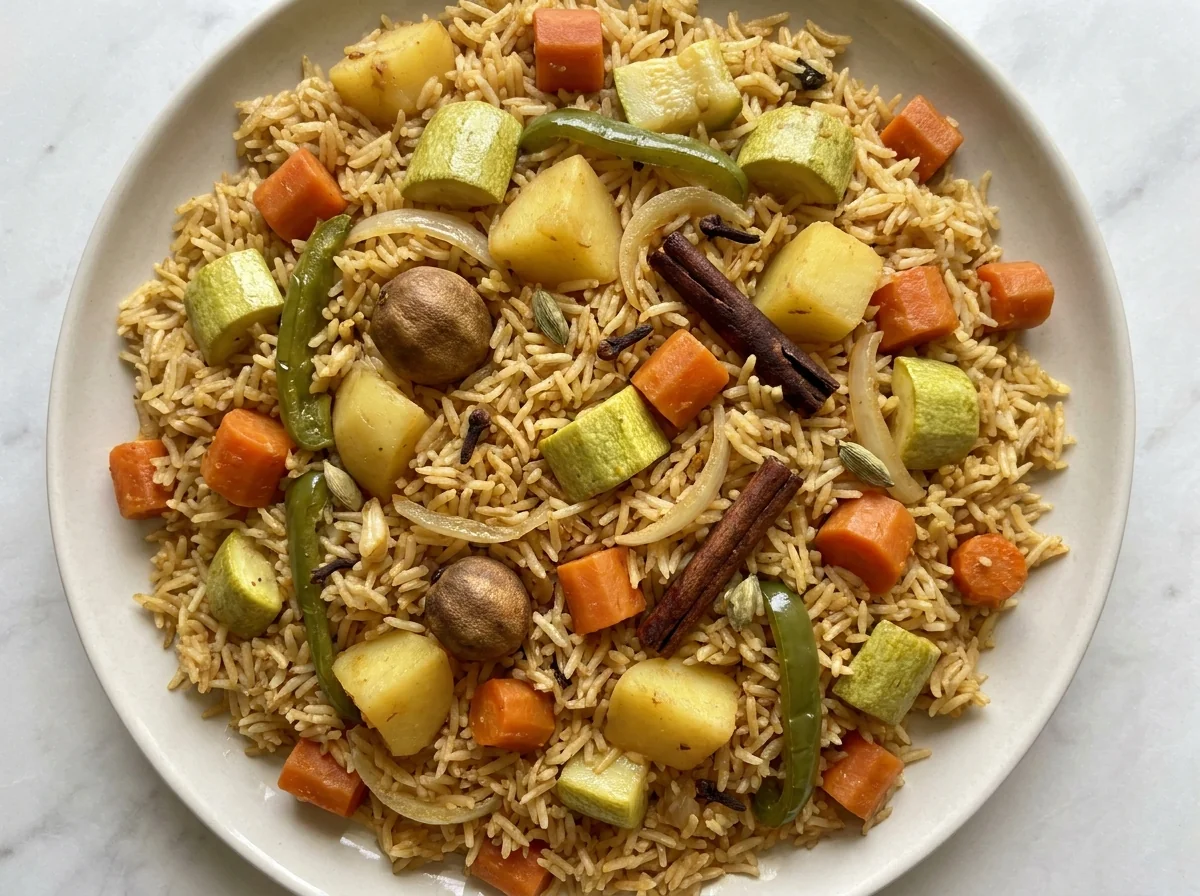
Vegetable Kabsa is a daughter of Saudi homes in the days when both the wallet and the stomach are light.
The red Kabsa base, its whole spices, and its loomi, with no meat: the identity is in the spice, not in the protein. The dish that proves Kabsa is a soul before it is a slaughter.
Preparation Steps
Build the full Kabsa base, every pillar intact
Brown the onion in the oil until deep golden, then the garlic, then the tomato paste until caramelized, then the grated tomatoes, the whole Kabsa spices, and the pierced loomi. The real Kabsa base doesn't change with the absence of meat: the spices are the identity.
Saute the firm vegetables in the base
Potato and carrot for five minutes, absorbing the red color and the spice. Sauteing before adding liquid fortifies and deepens them.
Coat the rice, then add liquid
The rinsed rice tosses for two minutes in the red base, then the hot salted stock goes in. A boil, then a covered simmer for fifteen minutes.
Zucchini and pepper over the top for the last ten minutes
The soft vegetables are scattered over the rice without stirring, cooking by steam. The lasting lesson of firmness order.
Rest, crown, and the daqqus garnish
Five minutes of rest, then fluff with the fork, and the toasted raisins and almonds over it for those who want the festive look: serve with daqqus and salad. A Kabsa that stands with the dignity of Friday and the budget of Tuesday.
Blood Sugar Impact
The glycemic index (GI) measures how quickly a food raises blood sugar, while the glycemic load (GL) measures how much a full serving raises it. Together they give the complete picture.
Glycemic Index
GI
65Medium
Low0–55Medium56–69High70+
A low value (≤55) means a gradual rise in blood sugar — the most suitable range for diabetes and insulin resistance.
Glycemic Load
GL
70High
Low0–10Medium11–19High20+
Glycemic load reflects the impact of the full serving. To lower it: take half a serving, or pair the recipe with a source of protein and fiber.
Nutritional Information
Per ServingMakes 4 servings · one serving is about 585 g of raw ingredients
Calories597 kcal30%of Daily Value*
Protein12 g24%of Daily Value*
Carbohydrates114 g41%of Daily Value*
Fat10 g13%of Daily Value*
Fiber7 g25%of Daily Value*
Sodium541 mg24%of Daily Value*
Potassium1090 mg23%of Daily Value*
Phosphorus244 mg20%of Daily Value*
* Percent Daily Values are based on a 2,000-calorie diet per FDA food-label reference values — your daily needs may be higher or lower. Values are derived from the recipe's ingredients via the USDA database.
Troubleshooting
The most common problems when preparing Budget Vegetable Kabsa (Saudi spiced rice dish), and how to fix them:
It came out as red rice with no Kabsa soul
The pillars were dropped with the meat. The loomi, the whole spices, and the honest browning. The identity is cheap, so don't drop it.
The potato fell apart before the rice was done
Small cubes. The large ones (3 cm) withstand the rice's journey.
The zucchini dissolved
It went in from the start. Over the top for the last ten minutes. The steam is enough for it.
The loomi made the dish bitter
Too many pieces, or completely broken. Two pieces, pierced once. The aroma, not the pulp.
Storage and Make-Ahead
Immediately
With its daqqus and salad.
In the refrigerator
Three days in containers. A ready work-lunch with the one-hour cooling rule.
In the freezer
One month. The zucchini softens on thawing but stays acceptable.
Tested Ingredient Substitutions
Original Ingredient
Tested Substitute
Ratio
Flavor Difference
The recipe vegetables
Pumpkin, eggplant, and green beans, whatever is on hand and cheap
~
Kabsa is generous at the door
An economical protein upgrade
A handful of our batch chickpeas with the rice
150 g
Protein for a riyal
A Friday upgrade
Our shredded chicken over it or a boiled egg
~
Between economy and feast there are degrees
The raisins and almonds
Simply omit them
~
The festive look is optional
How Much Does It Make? Scaling Guide
Ingredient
4 servings
2 servings
8 servings
Rice
400 g
200 g
800 g
Vegetables
700 g
350 g
1.4 kg
Stock
650 ml
325 ml
1.3 L
EEINA Nutrition Tip
Keep the pillars of Kabsa intact even when the meat is gone. The pierced loomi, the correct Kabsa spices, the honestly browned onion, and the caramelized paste: these four pillars are the Kabsa taste that memory knows; whoever drops them along with the meat ends up with ordinary red rice, not vegetable Kabsa. Economy drops the most expensive and guards the identity: and the identity here is spices that cost a few riyals.
Add This Recipe to Your Plan
The EEINA app saves your favorite recipes, calculates them from their real ingredients, and shows your daily numbers toward your goal. Try it free now.
Kabsa is a system of spice, loomi, and a red base before it is meat, and Saudi homes have always known vegetable Kabsa in the days of economy: heritage is wider than the restaurant menu.
How much does it cost compared to chicken Kabsa?
About a third of its cost, and the serving is about 550 calories with the fiber of three vegetables: a Friday dish on a mid-month budget.
How does it differ from our one-pot vegetable rice?
That one is international and spice-neutral; this one is Saudi in identity with its loomi, its whole spice, and its daqqus. The base is one and the pairing is different.
Where is its protein?
Honestly: it is light in protein on its own (about 9 g). A handful of chickpeas, a boiled egg, or a cup of yogurt completes it into a balanced meal: state what is missing and complete it, don't claim what isn't in it.