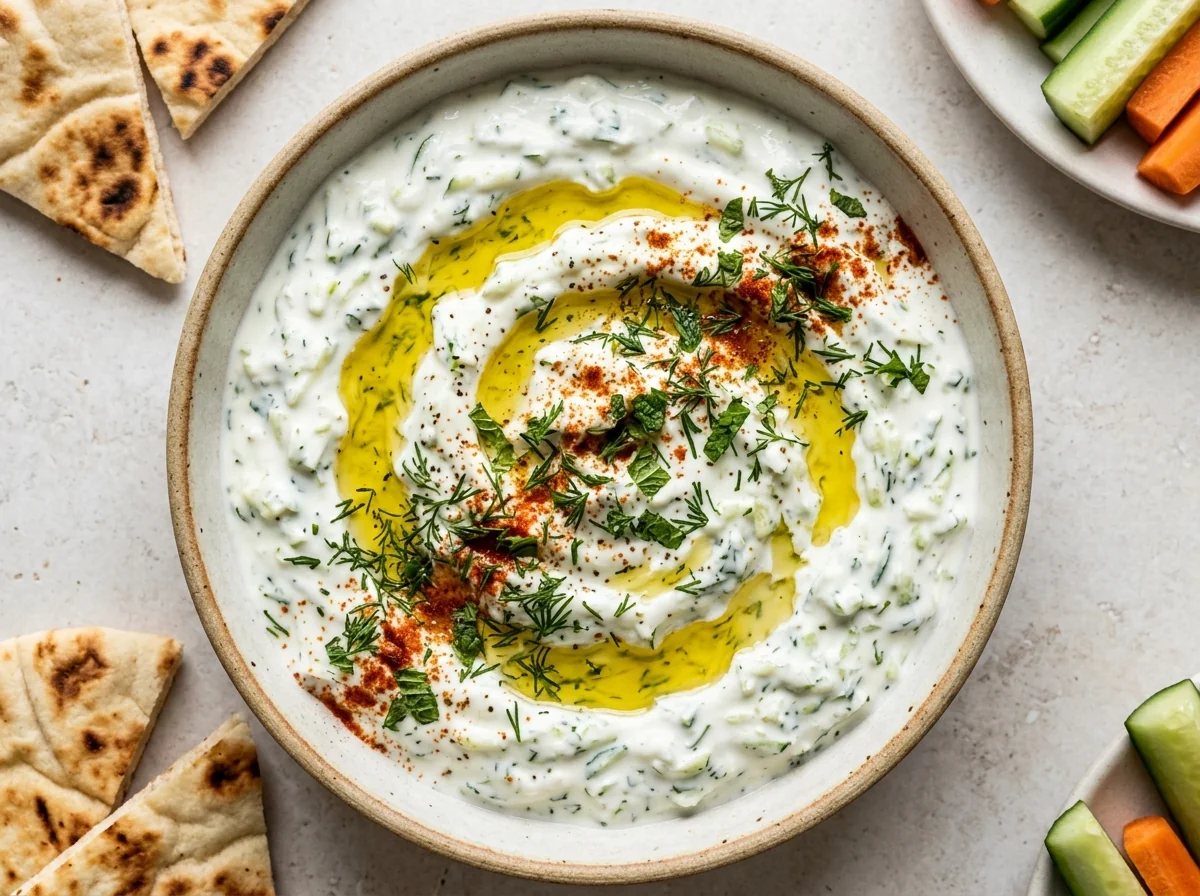
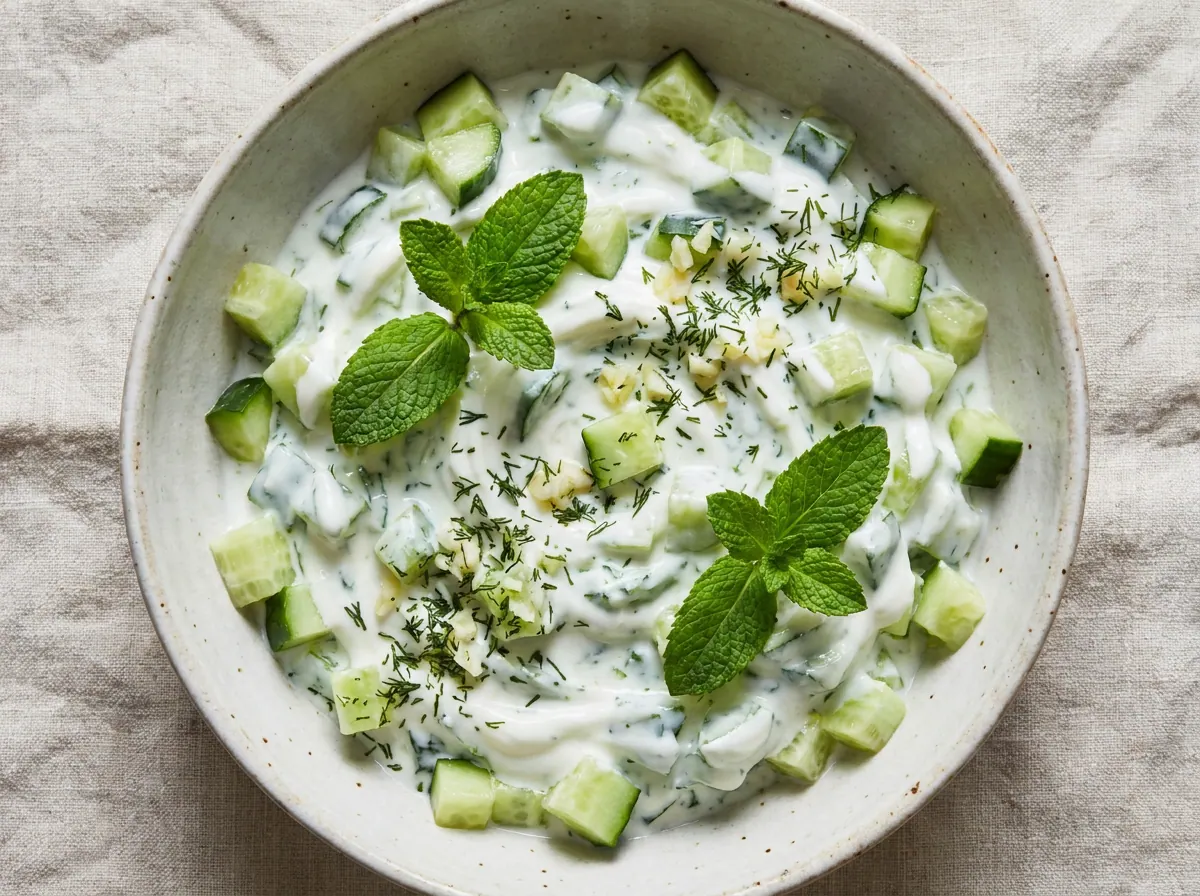
Tzatziki is one of the most famous Greek dishes, its name derived from the Turkish cacık.
It is prepared in every Greek, Cypriot, and Turkish household as an appetizer or side. For suhoor, it works as a refreshing starter before the main dish, or as a light snack with bread and vegetables.
Preparation Steps
Drain the cucumber
Grate the cucumber and place it in a sieve, sprinkling a spoonful of salt over it. Let it sit for 10 minutes so it releases its water. Squeeze it with your hands or in a towel to remove as much moisture as possible. Wet cucumber thins the yogurt.
Whisk the yogurt
In a bowl, whisk the Greek yogurt with a fork until smooth. Thick yogurt needs stirring to avoid lumps.
Combine the ingredients
Add the squeezed cucumber, garlic, lemon juice, olive oil, mint, dill, salt, and pepper. Mix well with a spoon.
Chill
Cover the bowl and chill for at least an hour. Chilling lets the garlic and mint open up in the yogurt.
Serve
Transfer the tzatziki to a serving bowl, make a well in the center, drizzle olive oil, and sprinkle with paprika and mint. Serve with toasted pita bread or cut vegetables as a refreshing suhoor appetizer.
Blood Sugar Impact
The glycemic index (GI) measures how quickly a food raises blood sugar, while the glycemic load (GL) measures how much a full serving raises it. Together they give the complete picture.
Glycemic Index
GI
12Low
Low0–55Medium56–69High70+
A low value (≤55) means a gradual rise in blood sugar — the most suitable range for diabetes and insulin resistance.
Glycemic Load
GL
1Low
Low0–10Medium11–19High20+
Glycemic load reflects the impact of the full serving. To lower it: take half a serving, or pair the recipe with a source of protein and fiber.
Nutritional Information
Per ServingMakes 4 servings · one serving is about 170 g of raw ingredients
Calories170 kcal8%of Daily Value*
Protein10 g20%of Daily Value*
Carbohydrates7 g3%of Daily Value*
Fat12 g15%of Daily Value*
Fiber1 g4%of Daily Value*
Sodium431 mg19%of Daily Value*
Potassium243 mg5%of Daily Value*
Phosphorus151 mg12%of Daily Value*
* Percent Daily Values are based on a 2,000-calorie diet per FDA food-label reference values — your daily needs may be higher or lower. Values are derived from the recipe's ingredients via the USDA database.
Troubleshooting
The most common problems when preparing Tzatziki — Greek Yogurt and Cucumber, and how to fix them:
The tzatziki is watery
Squeeze the cucumber more and add an extra spoonful of yogurt. Thick Greek yogurt is essential.
The flavor is flat
Double the garlic and add a spoonful of fresh mint. Raw garlic is the secret.
The flavor is bitter
The lemon has gone bad or the salt is too much. Taste and adjust.
The texture is thin
Strain the yogurt in a clean cheesecloth for 30 minutes. Strained yogurt takes on a creamy body.
Storage and Make-Ahead
Refrigerator (4°C)
Three days in an airtight container. Stir before serving.
Not suitable for freezing
Yogurt separates after thawing.
Tested Ingredient Substitutions
Original Ingredient
Tested Substitute
Ratio
Flavor Difference
Greek yogurt
Strained labneh
Same weight
Slightly different flavor.
Cucumber
Grated zucchini
Same weight
Different flavor and drier texture.
Mint
Fresh basil
Same weight
Different flavor.
Dill
Parsley
Same weight
Different flavor.
How Much Does It Make? Scaling Guide
Ingredient
4 people
8 people
12 people
Yogurt
400 g
800 g
1200 g
Cucumber
200 g
400 g
600 g
Olive oil
30 ml
60 ml
90 ml
Garlic
5 g
10 g
15 g
EEINA Nutrition Tip
Choose a true thick strained Greek yogurt. Regular yogurt makes a watery tzatziki. Squeeze the cucumber thoroughly in paper towels. Raw garlic is essential and should not be replaced with cooked garlic.
Add This Recipe to Your Plan
The EEINA app saves your favorite recipes, calculates them from their real ingredients, and shows your daily numbers toward your goal. Try it free now.