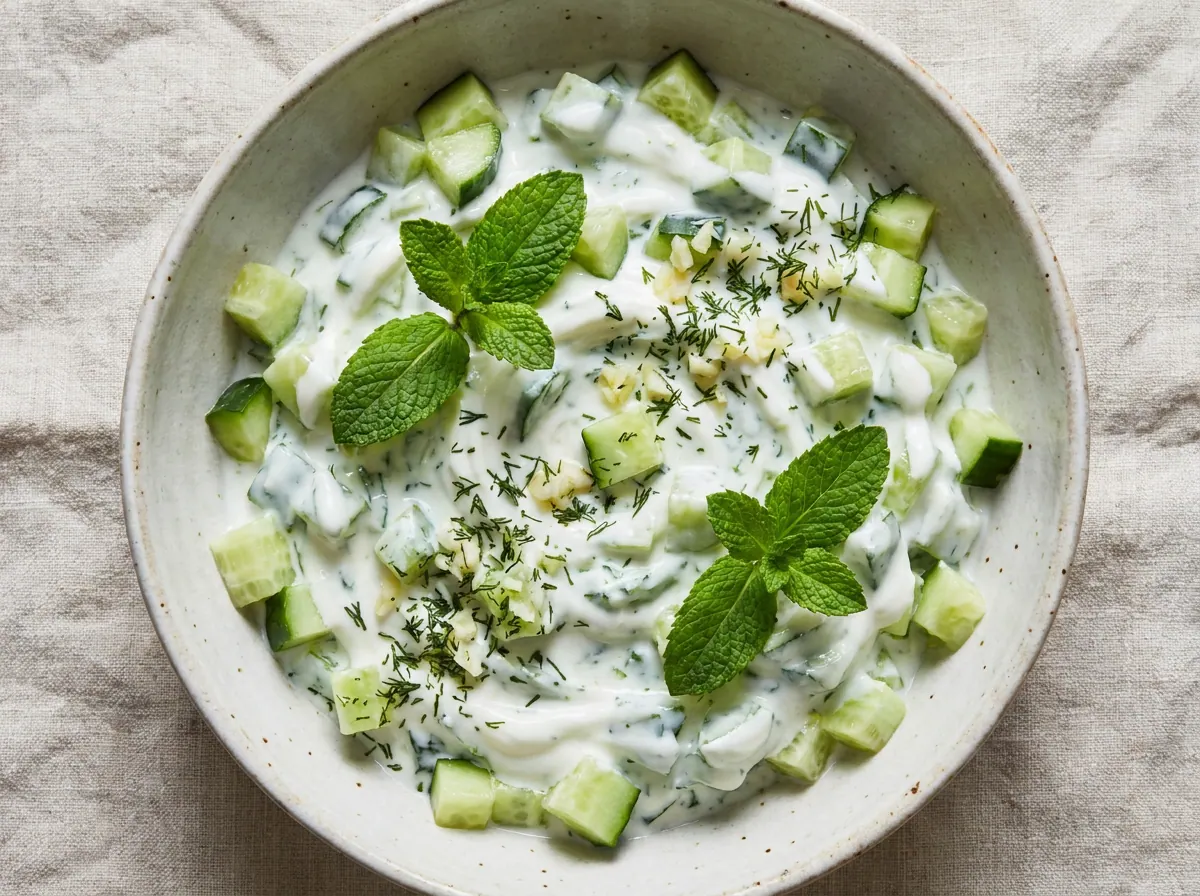
A light Saudi and Gulf yogurt salad with cucumber and mint — GI 30, very low; rich in calcium and probiotics. Serve chilled as a starter alongside rice and grilled meats.
Rob (yogurt) salad with cucumber and mint is one of the simplest and most refreshing starters on the Gulf table. Rob — plain yogurt — is the base, and the cucumber provides a cool crunch that cuts through the richness of main dishes.
It is served alongside rice, grilled meats and Kabsa (Saudi spiced rice dish), where its cold tang balances fatty meat and spiced rice. Its nutritional value is impressive for something so light: full-fat Rob offers calcium, protein and live probiotic cultures, while cucumber is mostly water and fibre with almost no calories. The high ratio of protein to carbohydrates in yogurt is the secret behind its very low glycaemic index.
Preparation Steps
Prepare the cucumber
Wash the cucumber well, then coarsely grate it or dice it finely. Sprinkle with a little salt and leave in a sieve for 5 minutes to draw out excess water, then gently squeeze with both hands or a clean cloth so the salad does not turn watery.
Whisk the Rob
Place the Rob (yogurt) in a bowl and whisk with a spoon until smooth and uniform.
Add the garlic
Crush the garlic clove with a pinch of salt to a paste, then stir into the Rob. One small clove is plenty in the Saudi and Gulf tradition — the garlic should not overpower.
Add the cucumber and mint
Add the squeezed cucumber and the chopped fresh mint, and fold in gently.
Season
Season with salt and lemon juice if using, then drizzle the olive oil over the surface.
Chill
Cover and refrigerate for at least 10 minutes before serving. Chilling melds the flavours and firms up the texture.
Garnish and serve
Just before serving, scatter a pinch of dried mint or a few fresh mint leaves on top. Serve cold as a starter or light snack alongside rice or grilled meats.
Blood Sugar Impact
The glycemic index (GI) measures how quickly a food raises blood sugar, while the glycemic load (GL) measures how much a full serving raises it. Together they give the complete picture.
Glycemic Index
GI
30Low
Low0–55Medium56–69High70+
A low value (≤55) means a gradual rise in blood sugar — the most suitable range for diabetes and insulin resistance.
Glycemic Load
GL
2Low
Low0–10Medium11–19High20+
Glycemic load reflects the impact of the full serving. To lower it: take half a serving, or pair the recipe with a source of protein and fiber.
Nutritional Information
Per ServingMakes 4 servings · one serving is about 140 g of raw ingredients
Calories96 kcal5%of Daily Value*
Protein4 g8%of Daily Value*
Carbohydrates7 g3%of Daily Value*
Fat6 g8%of Daily Value*
Fiber0 g0%of Daily Value*
Sodium192 mg8%of Daily Value*
Potassium210 mg4%of Daily Value*
Phosphorus105 mg8%of Daily Value*
* Percent Daily Values are based on a 2,000-calorie diet per FDA food-label reference values — your daily needs may be higher or lower. Values are derived from the recipe's ingredients via the USDA database.
Troubleshooting
The most common problems when preparing Rob (Yogurt) Salad with Cucumber and Mint, and how to fix them:
The salad is watery with liquid pooling at the bottom
The cucumber was not squeezed after salting. Cucumber is more than ninety per cent water, and if added without draining it releases into the Rob and loosens the texture. Quick fix: drain off the excess liquid and stir in a spoonful of strained yogurt. Next time: sprinkle the grated cucumber with a little salt, leave it in a sieve for 5 minutes, then squeeze firmly with both hands until no more drops fall.
Garlic flavour is overpowering and sharp
Too much garlic or too large a clove was used. In Rob salad, one small clove crushed to a paste with a pinch of salt is enough. To fix it: stir in half a cup of Rob and a spoonful of grated cucumber to balance the garlic, and serve well chilled — cold temperatures mellow its sharpness.
The salad is too sour
The Rob used was old or very acidic, or too much lemon juice was added. Lemon juice is optional here because Rob carries its own natural acidity. Choose a fresh, mildly tangy Rob, and add lemon drop by drop, tasting as you go. If it has turned too sour: a tiny pinch of sugar or a spoonful of fresh Rob will restore the balance.
The mint has turned black after an hour
The mint was chopped early with a blunt knife, bruising and oxidising the leaves. Chop fresh mint with a sharp knife just before serving, using short, quick strokes, and do not leave it chopped and exposed to the air. Dried mint as a garnish is a stable alternative that does not oxidise.
The salad tastes flat and lifeless
Too little salt, or it was served before chilling. Rob needs adequate salt to bring out its flavour, and chilling for at least 10 minutes allows the garlic and mint to meld into the yogurt. Taste before serving, adjust salt, and always serve it cold.
The texture is loose and will not hold together
The Rob was low-fat or too liquid, or the cucumber was not squeezed. For a firmer texture use full-fat Rob and squeeze the cucumber well. For extra thickness: strain the Rob in a piece of muslin over a sieve for 10 minutes before using to remove some of the whey.
Storage and Make-Ahead
Refrigerator (4 °C)
The mixed salad keeps for up to two days in an airtight container. Some water may separate on the surface — stir before serving. The Rob alone keeps until its use-by date on the packaging; mix with the cucumber just before serving to preserve the crunch.
Freezer (−18 °C)
Not suitable at all. Yogurt separates after thawing and cucumber turns into a watery pulp. Rob salad is a same-day, fresh dish.
Prep ahead
Squeezing the cucumber: up to two hours ahead, store the squeezed cucumber in an airtight container in the fridge. Whisking the Rob with garlic: up to one hour ahead, keep covered in the fridge. Final mixing and mint: no more than 10 minutes before serving.
Serving
A cold dish — do not heat. Serve straight from the fridge as a starter alongside rice and grills. Do not leave out of the fridge for more than two hours to keep the yogurt safe.
Tested Ingredient Substitutions
Original Ingredient
Tested Substitute
Ratio
Flavor Difference
Full-fat Rob
Plain plant-based yogurt (coconut or soy)
Same quantity
Dairy-free option with a lighter flavour and similar texture
Full-fat Rob
Low-fat Rob
Same quantity
Fewer calories, thinner texture, more pronounced acidity
Grated cucumber
Finely diced cucumber
Same weight
More pronounced crunch, needs slightly less squeezing
Fresh mint
Dried mint
1/3 of the quantity
More intense flavour — stir into the mixture rather than using only as garnish
Crushed garlic
Omit the garlic
—
Lighter and milder — good for those who dislike raw garlic
How Much Does It Make? Scaling Guide
Number of servings
Yogurt drink
Cucumbers
Fresh mint
Garlic
2 (appetizer × 2)
200 g
70 g
1 tbsp
0.5 small clove
4 (base)
400 g
140 g
2 tbsp
1 small clove
8 (large family)
800 g
280 g
4 tbsp
2 small cloves
12 (entertaining)
1200 g
420 g
6 tbsp
3 small cloves
EEINA Nutrition Tip
Squeezing the cucumber is the secret to the right texture. This salad succeeds or fails on one step — squeezing the cucumber after salting it. Unsqueezed cucumber releases its water into the Rob, thinning it and diluting the flavour. One minute of squeezing is the difference between a firm, refreshing salad and a watery, bland one.
Add This Recipe to Your Plan
The EEINA app saves your favorite recipes, calculates them from their real ingredients, and shows your daily numbers toward your goal. Try it free now.
Rob is the common Gulf term for plain fermented yogurt. In this recipe we use plain full-fat yogurt; one labelled 'live and active cultures' is preferable for the probiotic benefit.
Is it suitable for people with diabetes?
Very much so — its GI is 25 and its GL is 2, both very low, and it is light in carbohydrates. A safe starter in most situations; choose a plain Rob with no added sugar.
How long does it keep in the fridge?
Up to two days in an airtight container. Some water may separate on the surface — stir before serving. Best made on the day of serving.
Can I use dried mint instead of fresh?
Yes. Dried mint is a stable, non-browning alternative — use one third the quantity of fresh mint because it is more intense. Fresh mint is more refreshing; dried mint is better for garnish.
Sources: USDA · University of Sydney · Gulf GSO · Our methodology · Updated on