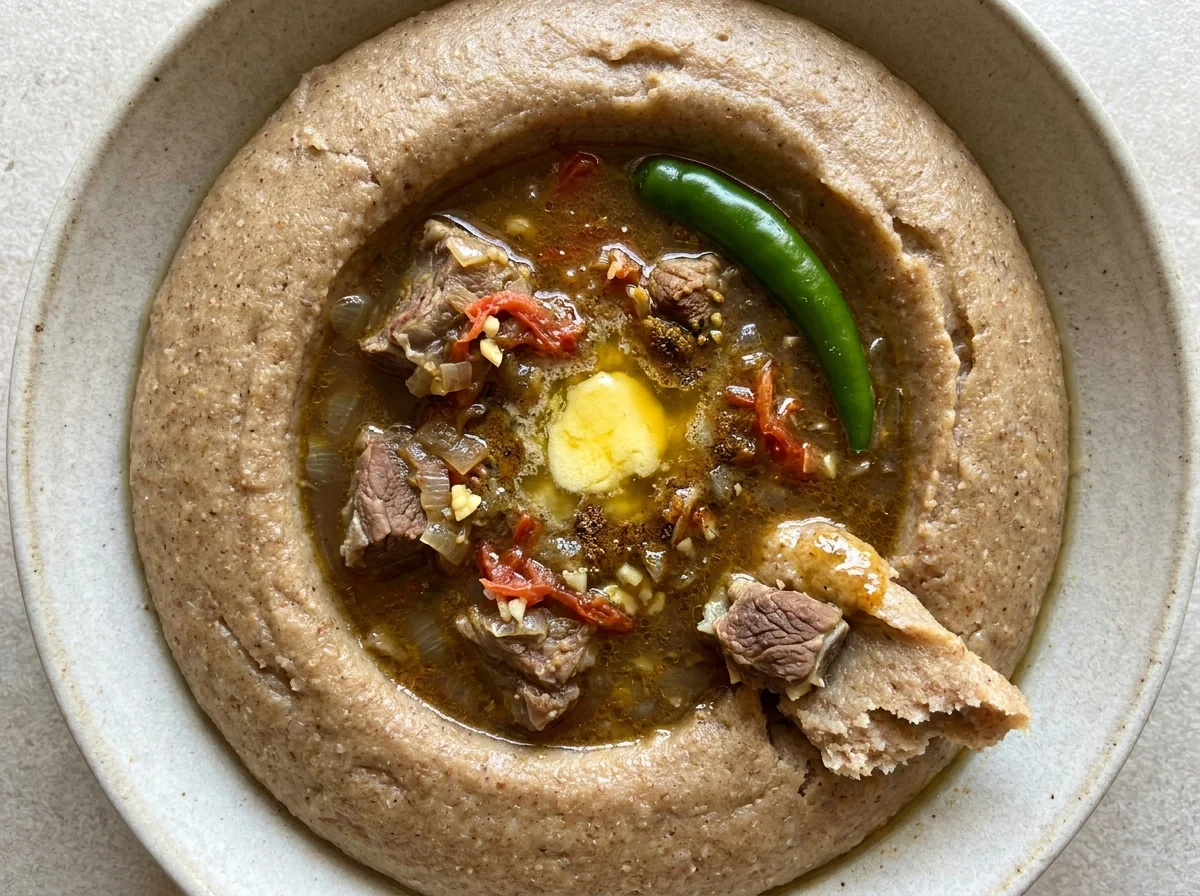
Meat asida with broth is the greater savory face of southern asida.
A wheat dough domed and drizzled with a seasoned red meat broth instead of honey, as documented in Saudi cooking pages. The lunch of occasions in Asir, Al-Baha, and their neighbors.
Preparation Steps
Cook the red meat broth first
Brown the meat in half the ghee, add the onion then the garlic and spices, then the tomatoes and hot pepper, cover with water, salt, and cook covered for an hour until the meat is tender and a generous red broth concentrates. It is the soul of this asida and its drizzle.
Beat the dough with grandmothers' arm
In a thick pot, boil the asida water with the salt and add the wheat flour all at once and beat it with a strong wooden spoon, or a whisk, in continuous vigorous beating for five minutes until a smooth dough comes together with no lump, then over the gentlest heat covered for ten minutes it cooks through to its depth.
Dome and hollow the pool
Turn the asida into a deep plate, dome it with the back of a wet spoon, and hollow a wide well in its top. The pool that will receive the broth and ghee.
Drizzle with the broth, meat, and ghee
Fill the well with the red meat broth, arrange the meat pieces around it, and drizzle the rest of the local ghee over the dome. The meeting of white and red that every southern home knows.
Eaten from its edge to its pool
A bite of asida dipped in the broth with a morsel of meat, the complete meal of the south documented in Saudi cookbooks, the lunch of the mountains and their occasions.
Blood Sugar Impact
The glycemic index (GI) measures how quickly a food raises blood sugar, while the glycemic load (GL) measures how much a full serving raises it. Together they give the complete picture.
Glycemic Index
GI
49Low
Low0–55Medium56–69High70+
A low value (≤55) means a gradual rise in blood sugar — the most suitable range for diabetes and insulin resistance.
Glycemic Load
GL
20High
Low0–10Medium11–19High20+
Glycemic load reflects the impact of the full serving. To lower it: take half a serving, or pair the recipe with a source of protein and fiber.
Nutritional Information
Per ServingMakes 5 servings · one serving is about 635 g of raw ingredients
Calories625 kcal31%of Daily Value*
Protein36 g72%of Daily Value*
Carbohydrates48 g17%of Daily Value*
Fat32 g41%of Daily Value*
Fiber7 g25%of Daily Value*
Sodium399 mg17%of Daily Value*
Potassium826 mg18%of Daily Value*
Phosphorus486 mg39%of Daily Value*
* Percent Daily Values are based on a 2,000-calorie diet per FDA food-label reference values — your daily needs may be higher or lower. Values are derived from the recipe's ingredients via the USDA database.
Troubleshooting
The most common problems when preparing Southern Meat Asida with Broth, and how to fix them:
The asida is lumpy
Flour added gradually or an arm that slacked. The single addition and the five minutes of beating. Its whole craft is in the forearm.
It came out loose and runny
Water more than three times the flour. The ratio is three to one, and a loose one is rescued by a few minutes of uncovered heat with beating.
The broth fell short of the pool
Concentration dragged on. Asida broth is generous and liquid, fills the pool and overflows. A drink of hot water adjusts it.
It set before the table
The asida waits for its broth, not the reverse. It is turned out, drizzled, and served within its quarter hour, and if it sets, hot water under the lid softens it.
Storage and Make-Ahead
Right away
Hot with its red pool. A child of its hour.
In the fridge
The asida and broth separate for two days. Steam the asida, reheat the broth, and gather the pool fresh.
Not suited to freezing
The beaten texture collapses on thawing.
Tested Ingredient Substitutions
Original Ingredient
Tested Substitute
Ratio
Flavor Difference
Lamb
Bone-in chicken
1 kg
A lighter broth in half the hour
Pure wheat flour
Half white
~
A lighter asida for beginners
Local ghee
Oil. Sparingly
~
Permissible, and local ghee here is identity, not luxury
The savory top
Honey and ghee with no broth
~
It returns to the sweet asida. Its sister in our library
How Much Does It Make? Scaling Guide
Ingredient
5 servings
2.5 servings
10 servings
Flour
300 g
150 g
600 g
Meat
700 g
350 g
1.4 kg
Asida water
900 ml
450 ml
1.8 L
EEINA Nutrition Tip
Beat with a single addition of flour and an arm that does not stop. The mother rule of all asidas: flour added gradually to boiling water clumps into raw lumps that nothing fixes; a single addition with continuous beating gives birth to a silky dough.
Add This Recipe to Your Plan
The EEINA app saves your favorite recipes, calculates them from their real ingredients, and shows your daily numbers toward your goal. Try it free now.
How is it different from our sweet fenugreek asida?
That one is breakfast with honey, ghee, and a fenugreek crown; this is lunch with a red meat broth. One dome and two pools: golden there and red here.
Why does it center the southern occasion tables?
A communal plate the whole household gathers around with a hand-bite. A symbol of gathering before it is a dish, and its wheat fills the crowds of feasts with inexpensive generosity.
Is it really eaten by hand?
It is a child of the bite: a pinch of asida with the fingertips is dipped and lifted, and the spoon is for the shy guest, no harm in it.
How does someone watching their weight lighten it?
A meat-generous broth pool and a modest asida base. The smart inversion of the habit of piling on dough.