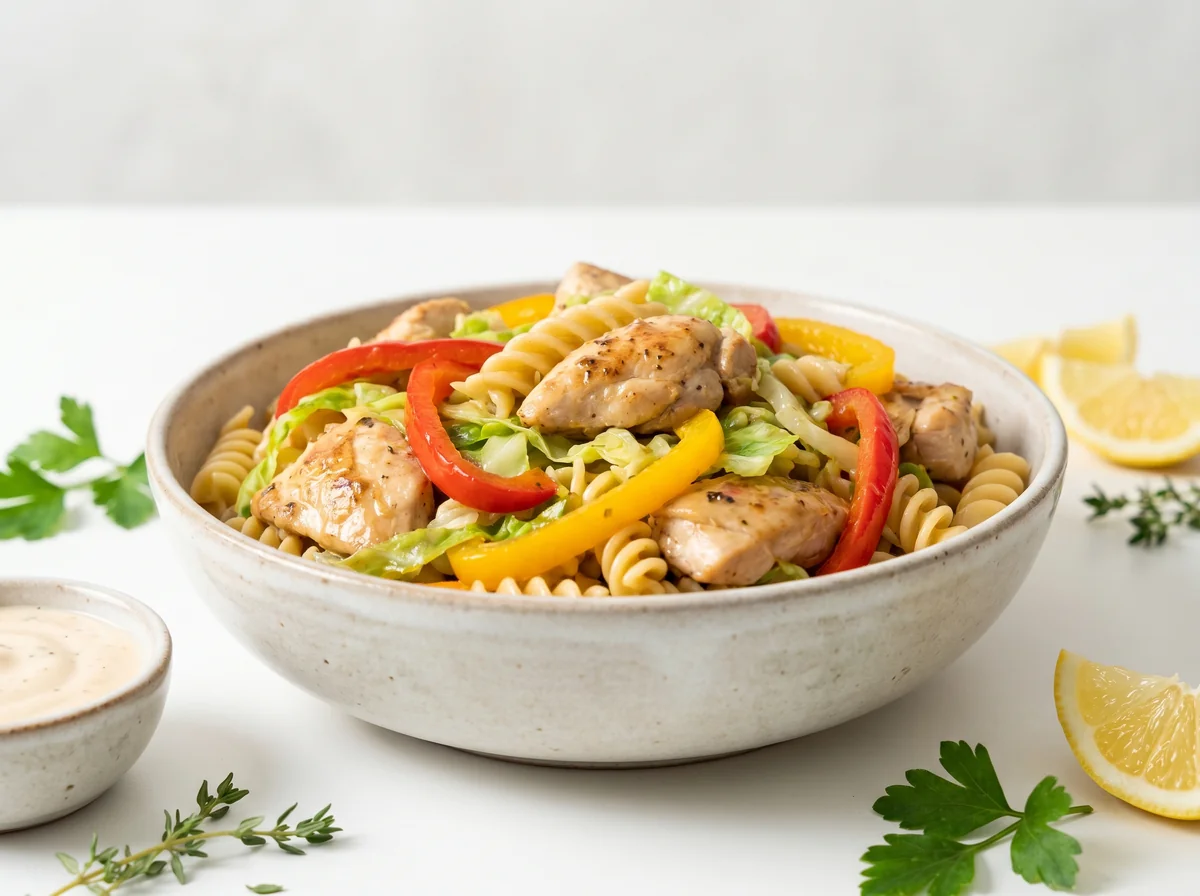
We wanted a dish that makes someone on a renal diet feel like they are sitting at a normal table, not a table of deprivation.
The quick sauté and its high heat lock in the chicken's flavour and keep the peppers and cabbage with a pleasant crunch, while lemon juice and zest, garlic, and parsley carry the weight that salt usually does. We chose white pasta as a familiar base in Saudi homes and kept everything away from tomatoes and soy so the dish stays light on the kidneys and satisfying on the palate at the same time.
Preparation Steps
Season the chicken
Toss the chicken slices with half the lemon juice, black pepper, paprika, and a light pinch of salt, and leave for ten minutes to absorb the flavour. Marinating with acid tenderises the fibres and reduces the need for salt.
Cook the pasta
Cook the pasta in unsalted boiling water over medium heat for ten to twelve minutes until tender but still holding its shape, then drain and reserve half a cup of the starchy cooking water. Leaving the water unsalted reduces the sodium in the dish.
Sear the chicken
Heat half the olive oil in a wide skillet over medium-high heat and sear the chicken for five to seven minutes, stirring, until golden and the centre reaches 74°C. This temperature ensures poultry is safely cooked through.
Sauté the aromatics
Set the chicken aside, add the remaining oil, then the onion and garlic and stir for one minute until fragrant — do not let the garlic burn or it will turn bitter.
Add the peppers and cabbage
Add the red and green peppers and the cabbage and stir over high heat for four to five minutes until the vegetables are tender with a slight crunch — quick cooking on high heat preserves texture and flavour.
Combine everything
Return the chicken to the skillet and add the pasta, the remaining lemon juice, the zest, and the za'atar (thyme-sumac-sesame blend). Stir for two minutes, splashing in a little of the reserved cooking water if the mixture looks dry, until the flavours come together.
Serve
Turn off the heat and scatter the fresh parsley. Taste before adding any extra salt — the lemon and garlic usually do the job. Serve the dish warm.
Blood Sugar Impact
The glycemic index (GI) measures how quickly a food raises blood sugar, while the glycemic load (GL) measures how much a full serving raises it. Together they give the complete picture.
Glycemic Index
GI
44Low
Low0–55Medium56–69High70+
A low value (≤55) means a gradual rise in blood sugar — the most suitable range for diabetes and insulin resistance.
Glycemic Load
GL
26High
Low0–10Medium11–19High20+
Glycemic load reflects the impact of the full serving. To lower it: take half a serving, or pair the recipe with a source of protein and fiber.
Nutritional Information
Per ServingMakes 4 servings · one serving is about 365 g of raw ingredients
Calories527 kcal26%of Daily Value*
Protein39 g78%of Daily Value*
Carbohydrates65 g24%of Daily Value*
Fat12 g15%of Daily Value*
Fiber6 g21%of Daily Value*
Sodium275 mg12%of Daily Value*
Potassium868 mg18%of Daily Value*
Phosphorus439 mg35%of Daily Value*
* Percent Daily Values are based on a 2,000-calorie diet per FDA food-label reference values — your daily needs may be higher or lower. Values are derived from the recipe's ingredients via the USDA database.
Troubleshooting
The most common problems when preparing Sautéed Chicken with Pepper and Cabbage over White Pasta (Renal-Friendly), and how to fix them:
The chicken is dry and tough
Slice the breast into even strips and do not overcook past 74°C — excess heat after the chicken is done drives out moisture.
The dish is bland because of low salt
Increase the lemon juice, zest, garlic, and za'atar (thyme-sumac-sesame blend) — acidity and herbs compensate for salt. Taste before adding any salt.
The pasta is clumped and sticky
Stir during cooking, do not leave it to cool without movement, and splash in a little of the reserved cooking water when combining to loosen any clumping.
The vegetables are soft and watery
Cook the peppers and cabbage over high heat for a short time with no crowding in the pan — a packed pan releases steam and boils the vegetables instead of sautéing them.
The garlic burned and turned bitter
Add the garlic after the onion and stir for less than a minute over moderate heat — pull the pan off the heat the moment it starts to colour quickly.
Storage and Make-Ahead
Refrigerator
Store the dish in an airtight container in the refrigerator for three days, refrigerating within two hours of cooking per USDA danger zone guidelines.
Freezer
Freeze for up to two months in an airtight container. It is preferable to freeze the chicken and vegetables without the pasta, as pasta may soften after thawing.
Reheating
Reheat over medium heat or in the microwave until thoroughly hot at 70°C, splashing in a little water to restore moisture.
Tested Ingredient Substitutions
Original Ingredient
Tested Substitute
Ratio
Flavor Difference
Chicken breast
Skinless turkey breast
1:1
An equivalent white protein similarly low in phosphorus, suitable for a renal diet.
Chicken breast
Mild white fish fillets (tilapia or cod)
1:1
Cook to 63°C; fish cooks faster so reduce the cooking time.
White pasta
Cooked white rice
1 cup cooked rice per 70 g pasta
White rice is low in phosphorus and potassium and a familiar staple on the Saudi table.
White pasta
Refined couscous
1:1 by cooked weight
A kidney-friendly option as long as it is refined, not whole grain.
Cabbage
Cauliflower florets
1:1
Cauliflower is also among the lower-potassium vegetables and holds up well in a sauté.
How Much Does It Make? Scaling Guide
Ingredient
4 servings
8 servings
12 servings
Chicken breast
500 g
1000 g
1500 g
White pasta
280 g
560 g
840 g
Red and green pepper
300 g
600 g
900 g
Cabbage
200 g
400 g
600 g
Olive oil
30 ml
60 ml
90 ml
Lemon juice
30 ml
60 ml
90 ml
EEINA Nutrition Tip
Soaking the sliced peppers and cabbage in warm water for ten minutes and draining them before cooking reduces their potassium content further — a useful step for anyone who has been asked to restrict potassium precisely. Add salt at the end and at the table, not during cooking; salt added last is perceived more at a lower quantity.
Add This Recipe to Your Plan
The EEINA app saves your favorite recipes, calculates them from their real ingredients, and shows your daily numbers toward your goal. Try it free now.
Is this dish suitable for someone on a renal diet?
It is designed to be low in sodium, potassium, and phosphorus by choosing white protein, refined pasta, and lower-potassium vegetables. But the permitted amounts vary with your individual condition, so consult your nephrologist and renal dietitian before adopting it.
Why no tomatoes or soy sauce?
Concentrated tomatoes are high in potassium, and soy sauce and ready-made stock are high in sodium — all avoided in a renal diet. We replaced them with lemon, garlic, and herbs for flavour.
How do I reduce the potassium in the vegetables further?
Soak the sliced peppers and cabbage in warm water for ten minutes, then drain before cooking. This step dissolves and removes some of the potassium.
Can I use bone-in chicken?
Skinless, boneless chicken breast is preferable — the skin raises fat content and the bone may release more phosphorus in longer cooking. Skinless breast is the most kidney-appropriate choice.
Is the dish free from common allergens?
The base recipe is free from dairy, eggs, nuts, peanuts, sesame, fish, crustaceans, and soya. Always check the pasta label — some varieties may contain eggs or traces of gluten.