Prune compote is Eastern Europe's winter sweet and our grandmothers' digestive remedy.
Dried plums that swell in an aromatic syrup made from their sugar alone. For the blood pressure patient it is a strategic snack: potassium among the highest in the whole kitchen cupboard, and sweetness without an added gram.
Preparation Steps
The prunes are immersed in the aromatics
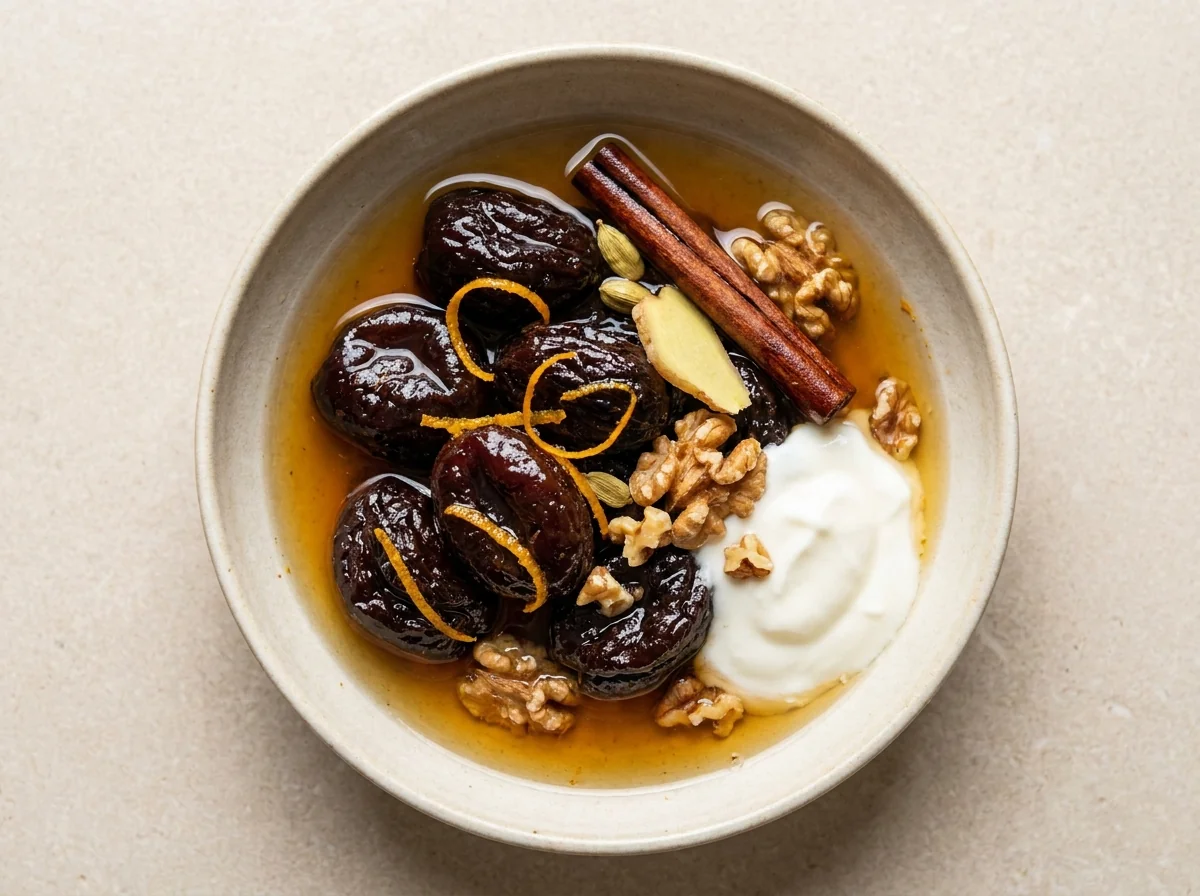
The prunes with the water, orange juice and zest, cinnamon, and cardamom in a small pot. Without a gram of sugar: prunes are among the sweetest dried fruits on their own.
A gentle simmer of twenty minutes until syrup
The prunes swell and the liquid thickens into a dark, glossy syrup. The compote makes its syrup from the sugar of its own fruit.
It cools in its syrup
The cold soak completes the absorption, and it deepens further with an overnight rest.
Over yogurt with crunchy walnut
Three prunes with their syrup over yogurt and the walnuts on top, a breakfast or an evening snack.
Potassium for blood pressure and fiber for regularity
Prunes are among the highest foods in potassium for weight, and their sorbitol is the well-known friend of digestive regularity. The grandmothers' sweet that medicine has endorsed twice over.
Blood Sugar Impact
The glycemic index (GI) measures how quickly a food raises blood sugar, while the glycemic load (GL) measures how much a full serving raises it. Together they give the complete picture.
Glycemic Index
GI
29Low
Low0–55Medium56–69High70+
A low value (≤55) means a gradual rise in blood sugar — the most suitable range for diabetes and insulin resistance.
Glycemic Load
GL
7Low
Low0–10Medium11–19High20+
Glycemic load reflects the impact of the full serving. To lower it: take half a serving, or pair the recipe with a source of protein and fiber.
Nutritional Information
Per ServingMakes 6 servings · one serving is about 100 g of raw ingredients
Calories122 kcal6%of Daily Value*
Protein1 g2%of Daily Value*
Carbohydrates27 g10%of Daily Value*
Fat2 g3%of Daily Value*
Fiber3 g11%of Daily Value*
Sodium1 mg0%of Daily Value*
* Percent Daily Values are based on a 2,000-calorie diet per FDA food-label reference values — your daily needs may be higher or lower. Values are derived from the recipe's ingredients via the USDA database.
Troubleshooting
The most common problems when preparing Prune Compote with Cinnamon and Orange, and how to fix them:
It came out too sweet for the evening
Its concentrated nature. The serving is three prunes, not the plate: and its sugar counts precisely for the diabetic.
The liquid stayed watery
The simmer was too short. The twenty minutes until the glossiness, and chilling thickens the rest.
A slight bitterness
Orange zest that dug into the white pith. The colored layer only. Citrus's standing lesson.
A digestive effect beyond the gentle
Prune sorbitol is truly effective. Build up gradually: two prunes first, and going further is a conscious decision.
Storage and Make-Ahead
In the fridge
A week in a jar with its syrup. The week's ready snack.
Over what?
Yogurt, oatmeal, and even a cheese plate. The syrup is a noble sauce.
Not frozen
It doesn't need it. Its week is generous.
Tested Ingredient Substitutions
Original Ingredient
Tested Substitute
Ratio
Flavor Difference
The prunes
Dried apricots. A golden compote (found in our library)
~
The two dried siblings
The orange
Drops of orange blossom water after the heat
~
A Levantine aroma
The walnuts
Almonds or leave them out
~
The crunch is optional
The ginger
Keeping it in winter
~
A fitting warmth
How Much Does It Make? Scaling Guide
Ingredient
6 servings
3 servings
12 servings
Prunes
250 g
125 g
500 g
Water
300 ml
150 ml
600 ml
Orange
1 piece
1/2 piece
2 pieces
EEINA Nutrition Tip
Never add sugar to prunes. The dried plum concentrates its fruit sugar fourfold, so it comes out among the sweetest things in the cupboard to begin with: its dark syrup forms from this own sugar with the hot soak; the commercial canned "compote" drowns it in a syrup it doesn't need. Read canned fruit labels in general: "in its own juice" is taken and "in syrup" is left on its shelf.
Add This Recipe to Your Plan
The EEINA app saves your favorite recipes, calculates them from their real ingredients, and shows your daily numbers toward your goal. Try it free now.
About 730 mg per hundred grams (a banana about 360 for comparison). The three-prune serving gives about 300 mg: among the densest sources of the blood pressure equation's second element.
Its sugar, where does the diabetic stand on it?
Honestly: concentrated (about 38 g per 100 g). The three-prune serving is about 15 g of carbohydrates, counted precisely in the plan: a superb blood pressure snack and a diabetic snack with a count.
How is the serving counted with its yogurt?
About 160 calories with three prunes, their syrup, and yogurt. A full-bodied evening snack: sweetness, crunch, and protein.
Is it really the "grandmothers' laxative"?
Its sorbitol and fiber are a documented duo for regularity. The side benefit that made it a household remedy before it was a sweet: and moderation is its law.