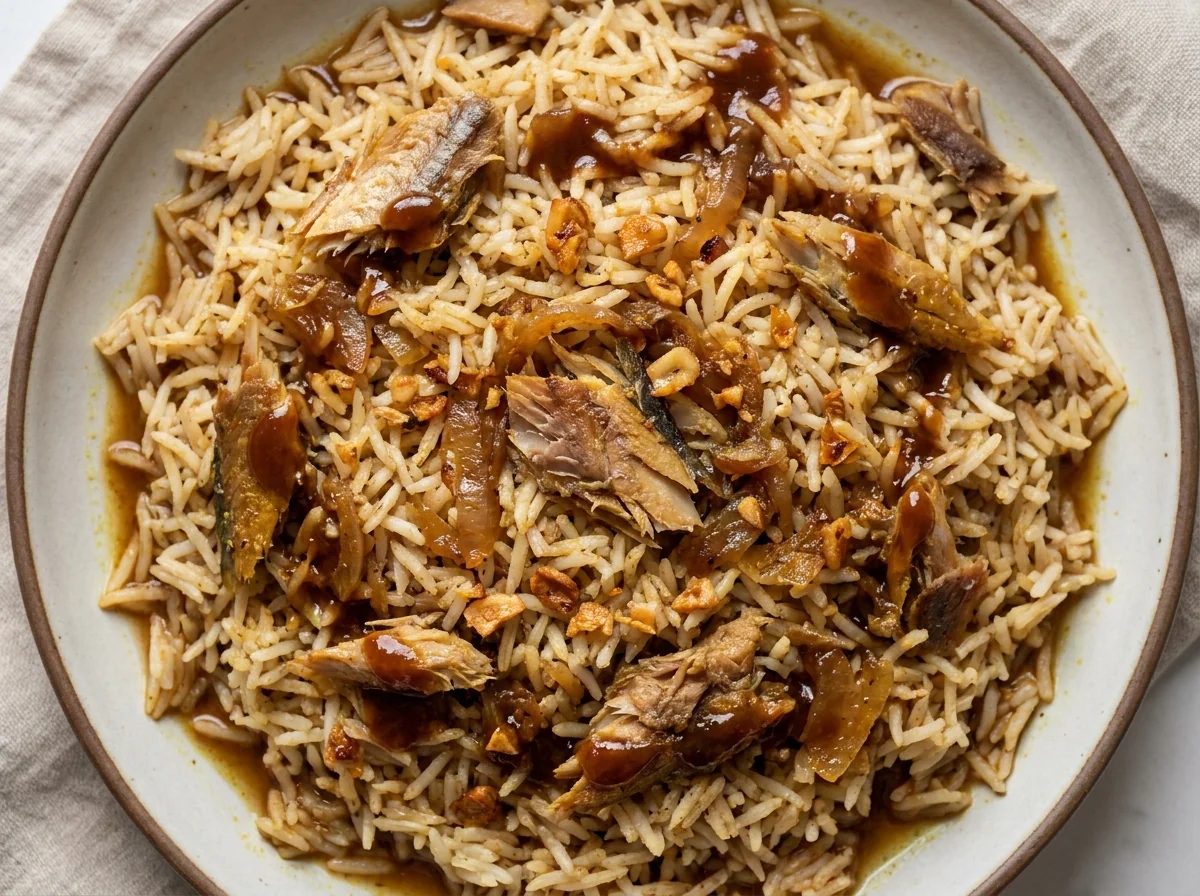
We make nashif salted fish the way it is made in the homes of the Emirates, where salting and drying fish was the method of preservation before refrigerators, so it kept for months and was cooked with onion and black lime over white rice.
It is a dish that carries the memory of the sea and the desert together, honest in the saltiness that defines it; we serve it truthfully as it is, while reducing the added salt to balance the fish's own saltiness.
Preparation Steps
Soaking the salted fish
Soak the salted fish in cold water for about two hours, changing the water twice, for this step lowers its high saltiness before cooking, then drain it and cut it into pieces.
Sautéing the base
Heat the ghee and sauté the chopped onion with the garlic until it wilts and turns golden, then add the whole black lime, tamarind, turmeric, bzar, and pepper and stir until the spices turn fragrant.
Cooking the salted fish
Add the drained salted fish and stir it with the base for three to five minutes until it soaks up the spices, then sprinkle on a little water and leave it over low heat.
Cooking the rice
Boil the washed rice in salted water until cooked and drain it, for boiled and drained rice is lower in salt than rice cooked in the remaining water.
Serving
Spread the rice on a platter, distribute the salted-fish-and-onion mixture over it, garnish with fresh cilantro, and serve hot.
Blood Sugar Impact
The glycemic index (GI) measures how quickly a food raises blood sugar, while the glycemic load (GL) measures how much a full serving raises it. Together they give the complete picture.
Glycemic Index
GI
67Medium
Low0–55Medium56–69High70+
A low value (≤55) means a gradual rise in blood sugar — the most suitable range for diabetes and insulin resistance.
Glycemic Load
GL
58High
Low0–10Medium11–19High20+
Glycemic load reflects the impact of the full serving. To lower it: take half a serving, or pair the recipe with a source of protein and fiber.
Nutritional Information
Per ServingMakes 4 servings · one serving is about 275 g of raw ingredients
Calories615 kcal31%of Daily Value*
Protein40 g80%of Daily Value*
Carbohydrates90 g33%of Daily Value*
Fat10 g13%of Daily Value*
Fiber3 g11%of Daily Value*
Sodium1060 mg46%of Daily Value*
* Percent Daily Values are based on a 2,000-calorie diet per FDA food-label reference values — your daily needs may be higher or lower. Values are derived from the recipe's ingredients via the USDA database.
Troubleshooting
The most common problems when preparing Emirati Salted Fish over Rice (Nashif Samak Malleh), and how to fix them:
The dish is too salty
Extend the soaking of the fish and change its water three times, and do not add any salt to the rice or the base, since the fish is the source of the saltiness.
The fish is tough
Extend its cooking over low heat with a splash of water until it softens, for dried fish needs time to soften.
The fish has a strong smell
Add whole black lime and tamarind, for their acidity softens the smell and balances the dish.
Storage and Make-Ahead
Refrigerator
Keep the fish with the onion and the rice separate in airtight containers for up to three days.
Freezing
Freeze the fish mixture for up to a month, and thaw it in the refrigerator before reheating with a splash of water.
Tested Ingredient Substitutions
Original Ingredient
Tested Substitute
Ratio
Flavor Difference
salted fish
seasoned fresh fish
same weight, 300 g
The flavor becomes lighter and less salty and loses the traditional character
ghee
absorbed frying oil
same weight, 25 g
The flavor is lighter than ghee
tamarind
lemon juice
half the weight, 8 g
A lighter acidity without the depth of tamarind
basmati rice
short-grain rice
same weight, 400 g
The texture becomes a little softer
How Much Does It Make? Scaling Guide
Ingredient
Half amount
Full amount (base)
Double
Dried salted fish
150 g
300 g
600 g
Basmati rice
200 g
400 g
800 g
Onion
150 g
300 g
600 g
Garlic
8 g
15 g
30 g
Emirati bzar
3 g
6 g
12 g
Tamarind
8 g
15 g
30 g
EEINA Nutrition Tip
Soak the salted fish and change its water twice before cooking, for this step alone determines the salt balance of the whole dish.
Add This Recipe to Your Plan
The EEINA app saves your favorite recipes, calculates them from their real ingredients, and shows your daily numbers toward your goal. Try it free now.