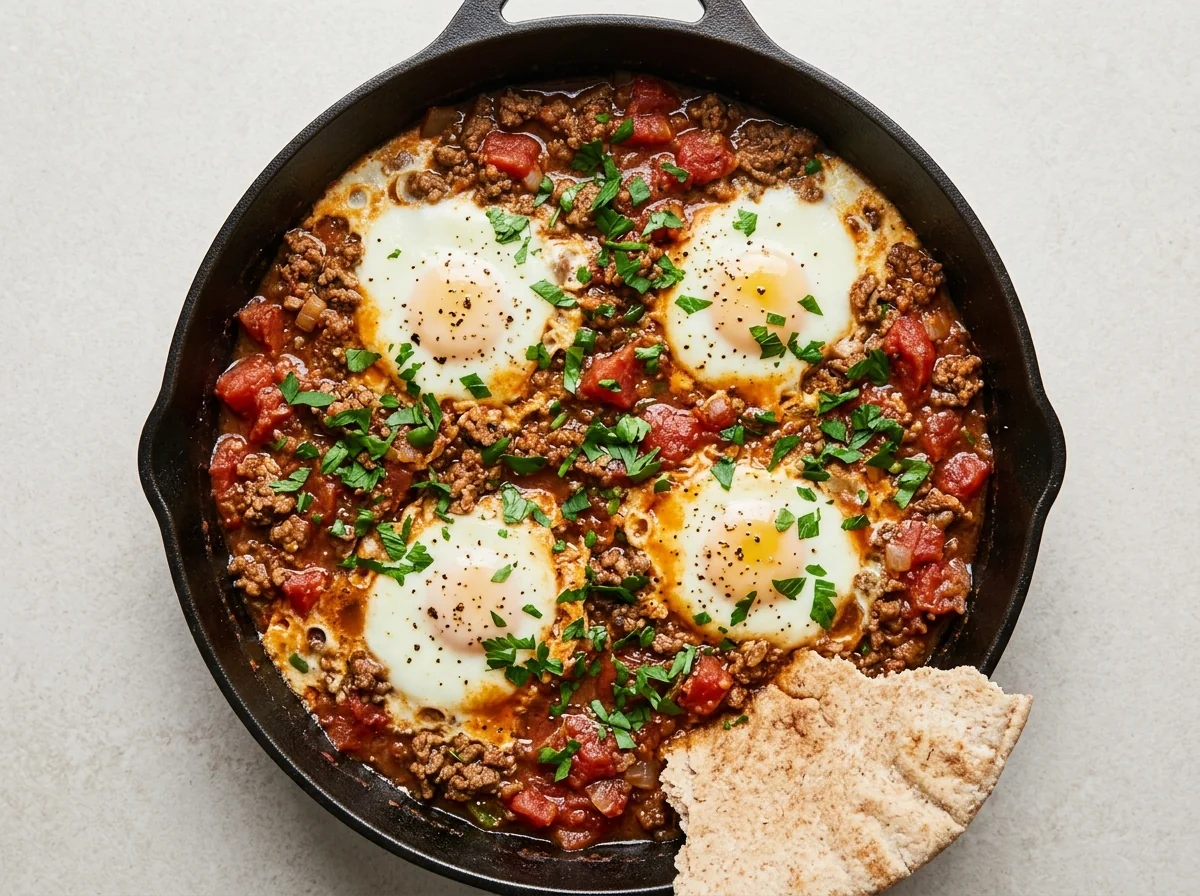
The filling dinner shakshuka: ground beef browned with onion, garlic, and cumin under a fresh tomato sauce, with eggs on top cooked covered to whatever doneness the family likes. One skillet, thirty-five minutes, and double the protein — turning the familiar breakfast shakshuka into a complete dinner.
The original in our library is the vegetarian egg-and-tomato shakshuka — a light breakfast with colored bell peppers and olive oil.
This is its dinner version from Sayidaty Kitchen: half a kilo of ground beef browned first, doubling the protein and turning the skillet into a complete family dinner, with the pepper here a single hot green pod for flavor rather than bell pepper filling the sauce. We made one declared change to the source: olive oil in place of the two spoons of butter, since the meat's own fat gives the dish richness enough.
Preparation Steps
Brown the ground beef
Heat the olive oil in a wide skillet over medium heat and add the ground beef, stirring and breaking it up with a spoon for 6 to 8 minutes until it turns fully brown and its liquid evaporates — well-browned meat is the foundation of this shakshuka's flavor.
Add the onion, garlic, and chili
Add the onion, garlic, and green chili to the meat and stir for 4 to 5 minutes on the same heat until the onion wilts and turns translucent and the garlic smells fragrant without burning.
Season the mixture
Sprinkle the salt, black pepper, and cumin over the mixture and stir for one minute until the spices coat the meat and the cumin releases its aroma — toasting spices in the fat wakes their flavor far more than adding them with the liquid.
Cook the tomatoes
Add the peeled chopped tomatoes and lower the heat, leaving the mixture for 5 to 7 minutes until the tomatoes release their water and the sauce thickens slightly into the meat. If it dries before it cooks, add a little warm water.
Add the eggs, covered
Open six wells in the mixture and crack an egg into each, then cover the skillet over low heat. For soft yolks, about 3 minutes; for fully set eggs, 6 to 8 minutes until white and yolk are firm. Firm whites are a non-negotiable condition.
Garnish and serve
Sprinkle with the chopped parsley and serve the shakshuka hot in its skillet with Arabic bread or oat bread — serving in the skillet keeps the eggs at their chosen doneness without cooking on in another dish.
Blood Sugar Impact
The glycemic index (GI) measures how quickly a food raises blood sugar, while the glycemic load (GL) measures how much a full serving raises it. Together they give the complete picture.
Glycemic Index
GI
10Low
Low0–55Medium56–69High70+
A low value (≤55) means a gradual rise in blood sugar — the most suitable range for diabetes and insulin resistance.
Glycemic Load
GL
1Low
Low0–10Medium11–19High20+
Glycemic load reflects the impact of the full serving. To lower it: take half a serving, or pair the recipe with a source of protein and fiber.
Nutritional Information
Per ServingMakes 4 servings · one serving is about 400 g of raw ingredients
Calories460 kcal23%of Daily Value*
Protein35 g70%of Daily Value*
Carbohydrates12 g4%of Daily Value*
Fat30 g38%of Daily Value*
Fiber3 g11%of Daily Value*
Sodium501 mg22%of Daily Value*
Potassium885 mg19%of Daily Value*
Phosphorus429 mg34%of Daily Value*
* Percent Daily Values are based on a 2,000-calorie diet per FDA food-label reference values — your daily needs may be higher or lower. Values are derived from the recipe's ingredients via the USDA database.
Troubleshooting
The most common problems when preparing Minced Meat Shakshuka, and how to fix them:
The meat came out pale, as if boiled
The tomatoes or onion went in before the browning finished, or the skillet was crowded and its surface cooled. Brown the meat alone over medium heat until its water fully dries and it colors, in a wide skillet that lets it touch the base.
The sauce is watery and the eggs sank into it
The tomatoes did not get their time before the eggs. Let them thicken until the sauce clings lightly to the spoon before opening the wells, and open each well with the back of a spoon so the white stays gathered in place.
The whites are still translucent and the base is starting to catch
The heat is stronger than the eggs need. Drop it to the lowest setting and seal the lid — the covered skillet's steam is what cooks the eggs' surface, not the base's heat, and two extra covered minutes are enough.
The dish came out hotter than the children can handle
Chili pods vary widely in fire. Remove the seeds and white veins before chopping — they are the heat's store — or swap it for half a green bell pepper, keeping the flavor and losing the heat.
Storage and Make-Ahead
Refrigerator (4°C)
Keep with the eggs in an airtight container for 2 days at most; the meat-and-tomato mixture alone keeps 3 days, with fresh eggs cracked over it when reheating.
Freezer (-18°C)
The meat-and-tomato mixture without eggs freezes for up to 2 months and thaws overnight in the refrigerator; cooked eggs do not freeze — their texture turns rubbery.
Reheating
Reheat the mixture in a covered skillet over low heat until it bubbles gently, and crack fresh eggs over it then — reheating cooked eggs dries them out.
Food safety
Cook the ground beef until its pink color is fully gone, and do not leave the dish at room temperature for more than 2 hours.
Tested Ingredient Substitutions
Original Ingredient
Tested Substitute
Ratio
Flavor Difference
Ground beef
Ground chicken
Same weight, 500 g
Lighter in fat and quicker to cook; brown it two minutes less so it does not dry.
Fresh tomatoes
Canned chopped tomatoes
A 400 g can in place of 600 g fresh
Faster and steadier in flavor outside tomato season; watch the can's sodium and reduce the salt.
Green chili pepper
Half a green bell pepper, chopped
75 g in place of 15 g
The fire goes and the pepper flavor stays — suits children's tables.
The six eggs
4 eggs only
One egg per serving
Slightly lowers the serving's calories and cholesterol; the meat keeps the protein high.
How Much Does It Make? Scaling Guide
Servings
Minced meat
Eggs
Tomatoes
Pan
2 servings (half recipe)
250 g
3 eggs
300 g
medium, 24 cm
4 servings (base)
500 g
6 eggs
600 g
wide, 28 cm
8 servings (double recipe)
1000 g
12 eggs
1200 g
in two batches, two pans
EEINA Nutrition Tip
This shakshuka's secret is in the order: the meat browns alone first until its water dries and it colors. If the tomatoes go in before the browning is complete, the meat boils instead of browning and the flavor comes out flat. And to hit each person's egg doneness, crack the firm-yolk eaters' eggs first, wait three minutes, then crack the rest.
Add This Recipe to Your Plan
The EEINA app saves your favorite recipes, calculates them from their real ingredients, and shows your daily numbers toward your goal. Try it free now.
How does it differ from the egg-and-tomato shakshuka in the EEINA library?
That one is a light vegetarian breakfast with colored bell peppers and paprika; this is a dinner with half a kilo of browned ground beef ahead of the tomatoes, doubling the protein and the satiety, with a single hot pod for flavor. It is the difference of a full meal, not a garnish.
Does it also work as breakfast or suhoor?
Yes — it is heavier than the usual breakfast shakshuka, so it makes a filling suhoor that holds hunger long, thanks to the meat and egg protein together, and half the quantity makes breakfast for two.
Is it safe for pregnant women?
Yes, on two conditions: the ground beef cooks until its pink color is completely gone, and the eggs stay covered until white and yolk are both set — full doneness is the safeguard against salmonella.
What bread to serve it with?
Arabic bread is the usual companion; oat or whole wheat bread is higher in fiber and gentler on blood sugar, and anyone cutting carbohydrates can eat it on its own — it satisfies with its meat and eggs.