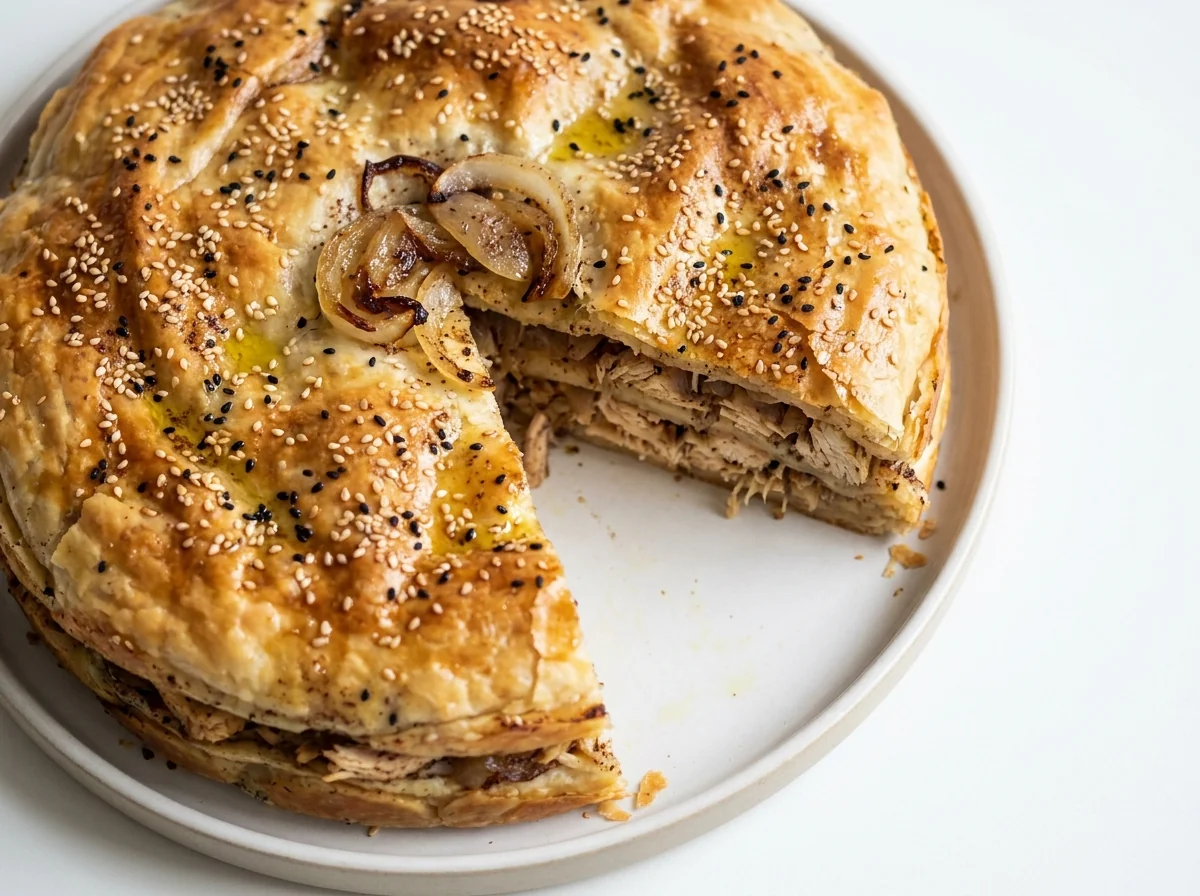
Makmoura comes from the tables of Jordanian and rural homes, and its name derives from 'kamr,' meaning to bury, for the chicken and onion are buried between layers of dough until they soak up the flavor of sumac.
It is made for family occasions and cut into triangles that feed those gathered around the dish, and in spirit it resembles musakhan, except that it is built from layers of homemade dough rather than on ready-made bread.
Preparation Steps
Kneading the dough
Mix the flour with the sesame, nigella seeds, anise, cumin, and salt, then add the olive oil and warm water gradually and knead until you get a soft, non-sticky dough, cover it, and let it rest for an hour.
Preparing the chicken
We will have boiled the chicken beforehand, removed its bones, and cut it into large pieces, keeping a little of its broth.
Sautéing the onion
Heat the olive oil in a wide skillet and sauté the onion until it wilts and turns translucent, then add the sumac, cardamom, salt, and black pepper and stir for a minute until fragrant.
Adding the chicken
Add the chicken pieces to the onion and sumac and toss gently until they are coated with the flavor, and sprinkle in a little broth so the filling stays moist.
Arranging the layers
Divide the dough into balls and roll them into thin sheets, lay a sheet in the bottom of an oiled tray and spread a layer of the chicken and onion filling over it, then repeat the layers and finish with an oiled sheet of dough.
Baking
Cover the tray with foil and bake it in an oven preheated to one hundred eighty degrees for about thirty minutes, then remove the cover and leave it for a few minutes until the top browns, cut it into triangles, and serve it hot.
Blood Sugar Impact
The glycemic index (GI) measures how quickly a food raises blood sugar, while the glycemic load (GL) measures how much a full serving raises it. Together they give the complete picture.
Glycemic Index
GI
67Medium
Low0–55Medium56–69High70+
A low value (≤55) means a gradual rise in blood sugar — the most suitable range for diabetes and insulin resistance.
Glycemic Load
GL
31High
Low0–10Medium11–19High20+
Glycemic load reflects the impact of the full serving. To lower it: take half a serving, or pair the recipe with a source of protein and fiber.
Nutritional Information
Per ServingMakes 6 servings · one serving is about 300 g of raw ingredients
Calories631 kcal32%of Daily Value*
Protein41 g82%of Daily Value*
Carbohydrates53 g19%of Daily Value*
Fat27 g35%of Daily Value*
Fiber6 g21%of Daily Value*
Sodium404 mg18%of Daily Value*
* Percent Daily Values are based on a 2,000-calorie diet per FDA food-label reference values — your daily needs may be higher or lower. Values are derived from the recipe's ingredients via the USDA database.
Troubleshooting
The most common problems when preparing Jordanian Makmoura (Layered Chicken and Sumac Pie), and how to fix them:
The dough stayed raw inside
Roll the layers thinner and lower the oven rack a little, and extend the covered baking until the dough is cooked before uncovering it.
The filling is dry
Sprinkle a little chicken broth between the layers and add more olive oil to the onion, since well-sautéed onion keeps the filling moist.
The sumac flavor is faint
Add the sumac in two batches, once with the onion and once sprinkled between the layers, and choose sumac that is fresh in color and deep red.
Storage and Make-Ahead
Refrigerator
Keep it in an airtight container for up to three days, and reheat it in the oven until its top turns crisp again.
Freezing
Freeze it baked and cut for up to a month, and reheat it directly in the oven without thawing so its layers do not go soft.
Tested Ingredient Substitutions
Original Ingredient
Tested Substitute
Ratio
Flavor Difference
boiled chicken
grilled chicken, cut up
same weight, 800 g
Grilled chicken adds a light smoky flavor to the filling
white flour
brown or whole wheat flour
same weight, 350 g
Brown flour raises the fiber and needs a little more water
olive oil
traditional ghee
same weight
Ghee is closer to the traditional flavor and adds richness
sumac
concentrated lemon juice
to the acidity
Lemon is an acceptable substitute, but it loses the color of sumac and its aromatic character
How Much Does It Make? Scaling Guide
Ingredient
1/2 quantity
Quantity (base)
Double
Flour
175 g
350 g
700 g
Boiled chicken
400 g
800 g
1600 g
Onion
150 g
300 g
600 g
Sumac
15 g
30 g
60 g
Olive oil (total)
37 ml
75 ml
150 ml
Salt (total)
4.5 g
9 g
18 g
EEINA Nutrition Tip
Do not skimp on the onion and sumac, for they are the soul of makmoura, and roll the dough thin so it cooks through well and stays tender between the layers rather than raw.
Add This Recipe to Your Plan
The EEINA app saves your favorite recipes, calculates them from their real ingredients, and shows your daily numbers toward your goal. Try it free now.
What is the difference between makmoura and musakhan?
Musakhan is served on ready-made taboon bread with the chicken, onion, and sumac on top, whereas makmoura is built from layers of homemade dough with the chicken and onion buried between them, then baked and cut into triangles.
Can ready-made bread be used instead of dough?
Yes, thin shrak or marqouq bread can be used instead of the dough sheets to save time, but homemade dough gives softer, more authentic layers.
How do we make the top of the makmoura crisp?
Uncover it at the end of baking, brush the top with a little oil, and leave it for a few minutes at a slightly higher heat until it browns.