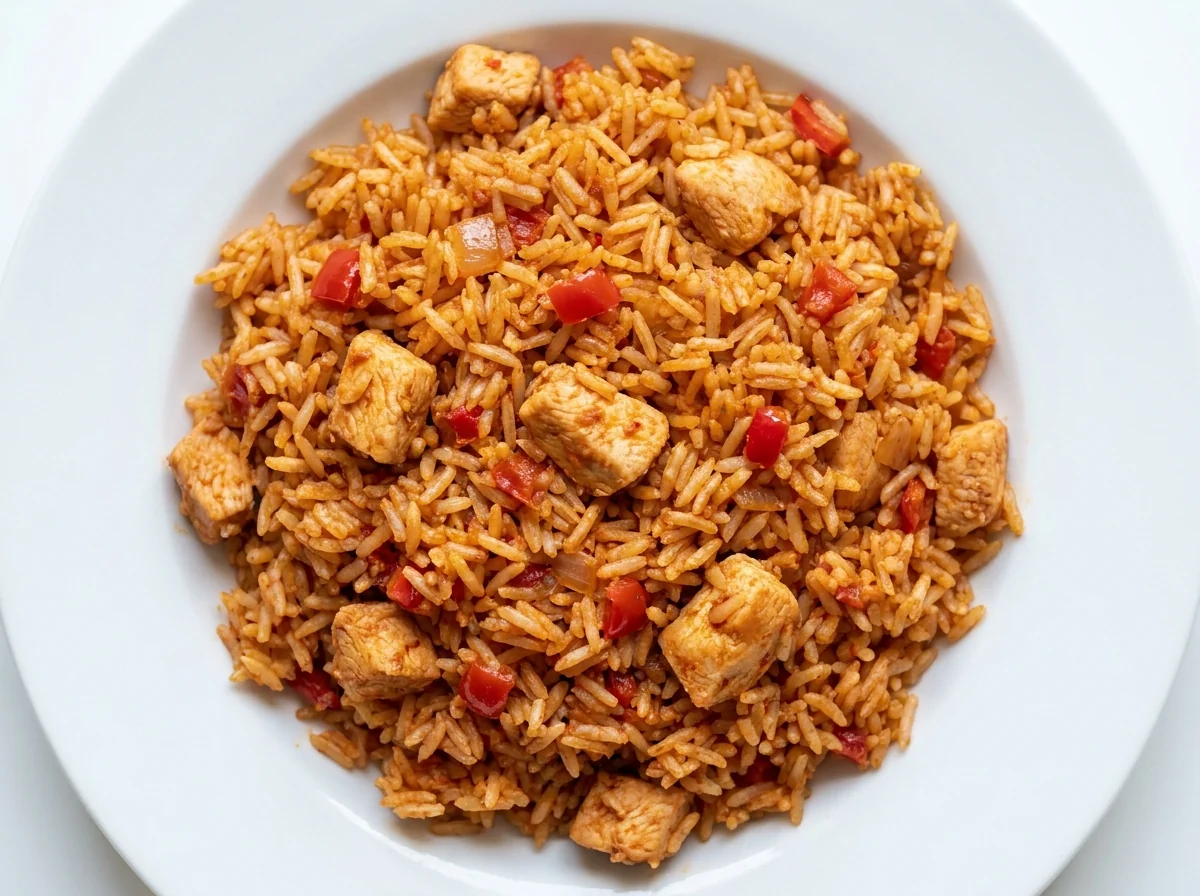
Jollof rice is one of West Africa's most famous dishes, and its origin is attributed to the Senegal region, then it spread across Nigeria, Ghana, and neighboring countries until it became the dish of occasions and feasts.
It is built on rice cooked in tomato, red pepper, and onion sauce in a single pot until the rice absorbs all the flavor and takes on its distinctive red color. The rivalry between the Nigerian and Ghanaian versions over the best jollof is well known among the region's people.
Preparation Steps
Season the chicken
Mix the chicken cubes with half the garlic and ginger, a pinch of salt, and black pepper, and leave them for ten minutes.
Prepare the base sauce
Blend the tomatoes, red bell pepper, hot pepper, and half the onion in a blender until you get a smooth mixture. This sauce is the base of jollof and gives it its red color.
Brown the chicken
In a heavy-bottomed pot, heat half the oil and brown the chicken cubes until golden, three to four minutes, then set them aside.
Sauté the onion and tomato paste
Add the rest of the oil and the remaining chopped onion, garlic, and ginger, and stir them for two minutes, then add the tomato paste and stir it for two minutes until it darkens and its acidity fades.
Cook the sauce until it thickens
Pour in the blended tomato mixture and add the thyme, curry, and bay leaves, and cook over medium heat for ten minutes, stirring, until it darkens and thickens and the oil rises to the surface. This thickening is the secret of jollof's flavor.
Add the rice and stock
Wash the rice well until the water runs clear, then add it to the sauce and stir it until it is coated in the red color, return the chicken, then pour in the stock and adjust the salt.
Cook it over low heat
Cover the pot tightly and lower the heat to its lowest, and leave it for twenty to twenty-five minutes until the rice absorbs all the liquid and cooks. Do not lift the lid often so the steam does not escape.
Fluff and serve
Take it off the heat and remove the bay leaves, fluff it gently with a fork until the grains separate, leave it covered for five minutes, then serve it hot.
Blood Sugar Impact
The glycemic index (GI) measures how quickly a food raises blood sugar, while the glycemic load (GL) measures how much a full serving raises it. Together they give the complete picture.
Glycemic Index
GI
60Medium
Low0–55Medium56–69High70+
A low value (≤55) means a gradual rise in blood sugar — the most suitable range for diabetes and insulin resistance.
Glycemic Load
GL
44High
Low0–10Medium11–19High20+
Glycemic load reflects the impact of the full serving. To lower it: take half a serving, or pair the recipe with a source of protein and fiber.
Nutritional Information
Per ServingMakes 4 servings · one serving is about 530 g of raw ingredients
Calories621 kcal31%of Daily Value*
Protein36 g72%of Daily Value*
Carbohydrates78 g28%of Daily Value*
Fat18 g23%of Daily Value*
Fiber4 g14%of Daily Value*
Sodium608 mg26%of Daily Value*
* Percent Daily Values are based on a 2,000-calorie diet per FDA food-label reference values — your daily needs may be higher or lower. Values are derived from the recipe's ingredients via the USDA database.
Troubleshooting
The most common problems when preparing West African Jollof Rice with Chicken, and how to fix them:
The rice cooked on the outside and stayed raw inside
The heat was high so the liquid dried before the grain cooked. Cook it over the lowest heat with a tight lid, and if needed sprinkle a little hot water and re-cover.
The rice came out sticky and clumped
It was not washed well or there was too much liquid. Wash the rice until the water runs clear, and stick to the stated amount of stock.
The color is pale and not red
The tomato paste was not sautéed enough or the sauce did not thicken. Sauté the paste until it darkens, and let the sauce cook until the oil rises.
The dish is too spicy
Scotch bonnet pepper is strongly hot. Reduce its amount or remove its seeds, or replace it with sweet red bell pepper.
Storage and Make-Ahead
Immediately
Served hot, and a side of green salad or fried plantain suits it.
In the refrigerator
Keeps for three days in an airtight container, and is reheated with a sprinkle of water until it softens.
Freezing
Freezes for up to a month in an airtight container, and is thawed in the refrigerator before reheating.
Tested Ingredient Substitutions
Original Ingredient
Tested Substitute
Ratio
Flavor Difference
Chicken
Meat or boiled chickpeas
~
Protein alternatives for the meat or vegetarian version
Basmati rice
Long-grain parboiled rice
1:1
It is the traditional rice most used in jollof
Scotch bonnet pepper
Red bell pepper
~
A close flavor without the heat for anyone who does not like it spicy
Chicken stock
Water with a low-salt stock cube
1:1
A simpler alternative with salt adjustment
How Much Does It Make? Scaling Guide
Ingredient
4 servings
2 servings
8 servings
Rice
300 g
150 g
600 g
Chicken
500 g
250 g
1 kg
Stock
500 ml
250 ml
1 L
EEINA Nutrition Tip
Cooking tomatoes in oil increases the availability of lycopene, an antioxidant tomatoes are known for since it dissolves in fats. Make sure the chicken is fully cooked to an internal temperature of 74 degrees Celsius per food safety guidelines.
Add This Recipe to Your Plan
The EEINA app saves your favorite recipes, calculates them from their real ingredients, and shows your daily numbers toward your goal. Try it free now.
Long-grain rice is best, and many West Africans use parboiled rice because it withstands cooking in the sauce without clumping, and basmati is an excellent substitute.
What is the difference between Nigerian and Ghanaian jollof?
Both are built on rice in tomato and pepper sauce. The Nigerian tends toward a deeper smoky flavor and long-grain rice, while the Ghanaian often uses basmati rice and a touch of aromatic spices, and the dispute between them is amusing and famous.
Why is it cooked over very low heat?
So the rice absorbs the liquid slowly and cooks evenly without burning the bottom, which is what gives it its cohesive texture and red color.
How is it made into a complete meal?
It is served with a green salad, extra chicken pieces, or fried plantain as in its homeland.