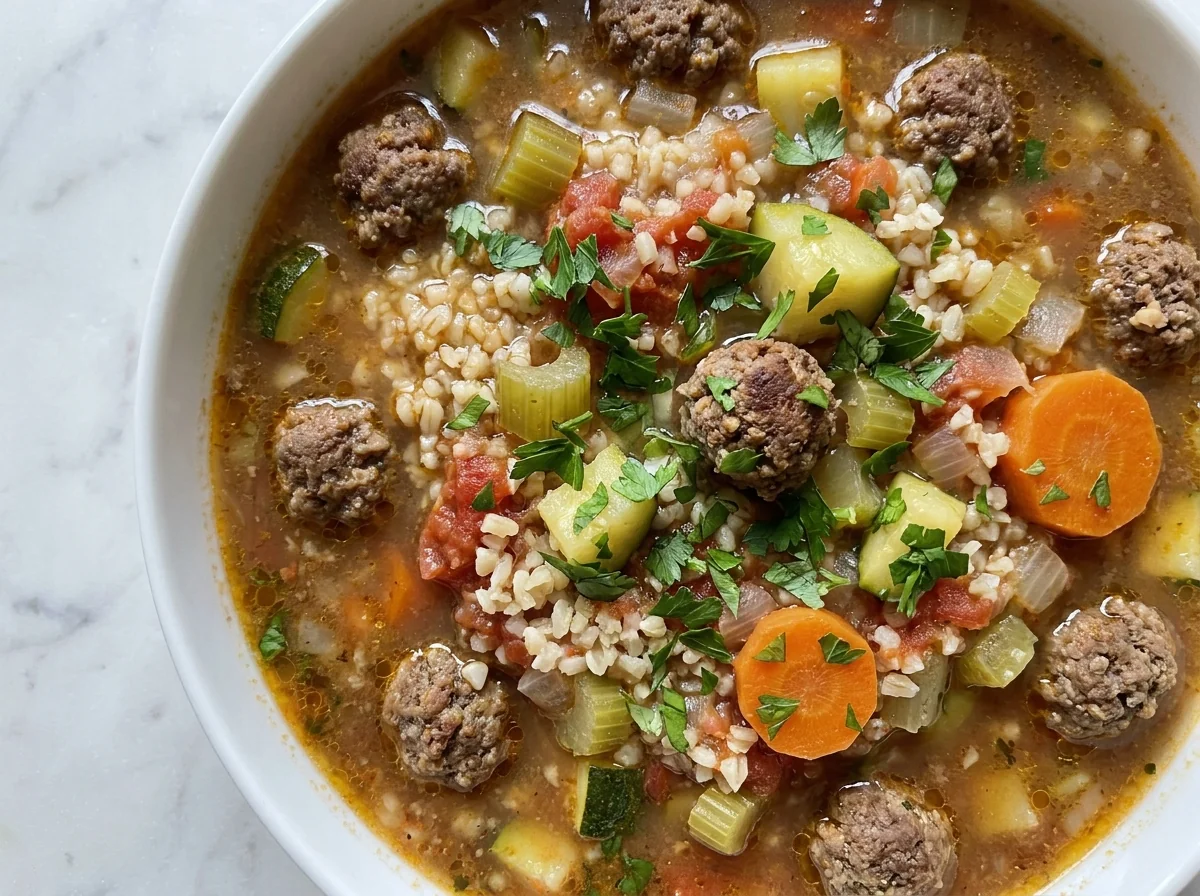
A warm grain soup that brings together coarse bulgur with meatballs and vegetables in chicken broth, present on the tables of the Levant and the Gulf whenever a filling dish is craved on a cold night.
Its presence fills a gap in our library, which knew barley, freekeh, and jareesh but not bulgur.
Preparation Steps
Season the meat
Mix the ground meat with the parsley, dried mint, salt, and black pepper and knead it well until it holds together, then shape small balls the size of a walnut, as distributing the herbs inside the mixture gives each ball an even flavor when cooked.
Brown the balls
Melt half the amount of butter in a pan over medium heat, add the balls, and turn them until they brown on all sides, then set them aside; the initial browning fixes their shape so they do not fall apart in the broth.
Sauté the vegetables
In a wide pot, melt the rest of the butter and sauté the onion until it wilts and turns translucent, then add the garlic for a minute, as starting with the onion builds a gentle flavor base before the rest of the vegetables.
Add the roots
Add the carrot and celery and stir for two minutes, then add the zucchini, grated tomatoes, and soaked bulgur and stir until the grains are coated in the fat, which distributes the flavor and prevents the bulgur from clumping.
Boil and cook
Pour in the chicken broth and season with the salt and pepper, and bring it to a boil, then cover the pot, lower the heat, and cook for 20 minutes until the bulgur and vegetables soften.
Add the balls
Add the meatballs to the soup and cook for 10 additional minutes over low heat until they are fully done and their internal temperature reaches 71 degrees Celsius per FSIS, which is the safety threshold for ground meat.
Blood Sugar Impact
The glycemic index (GI) measures how quickly a food raises blood sugar, while the glycemic load (GL) measures how much a full serving raises it. Together they give the complete picture.
Glycemic Index
GI
29Low
Low0–55Medium56–69High70+
A low value (≤55) means a gradual rise in blood sugar — the most suitable range for diabetes and insulin resistance.
Glycemic Load
GL
9Low
Low0–10Medium11–19High20+
Glycemic load reflects the impact of the full serving. To lower it: take half a serving, or pair the recipe with a source of protein and fiber.
Nutritional Information
Per ServingMakes 5 servings · one serving is about 485 g of raw ingredients
Calories369 kcal18%of Daily Value*
Protein20 g40%of Daily Value*
Carbohydrates39 g14%of Daily Value*
Fat15 g19%of Daily Value*
Fiber8 g29%of Daily Value*
Sodium1015 mg44%of Daily Value*
Potassium934 mg20%of Daily Value*
Phosphorus289 mg23%of Daily Value*
* Percent Daily Values are based on a 2,000-calorie diet per FDA food-label reference values — your daily needs may be higher or lower. Values are derived from the recipe's ingredients via the USDA database.
Troubleshooting
The most common problems when preparing Bulgur and Meatball Soup, and how to fix them:
The meatballs fell apart in the broth
Make sure to brown them well before adding them, and add them only in the last 10 minutes, not at the start of cooking.
The bulgur is still tough
Extend the covered cooking by five additional minutes and add a little hot broth if the soup dries out.
Storage and Make-Ahead
Refrigerator
Keep it in an airtight container for up to three days, and its texture thickens so we thin it with hot broth when reheating.
Freezer
Freeze it for up to a month, and it is better to freeze it without the bulgur because it may soften more than needed after thawing.
Tested Ingredient Substitutions
Original Ingredient
Tested Substitute
Ratio
Flavor Difference
coarse white bulgur
cracked freekeh
140 g
A grain of close texture that gives a similar soup for those who cannot find bulgur
ground beef
ground lamb
250 g
A halal substitute that gives a deeper flavor to the balls
chicken broth
vegetable broth
1080 ml
A vegetarian option that keeps the soup light
butter
olive oil
28 g
A plant-based, dairy-free substitute
How Much Does It Make? Scaling Guide
Ingredient
2 servings
4 servings (base)
8 servings
Ground beef
100 g
200 g
400 g
Coarse white bulgur
56 g
112 g
224 g
Chicken broth
432 ml
864 ml
1728 ml
Zucchini
120 g
240 g
480 g
EEINA Nutrition Tip
We soak the coarse bulgur for a full hour before cooking, which shortens its cooking time and gives it a tender, intact texture rather than a mushy one.
Add This Recipe to Your Plan
The EEINA app saves your favorite recipes, calculates them from their real ingredients, and shows your daily numbers toward your goal. Try it free now.
We prefer coarse because it keeps its grain in the soup, whereas fine crumbles and thickens the broth more than needed.
How do I know the meatballs are done?
They become dense in texture and their color changes completely, and the most reliable way is to measure their internal temperature to 71 degrees Celsius.