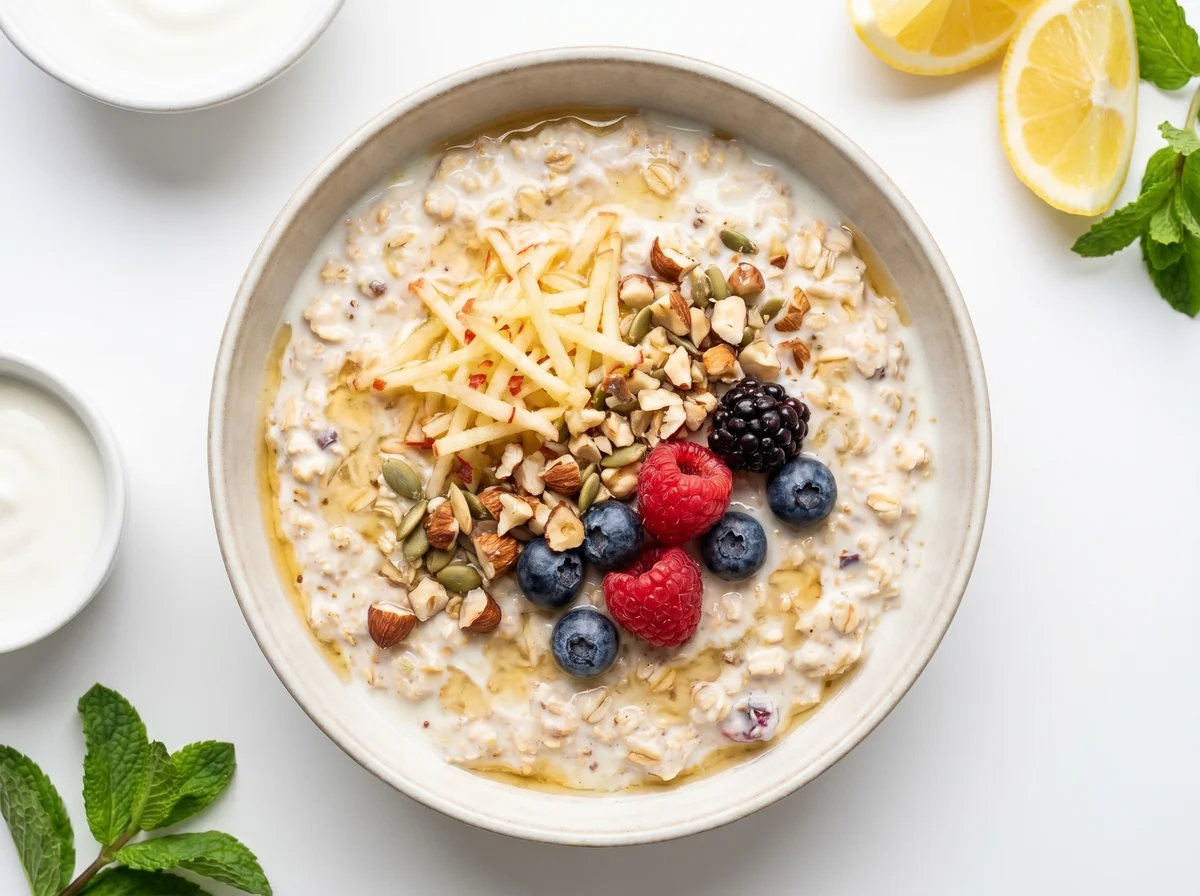
In the early twentieth century, Swiss physician Maximilian Bircher-Benner invented this dish at his clinic near Zurich, wanting a light raw breakfast to serve his patients instead of heavy meals. The idea is simple and clever: no fire, no cooking — just a long cold soak that does everything.
The oats drink in the milk and yogurt and soften into a creamy mixture; the grated apple dissolves into it giving natural sweetness and moisture; and the almonds add crunch with every spoonful. What sets Bircher apart from the popular overnight oats is not the soaking alone but the apple grated with its skin, which dissolves into the texture giving it its authentic Swiss character. Prepare it at night before bed and find it ready in the morning — a calm breakfast perfect for busy work mornings.
Preparation Steps
Soak the oats
Combine the oats with the milk and yogurt in a glass bowl until the flakes are completely covered and the surface is even — cold soaking is what breaks down the firmness of the oats without cooking and gives them their creamy texture.
Grate the apple and preserve its color
Grate the apple with its skin directly over the mixture, then squeeze the lemon over it and stir until the grated apple glistens — the lemon's acidity slows the oxidation of the apple and keeps it light-colored instead of browning.
Add and season
Add the cinnamon, a light pinch of salt, and honey if desired, and stir until evenly distributed — a pinch of salt balances the sweetness and brings out the flavors of both the apple and cinnamon.
Refrigerate overnight
Cover the bowl and place it in the refrigerator at below 5°C for at least 8 hours until the oats are soft and the consistency is thick and cohesive — the long cold time is the secret to the Bircher's maturity.
Serve
In the morning, stir the mixture and divide it into two bowls, then scatter the chopped almonds on top so they stay crunchy — adding the nuts at serving time rather than before preserves their crunch instead of letting them soften from soaking.
Blood Sugar Impact
The glycemic index (GI) measures how quickly a food raises blood sugar, while the glycemic load (GL) measures how much a full serving raises it. Together they give the complete picture.
Glycemic Index
GI
53Low
Low0–55Medium56–69High70+
A low value (≤55) means a gradual rise in blood sugar — the most suitable range for diabetes and insulin resistance.
Glycemic Load
GL
21High
Low0–10Medium11–19High20+
Glycemic load reflects the impact of the full serving. To lower it: take half a serving, or pair the recipe with a source of protein and fiber.
Nutritional Information
Per ServingMakes 2 servings · one serving is about 255 g of raw ingredients
Calories318 kcal16%of Daily Value*
Protein13 g26%of Daily Value*
Carbohydrates43 g16%of Daily Value*
Fat11 g14%of Daily Value*
Fiber4 g14%of Daily Value*
Sodium264 mg11%of Daily Value*
* Percent Daily Values are based on a 2,000-calorie diet per FDA food-label reference values — your daily needs may be higher or lower. Values are derived from the recipe's ingredients via the USDA database.
Troubleshooting
The most common problems when preparing Bircher Muesli with Apple and Nuts, and how to fix them:
Consistency is too dry in the morning
The oats absorbed all the liquid. Add 2 to 3 tablespoons of cold milk and stir until softened. Increase the liquid ratio slightly next time.
Consistency is runny and has not set
Liquid ratio is high or soaking time was too short. Return to the refrigerator for an extra hour or two, or add a tablespoon of dry oats and stir.
Apple turned brown
Lemon did not reach it quickly enough. Grate the apple directly over the mixture and squeeze the lemon immediately before it is exposed to air.
Too sour a taste
Greek yogurt is very sharp in acidity. Dilute it by adding a little more milk, or replace half of it with milk, or add a pinch of honey to balance it.
Almonds lost their crunch
They were added before soaking and softened from the moisture. Scatter the almonds at serving time in the morning only, not before.
Storage and Make-Ahead
Refrigerator (prepared)
Keeps in an airtight container at below 5°C for up to 2 to 3 days maximum — its shelf life is limited by the shortest-lived ingredient, which is the opened milk and yogurt.
Meal prep
Prepare a batch for the next two days in two separate airtight containers, and add fresh almonds each morning to preserve the crunch.
Freezing
Not recommended — freezing separates the yogurt liquids and makes the texture grainy and watery after thawing.
Tested Ingredient Substitutions
Original Ingredient
Tested Substitute
Ratio
Flavor Difference
Low-fat milk
Unsweetened almond or oat milk
1:1
A plant-based alternative for those avoiding lactose — lowers protein content so add a tablespoon of chia seeds for texture.
Greek yogurt
Plain plant-based yogurt (coconut or soy)
1:1
Keeps the creamy texture while reducing lactose — watch for the soy allergen.
Almonds
Sunflower or pumpkin seeds
1:1
A tree-nut-free alternative for those with tree nut allergies, with a similar crunch.
Grated apple
Grated pear
1:1
A seasonal alternative with a softer sweetness — keep the skin for extra fiber.
Honey
Finely chopped date or omit entirely
1 teaspoon per date
Natural sweetening with fiber, or omit to rely on the apple's sweetness.
How Much Does It Make? Scaling Guide
Ingredient
2 servings
4 servings
6 servings
Oats (g)
80
160
240
Milk (ml)
120
240
360
Yogurt (g)
120
240
360
Apple (medium)
1
2
3
Almonds (g)
20
40
60
EEINA Nutrition Tip
Choose whole rolled oats (old-fashioned) not quick oats — whole flakes raise blood sugar more slowly and are richer in beta-glucan. If you want to reduce sugars, skip the honey entirely and let the apple's sweetness be enough — the apple alone gives the dish a gentle sweetness without any addition.
Add This Recipe to Your Plan
The EEINA app saves your favorite recipes, calculates them from their real ingredients, and shows your daily numbers toward your goal. Try it free now.
What is the difference between Bircher muesli and overnight oats?
Both are cold-soaked oats, but Bircher is distinguished by the apple grated with its skin, which dissolves into the texture giving it natural sweetness and moisture, plus the yogurt which gives it an authentic Swiss creaminess. Overnight oats is a newer more flexible format with more varied add-ins.
Can it be prepared without a full night's refrigeration?
Soaking needs at least 8 hours for the oats to soften and the consistency to set. To speed it up use thinner flakes and reduce to 2 hours as a minimum, but the consistency will not be as creamy.
Is it suitable for diabetics?
Whole oats raise blood sugar slowly thanks to beta-glucan, and the recipe has no added sugar, making it a reasonable choice within a balanced plan. However, consult your doctor or dietitian to determine the appropriate portion for your condition.
Is it suitable for children?
Yes, after the age of one year, but chop the almonds very finely or replace them with smooth almond butter to avoid choking hazard for small children.
Can I prepare a batch for the whole week?
Not recommended — milk and yogurt limit the shelf life to 2 to 3 days in the refrigerator. Prepare a batch for 2 days maximum and add fresh almonds each morning.