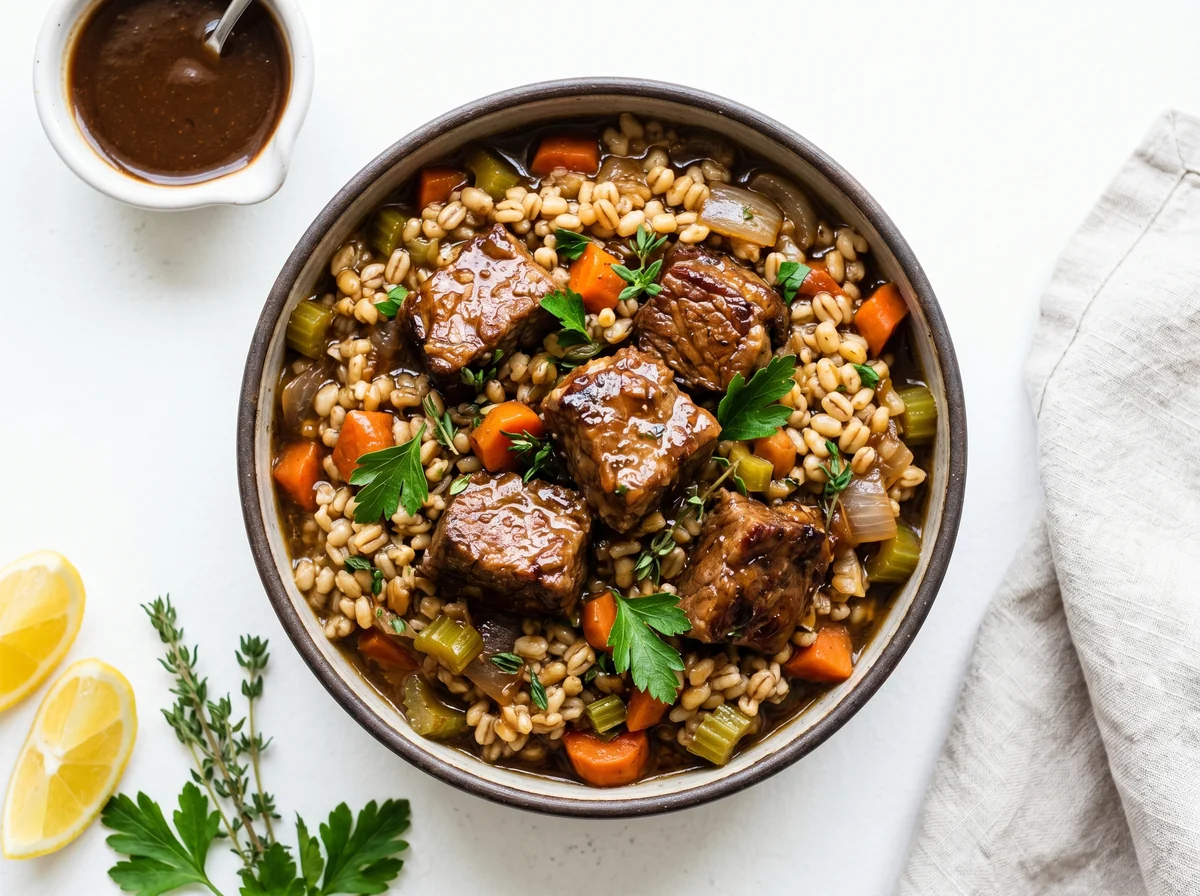
A nourishing bowl of roasted beef cubes over whole barley with roasted carrots and onion, finished with a tahini lemon sauce. A balanced Gulf-Mediterranean bowl rich in fiber and protein, supporting blood sugar and satiety.
The grain bowl is a modern expression of an ancient truth: that whole grains, slow-roasted meat, and vegetables form the foundation of a nourishing meal. Barley has been cultivated in the Arabian Peninsula for thousands of years, long before rice became the dominant grain.
In this bowl we return to barley — whole-grain, fiber-rich, and humble — pairing it with spiced roasted beef and sweet caramelized vegetables. The tahini lemon sauce draws from the Levantine tradition, bridging Gulf and Mediterranean into a bowl that is both deeply satisfying and nutritionally sound.
Preparation Steps
Cook the barley
Rinse the whole-grain barley under cold water, then bring to a boil with the water or broth in a medium pot. Reduce the heat to low, partially cover, and cook for 45 to 55 minutes until the barley is tender but still has a slight chew. Drain any excess liquid and set aside. Whole barley takes longer than pearl barley — soaking overnight reduces the cooking time significantly.
Season the beef and vegetables
Preheat the oven to 220°C. Toss the beef cubes with 1.5 tablespoons olive oil, cumin, coriander, turmeric, pepper, and salt until evenly coated. Separately toss the carrots and onion wedges with the remaining olive oil and a pinch of salt. Season generously — the spices give the beef its warm flavor that pairs with the earthiness of the barley.
Roast the beef
Spread the seasoned beef cubes in a single layer on one side of a large baking sheet (or a separate sheet). Roast in the preheated oven for 20 to 25 minutes, turning once halfway through, until the beef is browned on the outside and cooked through to an internal temperature of at least 71°C. A single layer is essential — crowded beef will steam rather than roast.
Roast the vegetables
Place the carrots and onion on the other side of the baking sheet (or a second sheet). Roast alongside the beef for 25 to 30 minutes until caramelized and tender at the edges. The vegetables can go into the oven at the same time as the beef. Roasting the onion in wedges caramelizes the natural sugars and gives sweet depth to the bowl.
Make the tahini sauce
Whisk together the tahini, lemon juice, minced garlic, and a pinch of salt. Add cold water one tablespoon at a time, whisking until the sauce is smooth, creamy, and pourable (the sauce will first seize and thicken — keep adding water and whisking). Taste and adjust the lemon and salt. The tahini sauce ties all the components together and adds a rich, nutty, tangy finish.
Assemble the bowls
Divide the cooked barley between four bowls. Arrange the roasted beef cubes and roasted vegetables over the barley. Drizzle generously with the tahini sauce. Garnish with fresh parsley, pomegranate seeds if using, and a lemon wedge. The pomegranate adds color, tart sweetness, and antioxidants — a beautiful and nutritious garnish for this Gulf-Mediterranean bowl.
Serve
Serve the bowls warm. Each bowl brings together whole barley (the fiber and blood-sugar foundation), roasted beef (the protein anchor), caramelized vegetables, and tahini lemon sauce — a complete, balanced meal that is satisfying, nourishing, and deeply flavored.
Blood Sugar Impact
The glycemic index (GI) measures how quickly a food raises blood sugar, while the glycemic load (GL) measures how much a full serving raises it. Together they give the complete picture.
Glycemic Index
GI
25Low
Low0–55Medium56–69High70+
A low value (≤55) means a gradual rise in blood sugar — the most suitable range for diabetes and insulin resistance.
Glycemic Load
GL
10Low
Low0–10Medium11–19High20+
Glycemic load reflects the impact of the full serving. To lower it: take half a serving, or pair the recipe with a source of protein and fiber.
Nutritional Information
Per ServingMakes 4 servings · one serving is about 495 g of raw ingredients
Calories640 kcal32%of Daily Value*
Protein32 g64%of Daily Value*
Carbohydrates54 g20%of Daily Value*
Fat33 g42%of Daily Value*
Fiber13 g46%of Daily Value*
Sodium883 mg38%of Daily Value*
Potassium1093 mg23%of Daily Value*
Phosphorus551 mg44%of Daily Value*
* Percent Daily Values are based on a 2,000-calorie diet per FDA food-label reference values — your daily needs may be higher or lower. Values are derived from the recipe's ingredients via the USDA database.
Troubleshooting
The most common problems when preparing Beef Barley Roasted Vegetable Bowl, and how to fix them:
Barley is still tough after 55 minutes
Whole-grain barley can take 60 to 75 minutes depending on the variety and whether it was soaked. Add more broth or water and continue cooking, partially covered, until tender. Soaking overnight reduces cooking time to around 30 to 40 minutes and is highly recommended.
Beef cubes are tough and dry
Overcooked, or the cubes were too small and dried out. Use 3 cm cubes, roast at high heat (220°C) for 20 to 25 minutes maximum, and use a meat thermometer to check doneness (71°C internal). Remove promptly from the oven — residual heat continues cooking.
Vegetables are not caramelizing — pale and soft
The pieces are too large, the oven is not hot enough, or they are overcrowded. Cut carrots into similar-sized chunks, roast at 220°C, and spread in a single layer with space between pieces. Crowded vegetables steam rather than roast.
Tahini sauce is gluey and thick
This is normal when first mixing — tahini seizes on contact with lemon juice and water. Keep whisking and add cold water one tablespoon at a time until the sauce loosens into a smooth, pourable consistency. Room-temperature tahini (not cold from the fridge) produces a smoother sauce.
Bowl feels dry
Not enough tahini sauce. The sauce should be drizzled generously — it is the moisture element that brings the bowl together. Make a double batch of the sauce and drizzle liberally, then add the lemon wedge for extra brightness.
Storage and Make-Ahead
Refrigerator (4°C)
Store each component separately: barley, beef, vegetables, and tahini sauce each in their own sealed container. This way components can be reheated or assembled fresh without the barley absorbing the sauce or the vegetables going soggy. Keeps for three days.
Freezer (-18°C)
Barley and roasted beef freeze well for up to two months. Roasted vegetables lose texture after freezing but are acceptable. The tahini sauce should be made fresh — it separates on freezing. Thaw overnight in the refrigerator.
Meal prep
Cook a large batch of whole barley at the start of the week (it keeps four days in the fridge). Roast beef and vegetables in one oven session. Store components separately and assemble bowls throughout the week — each takes 5 minutes to assemble.
Tested Ingredient Substitutions
Original Ingredient
Tested Substitute
Ratio
Flavor Difference
Whole-grain barley
Pearl barley or farro
Same amount
Pearl barley cooks faster (30 minutes, no soaking) with a softer texture; farro has a similar nutty chew. Pearl barley has slightly less fiber than whole grain — the beta-glucan benefit is preserved but reduced.
Beef
Lamb shoulder cubes or roasted chickpeas
Same weight for lamb; 400 g drained chickpeas for plant-based
Lamb has a similar spiced roasting quality; roasted chickpeas give a plant-based version rich in fiber and plant protein. Both pair beautifully with barley and tahini.
Yogurt sauce is creamy and tangy without sesame — important for sesame allergy. Hummus gives a thicker, nutty sauce. Both tie the bowl together in a similar way. Note: switching to yogurt removes the sesame allergen.
Carrots
Butternut squash or sweet potato cubes
Same weight
Butternut squash is similar in sweetness and roasting behavior; sweet potato adds more beta-carotene. Both caramelize beautifully at high heat alongside the beef.
Pomegranate seeds
Dried cranberries or fresh herbs only
2 tablespoons
Pomegranate is the traditional garnish for Gulf-Levantine bowls. Dried cranberries give a similar tart sweetness out of season. Both are optional — the bowl is complete without them.
How Much Does It Make? Scaling Guide
Ingredient
4 servings
8 servings
12 servings
Lean beef
500 g
1 kg
1.5 kg
Whole barley
200 g
400 g
600 g
Light broth
600 ml
1.2 L
1.8 L
Carrots
300 g
600 g
900 g
Tahini
45 g
90 g
135 g
EEINA Nutrition Tip
Whole barley is one of the most powerful grains for blood sugar and heart health because of its beta-glucan content — a soluble fiber that forms a viscous gel in the intestine, slowing glucose absorption and binding bile acids. The higher the beta-glucan, the gentler the post-meal blood sugar rise. Pair the barley with protein (beef) and healthy fat (tahini) for a complete blood-sugar-friendly meal. Note: whole barley takes longer to cook than pearl barley — soaking it overnight reduces cooking time and improves digestibility.
Add This Recipe to Your Plan
The EEINA app saves your favorite recipes, calculates them from their real ingredients, and shows your daily numbers toward your goal. Try it free now.
What is the difference between whole barley and pearl barley?
Whole barley has only the inedible outer hull removed, keeping the bran and germ intact — it is richer in fiber, especially beta-glucan, and has a nuttier, chewier texture. Pearl barley has had the bran polished off, making it faster-cooking and softer but with less fiber. For blood sugar and heart benefits, whole barley is the better choice — the beta-glucan content is significantly higher.
Why is barley beneficial for blood sugar?
Barley is rich in beta-glucan — a soluble fiber that forms a viscous gel in the small intestine. This gel slows the absorption of glucose into the bloodstream, resulting in a gentler, more gradual blood sugar rise after eating. The European Food Safety Authority (EFSA) approved a health claim that barley beta-glucan reduces post-meal blood glucose rise. This makes whole barley one of the most evidence-based grain choices for people with diabetes or insulin resistance.
Can this bowl be made gluten-free?
Barley contains gluten and cannot be made gluten-free. For a gluten-free grain bowl with similar nutritional properties, substitute the barley with cooked sorghum or brown rice with added psyllium husk (to mimic beta-glucan's fiber effect). The tahini sauce is naturally gluten-free.
Is the tahini sauce sesame-free?
No — tahini is made entirely from ground sesame seeds and is one of the most concentrated sesame sources. Anyone with a sesame allergy must substitute the tahini. A suitable alternative is a garlic-lemon yogurt sauce (labneh (strained yogurt) + lemon juice + garlic + a drizzle of olive oil) which gives a similar creamy, tangy finish without sesame.
Why are the nutrition values listed as zero?
The nutrition values for this recipe are pending verification against USDA FoodData Central and SFDA databases. The values shown (0) are placeholders and should not be used for dietary tracking. This recipe will be updated with verified values in a future version.
Sources: USDA · University of Sydney · Gulf GSO · Our methodology · Updated on