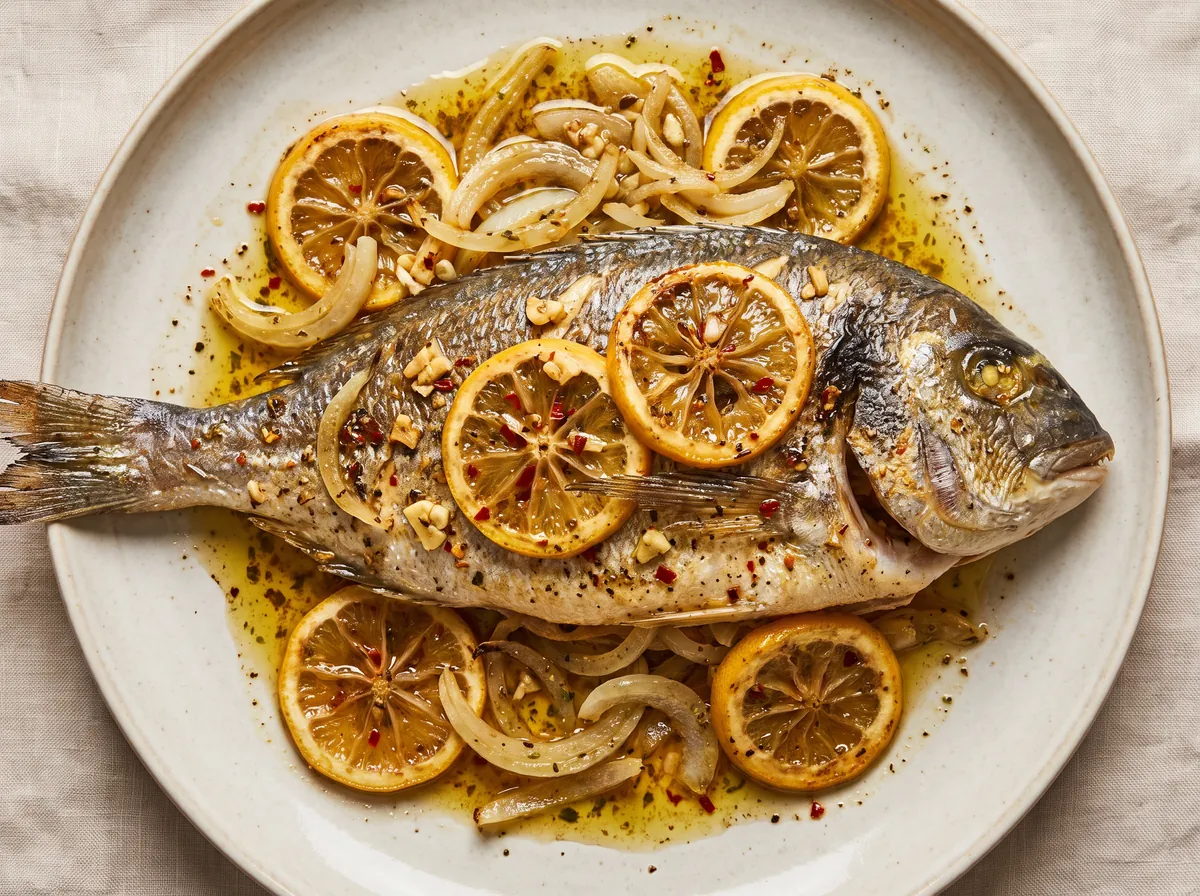
Whole sea bream roasted in the oven with a lemon, garlic, and cumin marinade, thin lemon slices tucked into slits along the back so their warmth seeps into the flesh. A method that keeps the fish tender with no frying, and with the salt deliberately reduced from the original recipe.
Oven-roasted fish with lemon slices tucked into scored slits is a familiar method on Arab coastal tables, and this version comes from Atyab Tabkha.
We made two declared adjustments to the original: we lowered the salt from two teaspoons (about 12 g) to 3 g for the whole tray, relying on the lemon and cumin for flavor, and we reduced the olive oil from half a cup to four tablespoons — keeping the original's core idea: a short covered bake, then uncovered at a gentler heat until browned.
Preparation Steps
Preheat the oven and prepare the fish
Preheat the oven to 200°C. Wash the cleaned fish inside and out with cold water, drain well, then pat dry with paper towels — dry fish absorbs the marinade instead of steaming in its own water.
Score the back and tuck in the lemon
With a sharp knife, cut parallel diagonal slits along the back of each fish about half a centimeter deep, three slits per side. Tuck a thin lemon slice into each slit so its edge sticks out — these slits carry the marinade into the flesh and speed up even cooking.
Mix the marinade
In a deep bowl, mix the lemon juice, olive oil, crushed garlic, onion slices, cumin, red chili, black pepper, and salt, and stir until it comes together into a fragrant liquid marinade.
Season the fish inside and out
Rub each fish thoroughly with the marinade on the outside, inside the cavity, and into the slits. Spread the remaining onion slices over the baking tray, arrange the fish on top, then pour the rest of the marinade over them.
Bake covered, then uncovered
Cover the tray with foil and bake for 10 minutes at 200°C so steam builds inside and the fish begins cooking gently. Then remove the foil, lower the heat to 170°C, and continue baking for about 45 minutes until the top browns and the flesh flakes easily at the thickest point near the head.
Serve
Take out the tray and let the fish rest for 5 minutes so its juices settle, then serve hot with the pan juices and the roasted lemon slices alongside rice or a green salad.
Blood Sugar Impact
The glycemic index (GI) measures how quickly a food raises blood sugar, while the glycemic load (GL) measures how much a full serving raises it. Together they give the complete picture.
Glycemic Index
GI
14Low
Low0–55Medium56–69High70+
A low value (≤55) means a gradual rise in blood sugar — the most suitable range for diabetes and insulin resistance.
Glycemic Load
GL
2Low
Low0–10Medium11–19High20+
Glycemic load reflects the impact of the full serving. To lower it: take half a serving, or pair the recipe with a source of protein and fiber.
Nutritional Information
Per ServingMakes 4 servings · one serving is about 380 g of raw ingredients
Calories360 kcal18%of Daily Value*
Protein34 g68%of Daily Value*
Carbohydrates19 g7%of Daily Value*
Fat17 g22%of Daily Value*
Fiber3 g11%of Daily Value*
Sodium413 mg18%of Daily Value*
Potassium1144 mg24%of Daily Value*
Phosphorus335 mg27%of Daily Value*
* Percent Daily Values are based on a 2,000-calorie diet per FDA food-label reference values — your daily needs may be higher or lower. Values are derived from the recipe's ingredients via the USDA database.
Troubleshooting
The most common problems when preparing Baked Sea Bream with Lemon and Garlic, and how to fix them:
The fish came out dry
The uncovered baking ran too long or the heat was above 170°C. Check at the 35-minute mark by piercing a fork near the head — once the flesh flakes and turns opaque white, take it out; the size of the fish changes the time needed.
The sourness is overpowering
The cup of lemon juice is for the marinade and pan juices together, not for drinking straight. For a milder tang, reduce the juice to half a cup and make up the difference with water — the juices stay plentiful with a gentler acidity.
The skin stuck to the tray and tore
The fish was placed directly on the tray bottom. Spread the onion slices as a layer under the fish — they lift it off the base and turn into a sweet roasted side themselves.
The top did not brown by the end of the time
A weak oven or the tray sat on a low rack. Move it to the upper rack and switch on the top broiler for 3 to 5 minutes, watching constantly, until the skin turns golden.
The heat is more than the family can handle
A full tablespoon of chili flakes gives noticeable heat. For a family table, start with half a tablespoon or swap in sweet paprika — the color stays and the fire calms down.
Storage and Make-Ahead
Refrigerator (4°C)
Keep in an airtight container for 2 days. Separate the flesh from the bones before storing if you want quicker, cleaner reheating.
Reheating
In a 150°C oven, covered with foil, with a spoonful of its own juices for about 10 minutes until warmed through without drying. The microwave toughens fish flesh, so avoid it.
Freezing
Freezing the whole roasted fish is not recommended — the flesh flakes apart and dries out when thawed. Freeze the fish raw and marinated for up to a month, then bake it straight after thawing in the refrigerator.
Food safety
Do not leave cooked fish at room temperature for more than 2 hours. Cool it quickly, then refrigerate, in keeping with the two-hour rule.
Tested Ingredient Substitutions
Original Ingredient
Tested Substitute
Ratio
Flavor Difference
Sea bream
Sea bass or emperor fish (sheri)
Same total weight
White fish close in texture and flavor — the same method works for them without adjustment.
Crushed red chili flakes
Sweet paprika
Same amount
The red color stays and the heat disappears, making it suitable for a children's table.
Whole fish
Sea bream fillets with skin
600 g fillets
Cooks much faster: 15 to 20 minutes uncovered at 200°C only, with no covered stage.
Cumin
Ready-made salt-free fish spice mix
Same amount
Make sure the blend contains no added salt so the sodium stays within our calculations.
How Much Does It Make? Scaling Guide
Servings
Fish
Lemon juice
Olive oil
Salt
2 servings
2 fish (700 g)
½ cup (120 ml)
2 tablespoons
1.5 g
4 servings
4 fish (1400 g)
1 cup (240 ml)
4 tablespoons
3 g
8 servings
8 fish (2800 g)
2 cups (480 ml)
8 tablespoons
6 g
EEINA Nutrition Tip
Ask the fishmonger to clean the sea bream and remove the gills while keeping the head on — roasting with the head and bones preserves the flesh's moisture and flavor. Before serving, spoon up the tray juices gathered from the lemon and onion and pour them over the fish: they are the essence of all the flavor.
Add This Recipe to Your Plan
The EEINA app saves your favorite recipes, calculates them from their real ingredients, and shows your daily numbers toward your goal. Try it free now.
Pierce a fork into the thickest part near the head and twist gently — if the flesh separates from the bone easily and has turned opaque white, it is done. A cloudy white eye is an extra sign of full doneness.
Can the fish be marinated the night before?
The marinade here is rich in lemon, and the acid starts chemically cooking the fish's surface if left too long. One to two hours in the refrigerator is the sweet spot; for overnight marinating, stick to the spices and oil and add the lemon juice just before the oven.
Only 3 g of salt for four fish — won't the dish taste flat?
The generous lemon, cumin, garlic, and pepper build a strong flavor that does not need much salt, and this reduction from the original is deliberate to keep the sodium down. Anyone not watching their sodium can add a pinch to their own portion at serving, not to the whole tray.
What goes best alongside this fish?
Brown rice, bulgur, or a green salad with olive oil, keeping the whole meal in the same style. The roasted onion slices under the fish are a ready-made side on their own.