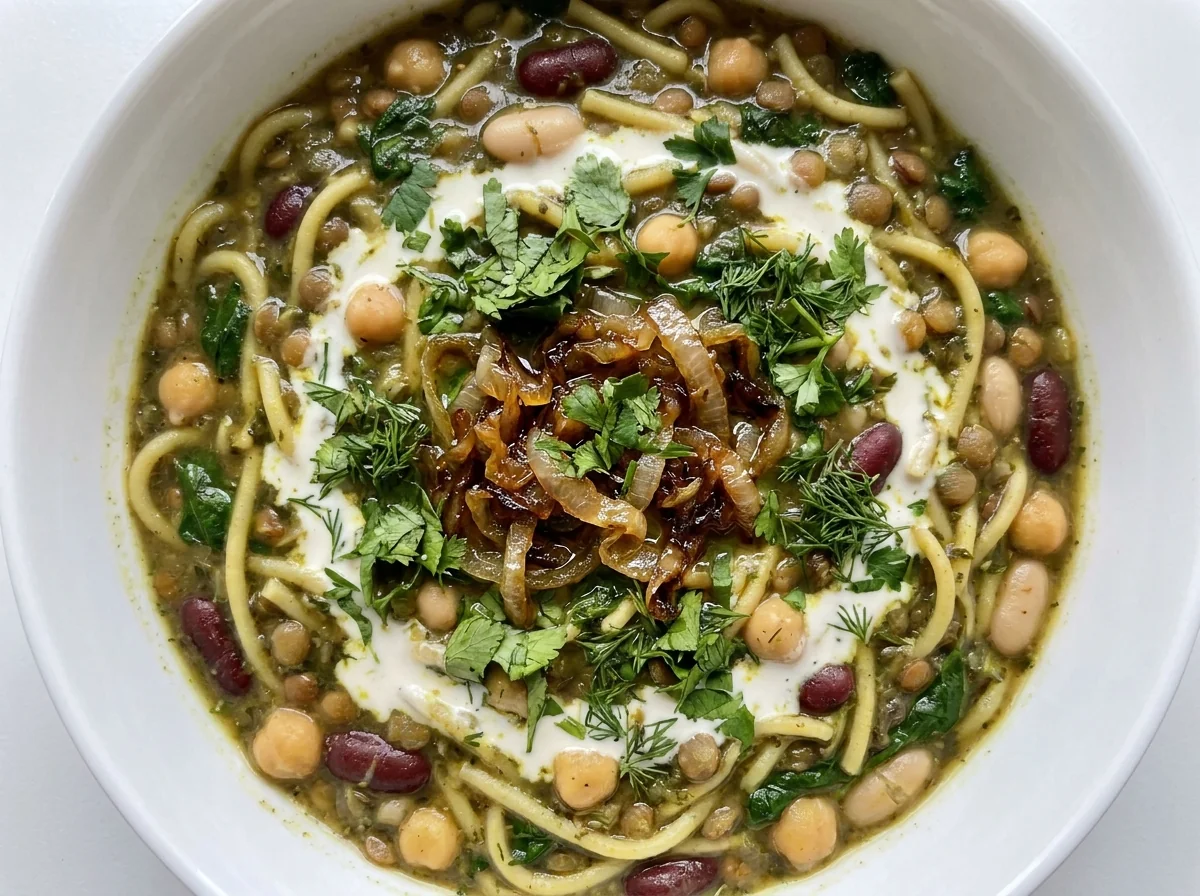
Ash Reshteh is a thick Persian soup cooked on special occasions, especially the Persian New Year (Nowruz).
It combines legumes, lentils, and green herbs with noodles. It is distinguished by three traditional garnishes: kashk (Persian fermented whey), fried onion, and mint oil, making it a complete meal in a single bowl.
Preparation Steps
The fried onion
Heat the oil and toss the onion for twenty to twenty-five minutes until it changes color, adding the garlic halfway through and then the turmeric carefully so it does not burn.
The mint garnish
Set aside a third of the onion and toss the dried mint into it while it is hot to prepare the serving garnish.
The legumes
Add the soaked chickpeas and beans with the water, salt, and pepper, and bring them to a boil, then lower the heat and cook for half an hour until the legumes soften.
The lentils
Add the lentils and cook for fifteen more minutes until they are done.
The herbs
Add the spinach, cilantro, parsley, dill, and green onion and cook for twenty minutes, adjusting the water so the texture stays thick.
Thickening
Dissolve the flour in a little of the soup so it does not clump, then return it to the pot to firm up the texture.
The noodles
Add the noodles and cook them for about ten minutes until they soften, then add the lemon juice so the texture becomes between a soup and a stew.
Serving
Stir part of the kashk into the soup, then ladle it into bowls and garnish it with the rest of the kashk, the fried onion, and the mint oil.
Blood Sugar Impact
The glycemic index (GI) measures how quickly a food raises blood sugar, while the glycemic load (GL) measures how much a full serving raises it. Together they give the complete picture.
Glycemic Index
GI
19Low
Low0–55Medium56–69High70+
A low value (≤55) means a gradual rise in blood sugar — the most suitable range for diabetes and insulin resistance.
Glycemic Load
GL
9Low
Low0–10Medium11–19High20+
Glycemic load reflects the impact of the full serving. To lower it: take half a serving, or pair the recipe with a source of protein and fiber.
Nutritional Information
Per ServingMakes 6 servings · one serving is about 495 g of raw ingredients
Calories453 kcal23%of Daily Value*
Protein19 g38%of Daily Value*
Carbohydrates58 g21%of Daily Value*
Fat17 g22%of Daily Value*
Fiber13 g46%of Daily Value*
Sodium600 mg26%of Daily Value*
* Percent Daily Values are based on a 2,000-calorie diet per FDA food-label reference values — your daily needs may be higher or lower. Values are derived from the recipe's ingredients via the USDA database.
Troubleshooting
The most common problems when preparing Noodle and Bean Herb Soup (Ash Reshteh), and how to fix them:
The soup is runny
Cook it uncovered for a while or add a little dissolved flour until it thickens.
The noodles are too swollen
They were cooked too long or left in the soup; add them near the end and serve the soup quickly.
The legumes are hard
They were not soaked enough; soak them overnight and extend their cooking until fully tender.
The soup color is dull
It lacks herbs or turmeric; increase the leafy greens and add a pinch of turmeric.
Storage and Make-Ahead
Refrigerator
Keep in an airtight container for up to three days, and it may thicken so thin it with a little water when reheating.
Freezer
Freeze without the noodles for up to two months, and add fresh noodles when reheating.
Tested Ingredient Substitutions
Original Ingredient
Tested Substitute
Ratio
Flavor Difference
kashk
strained Greek yogurt
about 200 g
Add it after taking the pot off the heat so it does not separate.
noodles
broken linguine pasta
same weight, 90 g
Gives a close texture and contains gluten.
red beans
black beans
same weight, 100 g
Gives a darker color and a close flavor.
spinach
chopped chard leaves
same weight, 120 g
Cook it a little longer until it softens.
How Much Does It Make? Scaling Guide
Ingredient
2 servings
4 servings (base)
8 servings
chickpeas
33 g
100 g
200 g
lentils
33 g
100 g
200 g
Leafy herbs
90 g
270 g
540 g
noodles
30 g
90 g
180 g
Water or broth
500 ml
1500 ml
3000 ml
EEINA Nutrition Tip
Fry the onion slowly until it changes color, as this is the base of the flavor, and dissolve the flour in a little of the soup before returning it so it does not clump, and save a third of the onion for the mint garnish.
Add This Recipe to Your Plan
The EEINA app saves your favorite recipes, calculates them from their real ingredients, and shows your daily numbers toward your goal. Try it free now.