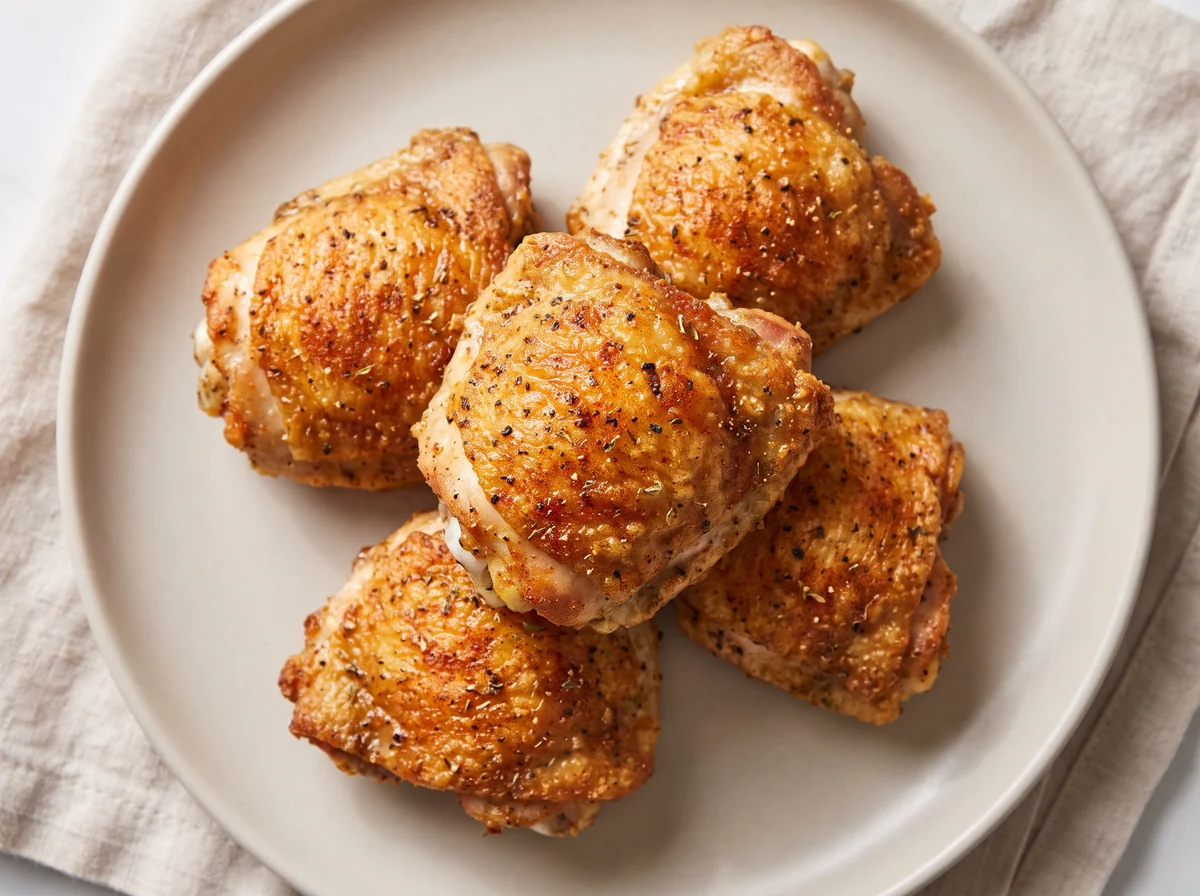
The same seasoned broasted crust without the oil bath: chicken thighs dipped in egg then in flour seasoned with paprika and oregano, cooked in the air fryer with no more than a spoonful of oil spray, coming out with a browned, dry-crisp crust and juicy meat on the bone. The difference from deep frying is far less fat — the chicken here absorbs no fryer oil.
The original is an air fryer broasted chicken recipe from Atyab Tabkha, kept to its own line: egg then flour seasoned with oregano, paprika, and onion and garlic powders, cooked at 200°C for 20 minutes.
We adjusted three documented things: we listed the bone-in thighs by net weight and made the kilo 4 realistic servings instead of the source's two, we added a measured 10 ml of oil spray the source did not mention because dry flour will not brown without a touch of fat, and we added a flip at the halfway mark so both faces crisp. Unlike the deep-fried broasted in our library, this version has no milk soak, exactly as in its source.
Preparation Steps
Prepare the seasoned flour
Mix the flour with the salt, black pepper, oregano, paprika, onion powder, and garlic powder in a wide dish, beat the eggs in a second dish until blended, and pat the chicken thighs dry with paper towels so the egg clings to their surface.
Coat the chicken
Dip each thigh in the beaten egg on all sides, then roll it in the seasoned flour and press with your palm until a firm coating covers it completely. Rest the pieces on a rack for 5 minutes so the coating hydrates and sets and does not flake off in the fryer.
Preheat the fryer and spray the oil
Preheat the air fryer at 200°C for 3 minutes, and spray the basket and the top of each thigh with the oil spray until the dry white flour patches disappear — any patch the oil does not touch comes out pale and floury.
Cook and flip
Arrange the thighs in the basket in a single spaced layer and cook 10 minutes at 200°C, then flip them, spray the second side with what remains of the spray, and cook 10 more minutes until the crust browns and dries crisp and the meat at the bone reaches 74°C.
Rest and serve
Rest the chicken on a rack for 5 minutes so its juices settle and the crust firms further, then serve hot with a large salad, bread, and a garlic sauce thinned with yogurt.
Blood Sugar Impact
The glycemic index (GI) measures how quickly a food raises blood sugar, while the glycemic load (GL) measures how much a full serving raises it. Together they give the complete picture.
Glycemic Index
GI
70High
Low0–55Medium56–69High70+
A low value (≤55) means a gradual rise in blood sugar — the most suitable range for diabetes and insulin resistance.
Glycemic Load
GL
17Medium
Low0–10Medium11–19High20+
Glycemic load reflects the impact of the full serving. To lower it: take half a serving, or pair the recipe with a source of protein and fiber.
Nutritional Information
Per ServingMakes 4 servings · one serving is about 225 g of raw ingredients
Calories369 kcal18%of Daily Value*
Protein38 g76%of Daily Value*
Carbohydrates25 g9%of Daily Value*
Fat12 g15%of Daily Value*
Fiber1 g4%of Daily Value*
Sodium677 mg29%of Daily Value*
Potassium488 mg10%of Daily Value*
Phosphorus390 mg31%of Daily Value*
* Percent Daily Values are based on a 2,000-calorie diet per FDA food-label reference values — your daily needs may be higher or lower. Values are derived from the recipe's ingredients via the USDA database.
Troubleshooting
The most common problems when preparing Air Fryer Broasted-Style Chicken, and how to fix them:
The crust came out pale with dry flour patches
The spray did not cover the surface. Spray until every white patch disappears, before cooking and after flipping — flour the oil never wets will not brown no matter how long it cooks.
The coating flaked off in the basket
The chicken was coated and cooked immediately, or the pieces were crowded. Rest the coated pieces 5 minutes before the fryer, space them apart, and flip them with tongs by the edge rather than dragging them.
The crust is done but the meat at the bone is pink
The thighs are larger than usual or touching. Add 3 to 5 minutes after the flip and measure at the thickest point against the bone — the meat around the bone is the slowest to cook.
The chicken is dry despite a good crust
The time ran on past 74°C. Check with a thermometer at the twenty-minute mark and pull the chicken the moment it reaches temperature — thighs are forgiving, but not without limits.
Storage and Make-Ahead
Refrigerator (4°C)
Keep in an airtight container for up to 3 days; the crust softens in the cold.
Reheating
Reheat in the air fryer at 180°C for 4 to 5 minutes and the crunch returns; the microwave softens the crust, so do not rely on it.
Freezer (-18°C)
Freeze the cooked chicken for up to 2 months, thaw overnight in the refrigerator, then rewarm in the air fryer — not the microwave.
Make ahead
Coat the pieces and keep them raw on an uncovered tray in the refrigerator for up to 4 hours, then cook straight from the cold with 2 extra minutes.
Tested Ingredient Substitutions
Original Ingredient
Tested Substitute
Ratio
Flavor Difference
Bone-in chicken thighs
Chicken breast cut into strips
650 g net with the same coating
Leaner and quicker to cook — cut the time to 12 minutes so they do not dry out.
Wheat flour
Rice flour and cornstarch, half and half
Same weight, 120 g
Makes the dish gluten-free and makes the crust even crispier.
Skin on the thighs
Removing it before coating
No replacement
Lowers the saturated fat; the seasoned crust makes up for the skin's crunch.
Oil spray
Brushing the pieces with olive oil
The same 10 ml
Same result, and the brush is more precise at reaching dry flour patches.
How Much Does It Make? Scaling Guide
Servings
Thighs (boneless meat weight)
Flour
Eggs
2 servings (half the quantity)
325 g (2 thighs)
60 g
50 g (piece)
4 servings (base)
650 g (4 thighs)
120 g
100 g (2)
8 servings (double, in two batches)
1300 g (8 thighs)
240 g
200 g (4)
EEINA Nutrition Tip
The essential difference from deep-fried broasted is in the fat, not the crust: deep frying soaks the coating with oil from the whole bath, while here the dish's entire fat is two spoonfuls of spray plus the thigh's own. To make it lighter still, pull the skin off before coating — you give up a share of saturated fat and the coating bonds directly to the meat.
Add This Recipe to Your Plan
The EEINA app saves your favorite recipes, calculates them from their real ingredients, and shows your daily numbers toward your goal. Try it free now.
How does it differ from the deep-fried broasted chicken in the EEINA library?
That one is soaked in milk then fried in abundant oil that both it and its crust absorb; this one has no soak, exactly as in its source, and cooks with just two spoonfuls of spray. The crust here is thinner and drier-crisp than a fried crust, and the fat is lower by a wide margin because there is no oil bath to absorb from.
Do we need to preheat the air fryer?
Yes, 3 minutes at 200°C. A cold basket turns the first minutes into slow steaming that softens the coating instead of drying it, while ready heat sets the crust from the first moment.
Why are the thighs listed by net weight?
Because the bone is roughly a third of the thigh's weight and is not eaten, so servings and nutrition are calculated on the 650 g of net meat, while the kilo is what you buy bone-in from the butcher.
Does it work for large quantities?
In batches — the fryer basket holds one spaced layer and no more, and stacking traps steam and steams the crust. For a large gathering, bake on an oven rack at 200°C with the same seasoning for about 35 minutes.