Lunch · Global Healthy Cuisine · Contemporary Gulf
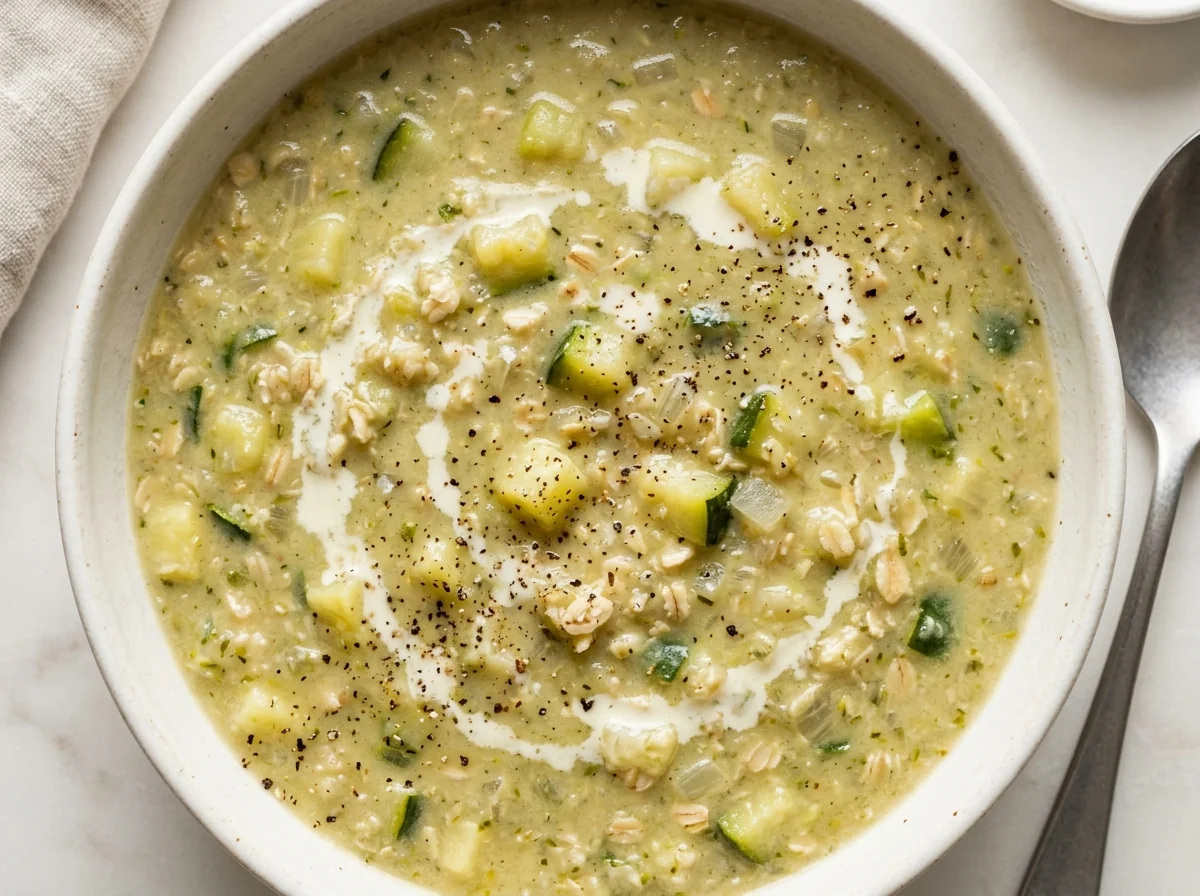
Zucchini and Oat Soup
A pureed zucchini soup that gets its thick body from oats rather than cream, coming out silky and warm with moderate calories. A light dish for anyone watching their weight who wants a creamy-feeling soup without the heaviness.
The original comes from Sayidaty Kitchen: a zucchini and oat soup that is pureed and finished with cream.
We lightened the recipe honestly for weight management: we brought the cream down from half a cup to just 2 tablespoons, dropped the butter in favor of olive oil, and reduced the salt to half a teaspoon. The creamy feel remains because the pureed oats build most of the body — the small amount of cream is a finishing touch, not the foundation.
Preparation Steps
Soften the onion
Heat the olive oil in a wide, heavy-bottomed pot over medium heat, then add the onion and stir for about 3 minutes until it softens and turns translucent without browning.
Add the zucchini and garlic
Add the zucchini cubes and crushed garlic, and stir for about 5 minutes until the zucchini glistens with oil and its edges begin to soften.
Add the stock and oats
Pour in the stock and add the oats, salt, and black pepper. Bring the mixture to a boil, then lower the heat, cover the pot, and let it cook for about 20 minutes. The oats open up in the stock and release their starch, thickening the soup naturally.
Puree the soup
Take the pot off the heat and let it settle for 2 minutes, then puree the mixture with an immersion blender until smooth and velvety with no lumps. If using a regular blender, work in batches and let the steam vent.
Add the cream and serve
Return the pot to low heat, add the 2 tablespoons of cream, and stir for about 3 minutes until fully blended, without letting it boil hard. Taste, adjust the seasoning, and serve hot.
Blood Sugar Impact
The glycemic index (GI) measures how quickly a food raises blood sugar, while the glycemic load (GL) measures how much a full serving raises it. Together they give the complete picture.
Glycemic Index
GI
20Low
Low0–55Medium56–69High70+
A low value (≤55) means a gradual rise in blood sugar — the most suitable range for diabetes and insulin resistance.
Glycemic Load
GL
2Low
Low0–10Medium11–19High20+
Glycemic load reflects the impact of the full serving. To lower it: take half a serving, or pair the recipe with a source of protein and fiber.
Nutritional Information
Per ServingMakes 4 servings · one serving is about 445 g of raw ingredients
Calories113 kcal6%of Daily Value*
Protein4 g8%of Daily Value*
Carbohydrates11 g4%of Daily Value*
Fat6 g8%of Daily Value*
Fiber3 g11%of Daily Value*
Sodium1087 mg47%of Daily Value*
* Percent Daily Values are based on a 2,000-calorie diet per FDA food-label reference values — your daily needs may be higher or lower. Values are derived from the recipe's ingredients via the USDA database.
Troubleshooting
The most common problems when preparing Zucchini and Oat Soup, and how to fix them:
The soup thickened too much after cooling
Oat starch keeps setting over time. Add a splash of stock or hot water when reheating and stir until the texture returns — this is normal behavior for any oat-thickened soup.
The oat flavor is more noticeable than it should be
Stick to just 2 tablespoons and make sure to blend thoroughly; fully pureed oats dissolve into the texture and go unnoticed. Increasing the amount turns the soup into porridge rather than soup.
The cream curdled when added
It was added at a hard boil. Lower the heat to a complete calm before adding it and stir immediately; if it curdles, blend the soup for a few extra seconds and it will come back together.
The texture has strings or lumps
The zucchini was not fully cooked before blending, or the blending was too short. Make sure a fork pierces the cubes with no resistance, and blend longer while moving the immersion blender up and down.
Storage and Make-Ahead
Refrigerator (4°C)
Keep in an airtight container for up to 3 days. The texture thickens over time because of the oats, so loosen it with a splash of water or stock when reheating over low heat, and never leave it at room temperature for more than 2 hours.
Freezer (-18°C)
Best frozen before adding the cream, for up to 2 months — dairy-based soups can separate after thawing. Thaw overnight in the refrigerator, reheat, then add fresh cream at serving time.
Reheating
Over low heat with constant stirring and no hard boil to protect the cream, or in the microwave for 2 minutes, stirring halfway through and adding a splash of liquid.
Tested Ingredient Substitutions
Original Ingredient
Tested Substitute
Ratio
Flavor Difference
Light cream
Low-fat Greek yogurt
2 tablespoons added to the bowl
Higher protein and less fat; add it after taking the soup off the heat so it does not separate.
Chicken stock
Low-sodium vegetable stock
Same amount
Makes the soup fully vegetarian if you also omit the cream or swap in a plant-based cream.
Regular oats
Certified gluten-free oats
Same amount
The option for anyone avoiding gluten, since regular oats are often cross-contaminated with gluten during processing.
Olive oil
Cooking oil spray
2 sprays instead of the tablespoon
Cuts calories further while still allowing a light saute of the onion.
How Much Does It Make? Scaling Guide
Servings
Zucchini
Stock
Oats
Cream
2 servings
2 pieces (300 g)
2 cups (500 ml)
1 tablespoon
1 tablespoon
4 servings
4 pieces (600 g)
4 cups (1000 ml)
2 tablespoons
2 tablespoons
6 servings
6 pieces (900 g)
6 cups (1500 ml)
3 tablespoons
3 tablespoons
EEINA Nutrition Tip
The oats are the real thickener here: 2 tablespoons are enough for four servings. If you want to skip the cream entirely, omit it and add 2 tablespoons of low-fat Greek yogurt to each bowl at serving time — you gain extra protein with less fat.
Add This Recipe to Your Plan
The EEINA app saves your favorite recipes, calculates them from their real ingredients, and shows your daily numbers toward your goal. Try it free now.
Why did you lighten the cream compared to the original recipe?
The original uses half a cup of cream and a tablespoon of butter, which push the fat per serving far too high in a soup meant to be light on calories. The pureed oats create nearly the same texture, so we kept just 2 tablespoons for flavor and stated the change openly.
Is it suitable for a gluten-free diet?
Oats themselves are theoretically gluten-free, but they are often cross-contaminated with gluten during processing. We only consider this soup gluten-free when made with oats explicitly labeled gluten-free.
Can it be made fully plant-based?
Yes — replace the chicken stock with vegetable stock, and omit the cream or use a plant-based cream such as light coconut cream, keeping in mind that coconut cream slightly changes the flavor.
Is it enough as a full lunch?
It is a light, low-protein dish. To turn it into a balanced lunch, pair it with a protein source such as grilled chicken, a boiled egg, or a handful of chickpeas — satiety rises without a big jump in calories.