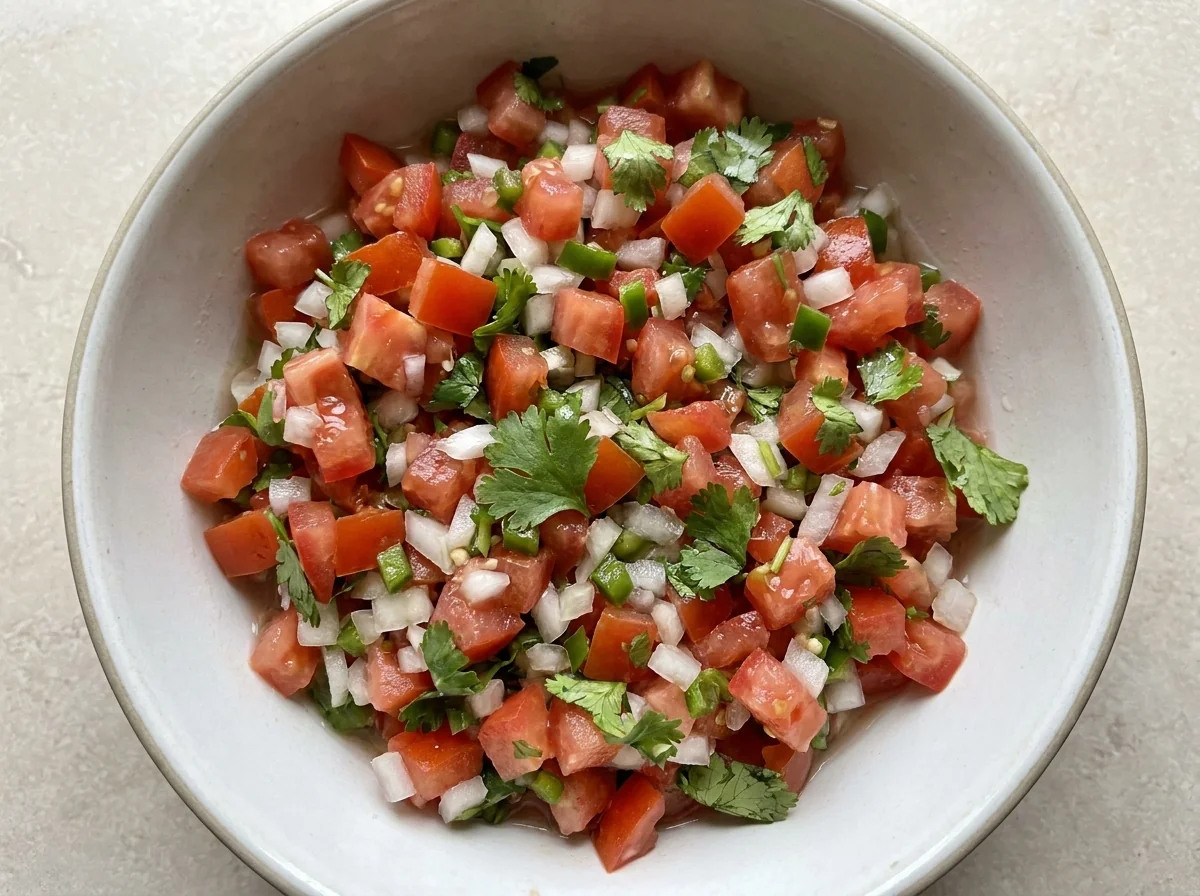
Pico de gallo (which means "rooster's beak" in Spanish) is Mexico's national fresh salsa: five ingredients chopped and not cooked.
For the blood pressure patient it is an excellent choice, because it is a full-flavored salsa with very little sodium, while most store salsas are high in salt.
Preparation Steps
Cut the tomatoes into small cubes
Choose ripe, firm tomatoes and cut them into small, even cubes with a sharp knife without mashing. Pico is a chopped salad and not a blended sauce, and the clarity of the cubes is part of its well-known look.
Soak the onion in cold water
Soak the chopped onion in cold water for five minutes, then drain it. The soaking breaks the sharpness of the raw onion and keeps its crunch.
Mix the five ingredients with a little salt
Mix the tomatoes, onion, cilantro, chili, and lime juice with only one gram of salt. These are the ingredients of the traditional Mexican recipe, and the little salt is enough because the generous lime juice completes the taste, which is why pico is among the lowest-sodium salsas.
Leave it in the fridge then serve
Leave it half an hour in the fridge until the flavors blend, then serve it over grills, eggs, and fish, or as a dip with vegetables. It is very suitable for blood pressure patients because of its low sodium.
Blood Sugar Impact
The glycemic index (GI) measures how quickly a food raises blood sugar, while the glycemic load (GL) measures how much a full serving raises it. Together they give the complete picture.
Glycemic Index
GI
14Low
Low0–55Medium56–69High70+
A low value (≤55) means a gradual rise in blood sugar — the most suitable range for diabetes and insulin resistance.
Glycemic Load
GL
1Low
Low0–10Medium11–19High20+
Glycemic load reflects the impact of the full serving. To lower it: take half a serving, or pair the recipe with a source of protein and fiber.
Nutritional Information
Per ServingMakes 6 servings · one serving is about 95 g of raw ingredients
Calories20 kcal1%of Daily Value*
Protein1 g2%of Daily Value*
Carbohydrates5 g2%of Daily Value*
Fat0 g0%of Daily Value*
Fiber1 g4%of Daily Value*
Sodium69 mg3%of Daily Value*
Potassium171 mg4%of Daily Value*
Phosphorus25 mg2%of Daily Value*
* Percent Daily Values are based on a 2,000-calorie diet per FDA food-label reference values — your daily needs may be higher or lower. Values are derived from the recipe's ingredients via the USDA database.
Troubleshooting
The most common problems when preparing Pico de Gallo (Fresh Mexican Salsa), and how to fix them:
It came out watery the next day
The tomatoes were soft or their soft seeds went in. Use firm tomatoes and scrape out the soft seeds, or drain it before serving.
The onion taste dominated the salsa
It was not soaked. Soak it five minutes in cold water before adding it.
The taste is bland
Too little lime juice or unripe tomatoes. Add more lime juice and choose ripe, in-season tomatoes.
The chili heat is stronger than wanted
The chili seeds went in. Scrape out the seeds before chopping for milder heat, or leave out the chili entirely.
Storage and Make-Ahead
In the fridge
Three days in a sealed container, and its taste is best in the first two days.
Freezing and cooking
It is not frozen or cooked, as it is eaten fresh only.
What is it served with from our library?
With herb chicken, grilled fish, eggs, and roasted potatoes.
Tested Ingredient Substitutions
Original Ingredient
Tested Substitute
Ratio
Flavor Difference
The cilantro
Parsley
~
For those who don't like the taste of cilantro
Adding chopped mango or pineapple
The fruit pico version
100 g
A well-known summer addition, and its sugar counts for diabetics
The lime
Lemon
~
Lime is more aromatic and lemon serves the purpose
Adding cubed avocado when serving
A version closer to guacamole
~
A popular creamy addition
How Much Does It Make? Scaling Guide
Ingredient
6 servings
3 servings
12 servings
Tomato
400 g
200 g
800 g
Onion
100 g
50 g
200 g
Lime
30 ml
15 ml
60 ml
EEINA Nutrition Tip
When reducing salt in food, compensate the taste with acidity such as lime juice: the acid activates the taste receptors so the feeling of missing salt decreases, and this is an approved method in the DASH eating plan for lowering sodium. The sense of taste also adapts to less salt within about two weeks of commitment.
Add This Recipe to Your Plan
The EEINA app saves your favorite recipes, calculates them from their real ingredients, and shows your daily numbers toward your goal. Try it free now.
How much sodium is in a serving compared to store salsas?
About 70 mg, compared to about 450 mg for a quarter cup of canned salsa, and more than that in ready barbecue sauces. That is why the blood pressure patient can eat it in a comfortable amount.
And how many calories?
About 25 calories per serving, and it is among the lightest full-flavored salsas in our library.
What is the difference between it and Saudi daqqous?
They are close. Daqqous is blended and sometimes cooked with garlic, and pico is raw, chopped with cilantro and lime. Both can be served at the table.
When is it at its best?
Over lightly seasoned grills, where it compensates for the flavor of the salt left out in the blood pressure patient's kitchen.