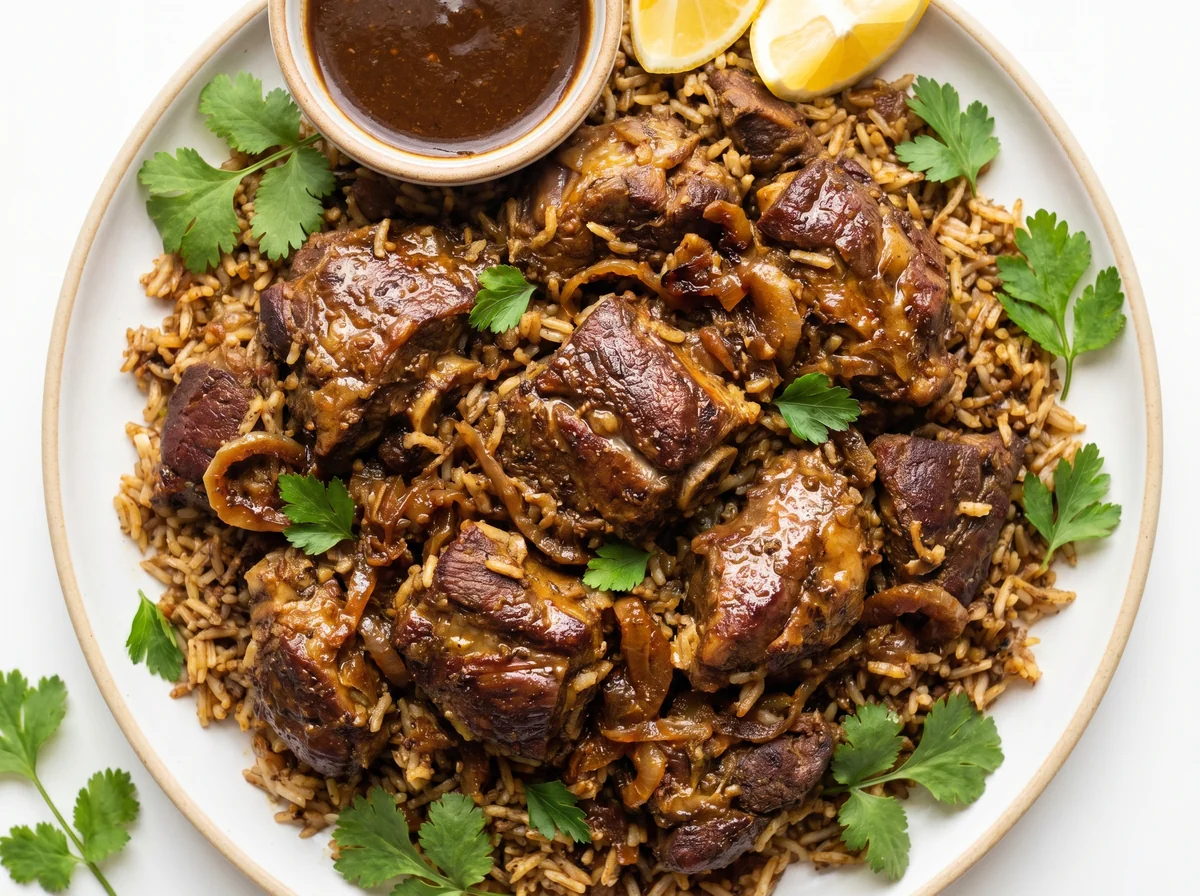
Oman's Eid centrepiece — meat marinated in a rich Omani spice paste, wrapped tightly, and slow-cooked for hours until it melts off the bone. A celebratory heritage dish, high in protein, very low in carbs, and free of common allergens.
Omani Shuwa is Oman's quintessential Eid dish — among the most ancient and cherished in Omani heritage, associated especially with Eid Al-Adha. The meat is marinated in a rich, complex Omani spice blend (cumin, coriander, cardamom, cloves, chilli, turmeric, garlic, and ginger), wrapped in banana leaves, then slow-cooked for many hours (traditionally in an underground charcoal-lined pit covered with soil — called an earth oven — for a day or more).
Shuwa is a communal celebration ritual: families and the village cooperate to marinate the meat and bury it on the first day of Eid, then unearth and share it throughout the Eid days. The melt-away meat saturated with spices is extraordinary. Shuwa is a symbol of authentic Omani heritage, festive generosity, and the spirit of solidarity and community.
Preparation Steps
Make the spice paste
Mix the Omani Shuwa spices (cumin, coriander, cardamom, cloves, chilli, turmeric) with the garlic, ginger, vinegar or ground loomi, salt, and oil into a rich marinade paste. The rich Omani spice blend is the soul of Shuwa — deep, complex, unmistakable flavor.
Marinate the meat
Rub the large meat pieces thoroughly with the spice paste (into every crevice), then leave to marinate in the refrigerator for several hours (or overnight). Long, deep marinating allows the flavor to penetrate the meat (essential for authentic Shuwa) — do not rush it.
Wrap the meat
Wrap the marinated meat tightly in banana leaves (traditional) or in foil and roasting bags. The tight wrap traps moisture and flavor, and protects the meat during the long slow cook, allowing it to cook in its own juices without drying out.
Cook it very slowly
Cook the wrapped meat extremely slowly over very low heat for many hours (traditionally in a charcoal-lined underground pit that is covered, 6 to 24 hours; at home in a very low oven for 6 hours or more). Extreme slowness is the secret of Shuwa: the meat melts to tenderness and fully absorbs the spices.
Check for tenderness
Carefully unwrap and confirm that the meat is very tender, falling easily off the bone, and saturated with spices. Successful Shuwa has melt-away meat (maximum tenderness from long slow cooking) with deep, penetrating spice flavor. Reserve any cooking juices.
Serve
Pull the meat apart and serve hot over spiced Omani rice (or with bread), with the cooking juices. This is Oman's Eid dish par excellence (especially Eid Al-Adha, prepared communally by villagers and buried in the pit on the first day of Eid). A celebratory heritage dish that brings families together — the melt-away meat saturated with rich Omani spices is a joy, and a symbol of Omani heritage, festive generosity, and community spirit.
Blood Sugar Impact
The glycemic index (GI) measures how quickly a food raises blood sugar, while the glycemic load (GL) measures how much a full serving raises it. Together they give the complete picture.
Glycemic Index
GI
43Low
Low0–55Medium56–69High70+
A low value (≤55) means a gradual rise in blood sugar — the most suitable range for diabetes and insulin resistance.
Glycemic Load
GL
2Low
Low0–10Medium11–19High20+
Glycemic load reflects the impact of the full serving. To lower it: take half a serving, or pair the recipe with a source of protein and fiber.
Nutritional Information
Per ServingMakes 8 servings · one serving is about 205 g of raw ingredients
Calories316 kcal16%of Daily Value*
Protein27 g54%of Daily Value*
Carbohydrates4 g1%of Daily Value*
Fat21 g27%of Daily Value*
Fiber0 g0%of Daily Value*
Sodium87 mg4%of Daily Value*
Potassium518 mg11%of Daily Value*
Phosphorus264 mg21%of Daily Value*
* Percent Daily Values are based on a 2,000-calorie diet per FDA food-label reference values — your daily needs may be higher or lower. Values are derived from the recipe's ingredients via the USDA database.
Troubleshooting
The most common problems when preparing Omani Shuwa, and how to fix them:
The meat is tough
Not cooked long enough. Shuwa needs extremely slow, long cooking (hours at very low heat) to melt — short cooking or high heat leaves it tough. Extreme, prolonged slowness is essential for tenderness.
The meat is dry
The wrap was not tight, or heat was too high. Wrap the meat firmly (banana leaves / foil) so it cooks in its own juices, and cook at very low heat. A tight wrap and gentle heat keep it moist despite the long cook.
The flavor is superficial
Too short a marinade. Rub the spice paste into the meat deeply (into every crevice) and leave it for hours or overnight before cooking. Long, deep marinating makes the flavor penetrate — the secret of Shuwa — so do not rush it.
The spices are unbalanced
An imprecise blend. Use a balanced Omani Shuwa spice blend (cumin, coriander, cardamom, cloves, chilli, turmeric) — a rich, balanced blend is the foundation of the distinctive Omani flavor. Adjust to taste.
The outside burned
Heat too high. Cook at very low temperature (Shuwa is gentle slow-cooking, not fast roasting), and the wrap protects the surface. High heat chars the outside before the inside melts.
Storage and Make-Ahead
Refrigerator (4°C)
Shuwa keeps in an airtight container in the refrigerator for 3 to 4 days, and the flavor actually improves. Reheat gently (covered, with a splash of cooking juices or water to keep it moist). Remove solidified fat from the surface before reheating.
Freezer
Cooked Shuwa meat freezes well for 2 to 3 months in an airtight container (slow-cooked meats freeze excellently). Thaw and reheat gently. Practical for preserving large Eid quantities.
Advance prep
Shuwa is inherently a long-prep dish (marinated and cooked over Eid days), so advance preparation is natural. Marinate the meat the night before cooking, cook slowly, and refrigerate or freeze the leftovers for the days ahead.
Food safety
Cook the meat until fully done and melt-tender. Cool the Shuwa quickly after serving, do not leave it unrefrigerated for more than two hours, and reheat thoroughly. In traditional pit cooking, follow local safety practices.
Tested Ingredient Substitutions
Original Ingredient
Tested Substitute
Ratio
Flavor Difference
Underground pit cooking
Very low home oven
—
The underground pit (earth oven) is traditional and gives a smoky flavor; a very low home oven (with a tight wrap) is a practical alternative using the same slow-cooking principle
Banana leaves
Foil and roasting bags
—
Banana leaves are traditional (adding flavor and moisture); foil and roasting bags are a practical alternative that traps moisture and flavor
Fatty lamb
Leaner cuts
Same amount
Reduces saturated fat; some fat helps with tenderness during long cooking, but leaner cuts can be chosen and visible fat trimmed
How Much Does It Make? Scaling Guide
Servings
Meat
Spice blend
Garlic
4 (small)
750 g
half amount
1/2 head
8 (base)
1.5 kg
full amount
1 head
16 (holiday)
3 kg
double
2 heads
EEINA Nutrition Tip
Shuwa is rich in high-quality protein, iron, and zinc, and is very low in carbohydrates. The slow cooking without frying, and the generous spices (antioxidants and digestive aids), are further positives. Its main challenges are saturated fat (fatty lamb) and sodium (salt and marinade). To lighten: choose leaner cuts and trim visible fat, remove solidified fat from the cooking juices, moderate the salt, and balance with moderate rice, a salad, and vegetables. Mind the amount of accompanying rice (it raises the load). A protein-rich Eid dish — enjoy it at celebrations, moderating the fat and rice.
Add This Recipe to Your Plan
The EEINA app saves your favorite recipes, calculates them from their real ingredients, and shows your daily numbers toward your goal. Try it free now.
Oman's Eid dish: meat marinated in a rich Omani spice blend, wrapped in banana leaves, and slow-cooked for many hours (traditionally in an underground charcoal-lined pit covered with soil). The meat melts to tenderness and is saturated with spices. A celebratory heritage dish associated with Eid Al-Adha, prepared communally and bringing families together.
Why is it cooked in an underground pit?
The traditional method: a pit is dug and lined with charcoal, the wrapped meat is placed inside and covered with soil for hours (a day or more). This extremely slow cooking at a stable enclosed temperature melts the meat and imparts a unique smoky flavor. It is a communal Eid ritual (buried on the first day, unearthed during Eid days). At home it is cooked in a very low oven.
How long does Shuwa take?
Many hours: traditionally in the pit from 6 to 24 hours (buried on the first day of Eid, unearthed during Eid days); at home in a very low oven about 6 hours or more. Extreme slowness is the secret (it melts the meat and lets it absorb the spices) — Shuwa is not a quick dish but a celebratory one worth waiting for.
Is Shuwa healthy?
Rich in protein, iron, and zinc, very low in carbohydrates, slow-cooked without frying, with antioxidant spices. Its challenges are saturated fat (lamb) and sodium, plus the amount of accompanying rice. Choose leaner cuts, trim visible fat, moderate the salt and rice, and balance with a salad. An Eid protein-rich dish — enjoy it in moderation.
Sources: USDA · University of Sydney · Gulf GSO · Our methodology · Updated on