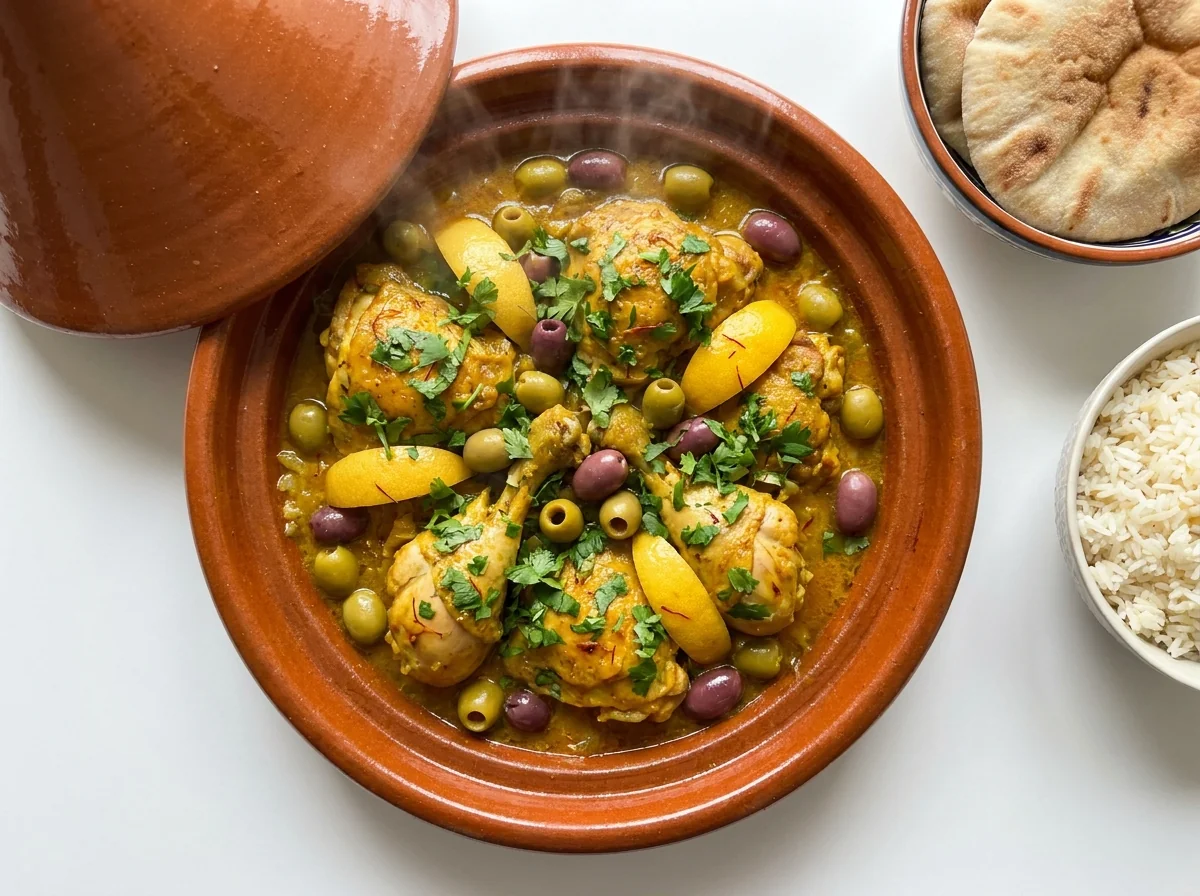
Chicken tagine with olives and preserved lemon is one of the most famous Moroccan tagines of all.
The preserved lemon that Moroccan households ferment for months is the jewel of the dish and its signature. It leads the tables of Ramadan and hospitality in Morocco.
Preparation Steps
Steep the chicken in its Moroccan marinade
In a bowl, toss the chicken pieces with the grated onion, garlic, ginger, turmeric, soaked saffron, half the cilantro and parsley, the olive oil, pepper and a little salt. The olives and preserved lemon are coming with their saltiness, so go easy. One hour minimum to marinate, and a night in the fridge is the Moroccan custom.
Brown in the tagine or a heavy pot
In a tagine over low heat or a heavy-bottomed pot, heat a spoonful of oil and arrange the chicken pieces with their marinade, and turn them for five minutes until their surface pales and the yellow spices release their warm aroma.
Cook slowly the way tagines do
Add the water and cover with the tagine dome or the lid, and leave the heat low for fifty minutes, turning the pieces once. The tagine cooks with its steam circulating in its dome, and its sauce concentrates golden-yellow and clings to the chicken.
Add the olives and preserved lemon. The signature
Rinse the preserved lemon of its excess salt, remove its pulp and cut its rind into slices, the rind is the jewel, not the pulp, and add it with the olives to the tagine, and let them marry with the sauce for a final quarter of an hour: a deep fermented acidity that fresh lemon can never give.
Finish with the greens and serve it in its tagine
Taste and correct the salt carefully, scatter the rest of the cilantro and parsley, and bring the tagine with its dome to the table so the steam rises in front of those seated. With Moroccan bread or rice, and the sight of the steam is half the hospitality.
Blood Sugar Impact
The glycemic index (GI) measures how quickly a food raises blood sugar, while the glycemic load (GL) measures how much a full serving raises it. Together they give the complete picture.
Glycemic Index
GI
7Low
Low0–55Medium56–69High70+
A low value (≤55) means a gradual rise in blood sugar — the most suitable range for diabetes and insulin resistance.
Glycemic Load
GL
0Low
Low0–10Medium11–19High20+
Glycemic load reflects the impact of the full serving. To lower it: take half a serving, or pair the recipe with a source of protein and fiber.
Nutritional Information
Per ServingMakes 6 servings · one serving is about 330 g of raw ingredients
Calories491 kcal25%of Daily Value*
Protein51 g102%of Daily Value*
Carbohydrates7 g3%of Daily Value*
Fat27 g35%of Daily Value*
Fiber2 g7%of Daily Value*
Sodium1164 mg51%of Daily Value*
* Percent Daily Values are based on a 2,000-calorie diet per FDA food-label reference values — your daily needs may be higher or lower. Values are derived from the recipe's ingredients via the USDA database.
Troubleshooting
The most common problems when preparing Moroccan Chicken Tagine with Olives and Preserved Lemon, and how to fix them:
The tagine is too salty
The lemon was not rinsed or we salted as usual. The preserved lemon and olives carry the dish's salt. Salt at the end by tasting, not before.
The chicken dried out and fell apart
Strong heat or prolonged time. The tagine is the child of low heat. Fifty calm minutes, not half an hour of high heat.
The sauce stayed watery and pale
Excess water or a lid dripping inward. Three hundred ml is enough, and uncover the lid for the last ten minutes until it concentrates golden.
A faint bitterness in the taste
The lemon pulp slipped in or very bitter olives. The pulp is always removed, and the olives are boiled for two minutes in separate water before going in if they are sharp.
Storage and Make-Ahead
Right away
In its tagine with its steam rising before the guests.
In the fridge
Three days and its taste deepens. Reheated gently in its tagine with a spoonful of water.
In the freezer
One month without the olives and lemon. They are added fresh when reheating so their flavor stays alive.
Tested Ingredient Substitutions
Original Ingredient
Tested Substitute
Ratio
Flavor Difference
Ready-made preserved lemon
Quick homemade preserved lemon (lemon with coarse salt for two weeks)
~
For anyone who did not find it ready-made, and patience for a month is deeper
Whole chicken
Chicken thighs only
1 kg
The juiciest tagine pieces and the hardest to dry out
Green olives
Moroccan purple olives
1:1
The most original Moroccan source if available
Bread alongside it
White rice or steamed couscous
~
All starchy bases suit its sauce
How Much Does It Make? Scaling Guide
Ingredient
4 servings
2 servings
8 servings
Chicken
1.2 kg
600 g
2.4 kg
Olives
120 g
60 g
240 g
Preserved lemon
1 piece
1/2 piece
2 pieces
EEINA Nutrition Tip
Remove the pulp of the preserved lemon and use only its rind. The pulp is very salty and bitter, and the fermented rind is the carrier of all the aroma. And rinse it beforehand, for its saltiness is enough for the tagine and more.
Add This Recipe to Your Plan
The EEINA app saves your favorite recipes, calculates them from their real ingredients, and shows your daily numbers toward your goal. Try it free now.
A whole lemon fermented with salt for months until its rind softens and its aroma transforms. It is sold in large markets and at spice shops under the name 'preserved lemon' or 'masbar,' and homemade is easy for anyone patient.
Can it be cooked without a clay tagine?
Yes, in any heavy pot with a tight lid. The tagine adds a ritual and a gentler heat distribution, and the recipe holds in both.
Why is it considered one of the lightest main chicken dishes?
No frying and no cream. Chicken cooked in its own steam, its sauce of onion, spices and moderate olive oil, and its saltiness from natural pickles, not ready-made sauces.
What do I complete a Moroccan Iftar table with?
A harira to open, a tagine in the center and a Moroccan carrot salad alongside. A graduated, complete table from a single cuisine.