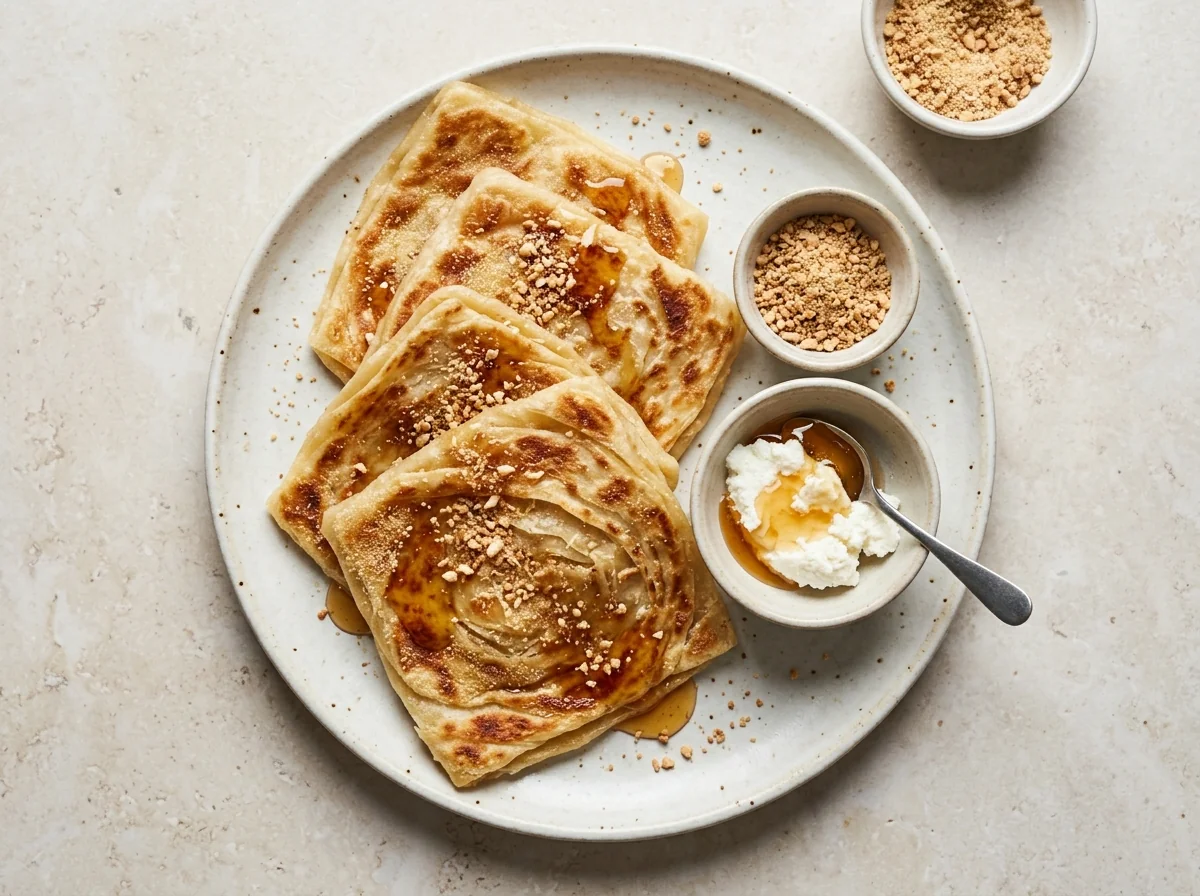
Msemen is one of the most famous Maghrebi breads, sharing its roots with the Tunisian rfiss and the Algerian mlawi.
The name comes from 'musamman,' meaning 'one who increases milk,' referring to its benefit for nursing mothers in olden times. At suhoor it works as sweet or savory bread, filling the faster and giving instant energy.
Preparation Steps
Prepare the dough
Mix the two flours with the salt, sugar, and yeast. Add the warm water gradually and knead for 10 minutes until the dough becomes soft. Cover and leave to proof for 1 hour.
Divide and cover
Divide the dough into 8 balls. Brush each ball with butter and cover with plastic. Leave to rest for 15 minutes.
Stretch out
On a greased surface, stretch each ball by hand (not with a rolling pin) into a very thin sheet the size of a large plate. The oily feel prevents sticking.
Form the folds
Brush the sheet with a layer of butter and fold it like a fan or an envelope (from the edges to the middle). Repeat with a second ball and stick them together to form a square. Rest for 10 minutes.
Fry
In a non-stick pan over medium heat, place the square and brush the top with butter. Fry for 3 minutes per side until it takes an even golden color. High heat burns the outside and leaves the inside raw.
Serve
Arrange the msemen on a plate and serve hot with honey or date molasses, or with white cheese and yogurt with honey. Msemen is suitable for suhoor because of the complex starches and fat that give instant energy.
Blood Sugar Impact
The glycemic index (GI) measures how quickly a food raises blood sugar, while the glycemic load (GL) measures how much a full serving raises it. Together they give the complete picture.
Glycemic Index
GI
70High
Low0–55Medium56–69High70+
A low value (≤55) means a gradual rise in blood sugar — the most suitable range for diabetes and insulin resistance.
Glycemic Load
GL
67High
Low0–10Medium11–19High20+
Glycemic load reflects the impact of the full serving. To lower it: take half a serving, or pair the recipe with a source of protein and fiber.
Nutritional Information
Per ServingMakes 4 servings · one serving is about 235 g of raw ingredients
Calories790 kcal40%of Daily Value*
Protein13 g26%of Daily Value*
Carbohydrates100 g36%of Daily Value*
Fat38 g49%of Daily Value*
Fiber4 g14%of Daily Value*
Sodium595 mg26%of Daily Value*
* Percent Daily Values are based on a 2,000-calorie diet per FDA food-label reference values — your daily needs may be higher or lower. Values are derived from the recipe's ingredients via the USDA database.
Troubleshooting
The most common problems when preparing Moroccan Msemen, and how to fix them:
Msemen is tough
Add more butter between the layers and stretch the dough thinner. More layers make the texture flaky.
It burns on the outside
Lower the heat and keep brushing the top with butter. High heat burns the crust quickly.
Inside is raw
Cover the pan with a lid for the last minute. The steam finishes the cooking.
Dough is sticky
Add a spoon of flour and knead again. Wet dough sticks to the hands.
Storage and Make-Ahead
At room temperature
1 day. Reheat in a dry pan.
Refrigerator
3 days. Reheat in a 170°C oven for 5 minutes.
Freezer
2 months before cooking. Fry directly from the freezer, extending by 2 minutes.
Tested Ingredient Substitutions
Original Ingredient
Tested Substitute
Ratio
Flavor Difference
White flour
Whole wheat flour
1:1
Deeper flavor and more fiber.
Yeast
Baking powder
10 g
Different flavor and denser texture.
Butter
Local ghee
1:1
A luxurious flavor.
Honey
Date molasses
Same quantity
Gulf-style flavor.
How Much Does It Make? Scaling Guide
Ingredient
4 people
8 people
12 people
White flour
300 g
600 g
900 g
Semolina
100 g
200 g
300 g
Butter
60 g
120 g
180 g
Oil
80 ml
160 ml
240 ml
EEINA Nutrition Tip
Stretch the dough by hand rather than rolling pin to get irregular thin layers — this is the secret to msemen's flakiness. Choose a thick non-stick pan for even heat distribution.
Add This Recipe to Your Plan
The EEINA app saves your favorite recipes, calculates them from their real ingredients, and shows your daily numbers toward your goal. Try it free now.