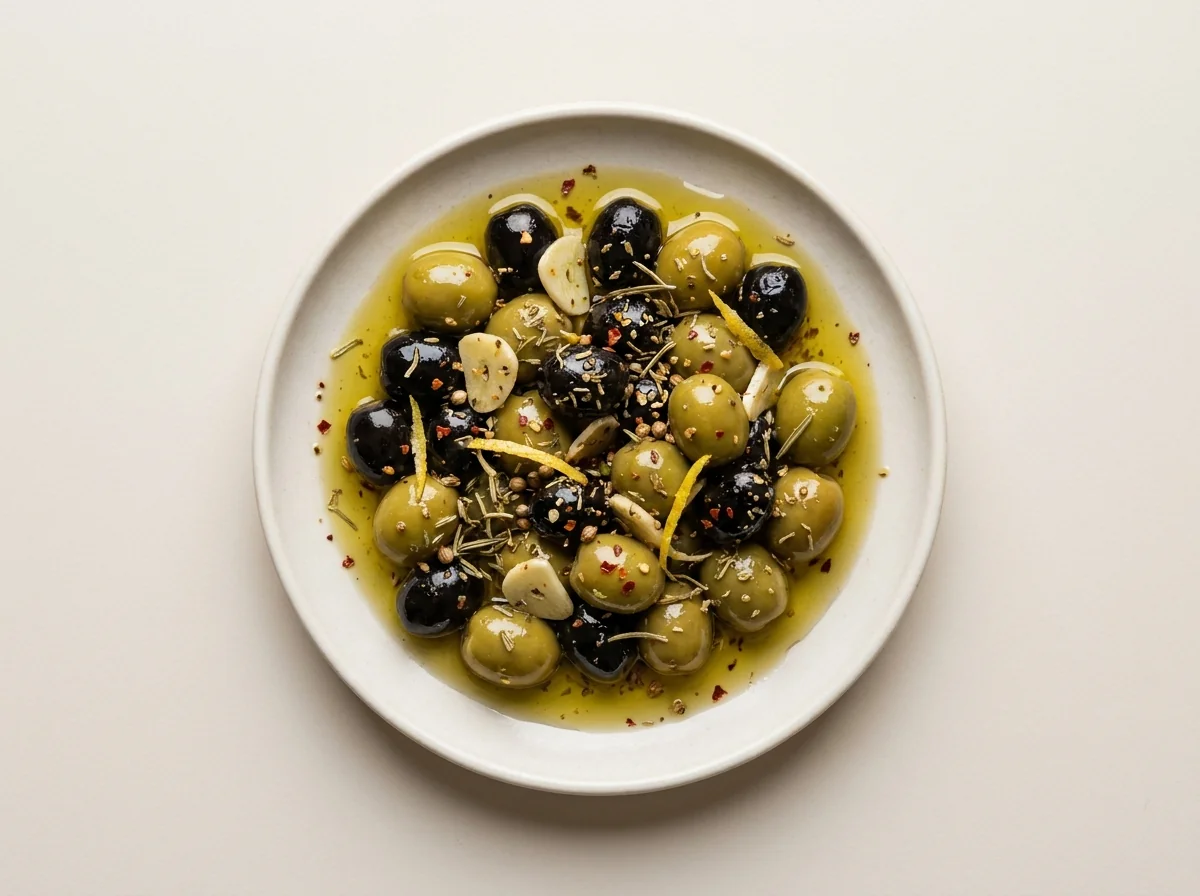
Marinated olives are the never-absent corner of the Mashreqi breakfast table.
Olives are cracked and left overnight in an oil perfumed with lemon, garlic, and thyme, so they turn from shelf cans into hospitality appetizers. Marinating them at home is minutes and a night's patience.
Preparation Steps
Wash the olives of their jar's salt
Drain the olives from their brine and rinse them in cold water, and for very salty ones, an hour's soak in water tames them: we want olives that absorb our marinade, not ones drowned in factory salt.
Crack the large olives
Press the large olives with the side of the knife in a press that cracks them without mashing. The cracks are the doors of the marinade to the core.
Prepare the perfumed marinating oil
In a bowl, toss the olive oil with the lemon zest, peel strips, juice, garlic, thyme, crushed coriander, and chili. A golden oil in which the perfumes swim will itself become a later dipping treasure.
Marinate and let it sit overnight. Patience is flavor
Toss the olives in the perfumed oil until every olive is coated, pack it into a jar with the oil covering it, and let it sit a night in the fridge at least, with three days reaching its perfection: the olive is slow to ask permission and generous to give.
Serve it as the steady corner of the morning
In a small dish with a little of its oil. A neighbor of the labneh (strained yogurt), cheese, and eggs on every Mashreqi breakfast table, and its leftover oil is a priceless bread dip.
Blood Sugar Impact
The glycemic index (GI) measures how quickly a food raises blood sugar, while the glycemic load (GL) measures how much a full serving raises it. Together they give the complete picture.
Glycemic Index
GI
3Low
Low0–55Medium56–69High70+
A low value (≤55) means a gradual rise in blood sugar — the most suitable range for diabetes and insulin resistance.
Glycemic Load
GL
0Low
Low0–10Medium11–19High20+
Glycemic load reflects the impact of the full serving. To lower it: take half a serving, or pair the recipe with a source of protein and fiber.
Nutritional Information
Per ServingMakes 12 servings · one serving is about 40 g of raw ingredients
Calories105 kcal5%of Daily Value*
Protein0 g0%of Daily Value*
Carbohydrates2 g1%of Daily Value*
Fat11 g14%of Daily Value*
Fiber1 g4%of Daily Value*
Sodium519 mg23%of Daily Value*
* Percent Daily Values are based on a 2,000-calorie diet per FDA food-label reference values — your daily needs may be higher or lower. Values are derived from the recipe's ingredients via the USDA database.
Troubleshooting
The most common problems when preparing Marinated Olives with Thyme and Lemon, and how to fix them:
It still tastes of its first jar
Marinating without washing or a hasty taste. Rinsing first, the cracking, and the three nights. The trinity of transformation.
Its saltiness won despite marinating
Very salty factory olives. The hour's soak in water before anything, repeated for the difficult ones with fresh water.
The garlic turned green or the oil soured
Garlic in long-kept oil outside the cold. The jar in the fridge always and used within two weeks. The strict garlic-in-oil rule.
Its oil solidified in the fridge
The nature of honest olive oil in the cold. A few minutes outside it return it liquid, and it is a badge of quality, not a flaw.
Storage and Make-Ahead
In the fridge
Two weeks in a jar covered by its oil with a dry spoon, and the garlic is the reason for the ceiling.
For fine hospitality
Taken out half an hour before serving so its oil runs and its perfumes wake.
Its leftover oil
A fine bread dip and a salad-dressing base. Not a drop of it is poured out.
Tested Ingredient Substitutions
Original Ingredient
Tested Substitute
Ratio
Flavor Difference
The dried thyme
Rosemary and bay leaf
~
A deeper Mediterranean marinade
The fresh lemon
A little chopped preserved lemon
~
A fermented depth that suits its lovers
The chili
Omit it
~
A mild version for the whole table
The mixed olives
Kalamata or cracked green only
~
Each variety has its character, and the mix is finer
How Much Does It Make? Scaling Guide
Ingredient
1 jar ~400 g
200 g
2 jars
Olives
400 g
200 g
800 g
Olive oil
80 ml
40 ml
160 ml
EEINA Nutrition Tip
Let it sit a night at least, and three for perfection. The olive is a dense body that flavors do not enter quickly: taste it on the marinating day and then on its third day, and you will understand why stores sell the marinated kind at three times the price of the plain.
Add This Recipe to Your Plan
The EEINA app saves your favorite recipes, calculates them from their real ingredients, and shows your daily numbers toward your goal. Try it free now.
Olives are naturally salty. Doesn't that worry someone with high blood pressure?
Its olives are counted by the piece, not by the handful: five washed, marinated olives are a measured flavor addition, and our washing and soaking bring its salt down an important degree.
What fats does the olive carry?
Heart-friendly monounsaturated fats, exactly like its oil, which is why it heads the Mediterranean diet with its steady small dish.
Why marinate it when stores sell it marinated?
The store-marinated kind is three times the price with a marinade of unknown age, while your jar is with your virgin oil, fresh garlic, and a third of the cost.
What is its place in our breakfast?
The steady corner beside the labneh, cheese, eggs, and za'atar. Five olives that complete the Mashreqi morning table as an identity.