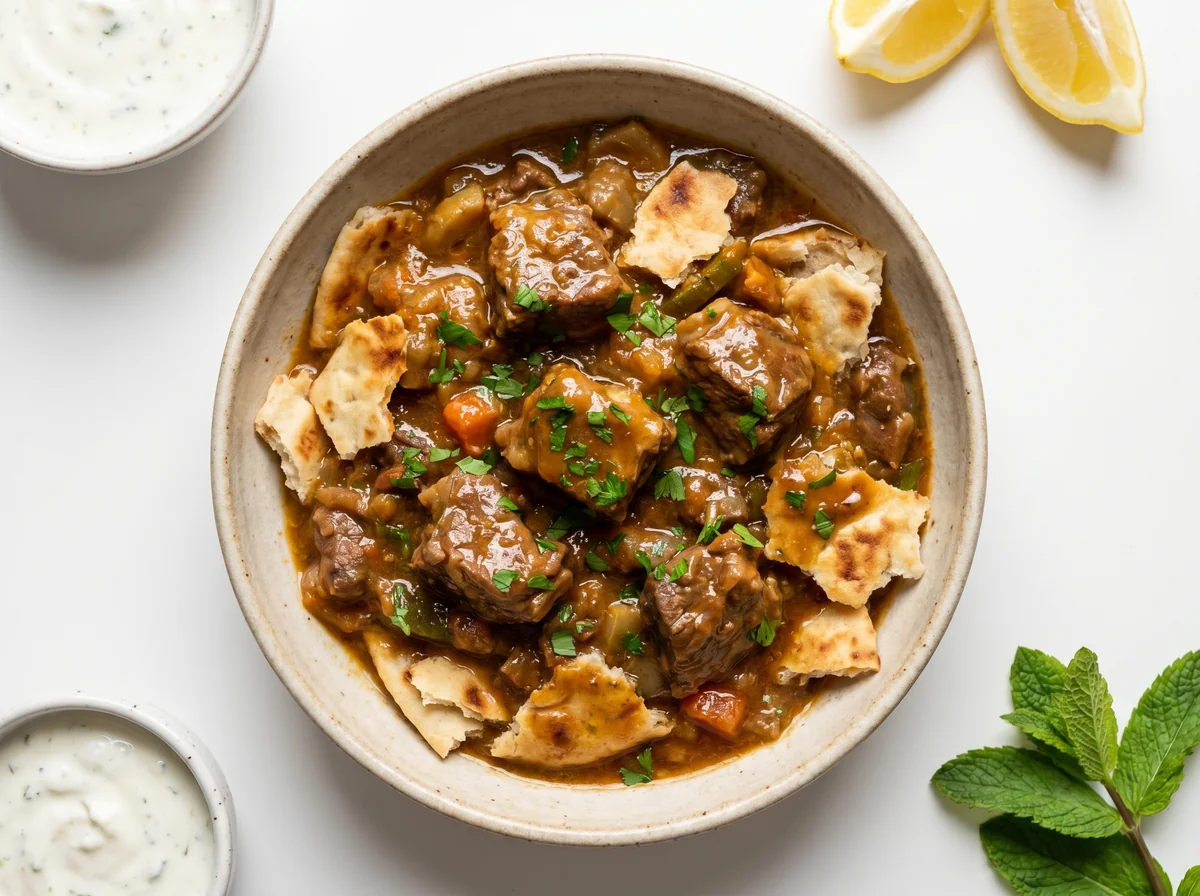
Najdi Lamb Margoog (vegetable stew with flatbread)
A warming Najdi everyday dish — thin dough rounds cooked in spiced lamb and vegetable broth until they soak up all the flavour. EEINA's version uses whole-wheat dough, lean lamb, and generous vegetables, keeping the soul and warmth of Margoog (vegetable stew with flatbread) authentic.
Margoog (vegetable stew with flatbread) is a venerable Najdi everyday dish — the food of homes on winter nights. What sets it apart are the thin dough rounds cooked in lamb and vegetable broth until they absorb its flavour and create a hearty, warming texture.
It differs from all rice dishes by being based on dough rather than rice. EEINA's version uses whole-wheat dough, lean lamb, and generous vegetables, so Margoog retains its warmth and authenticity with a lighter profile and more fibre.
Preparation Steps
Knead the dough rounds
Mix the flour with a pinch of salt and water gradually until a firm, soft dough forms, then cover and let it rest for 20 minutes. Resting makes the dough more pliable and easier to roll thin.
Brown the lamb and build the broth
Heat the oil in a wide pot and brown the lamb, then add the onion, garlic, and the Margoog spice blend and stir until fragrant. Add the grated tomatoes, tomato paste, and the pierced loomi (dried black lime) and stir until the tomatoes melt into the base.
Cook the lamb
Pour in the hot water and salt, cover the pot, and cook over a low flame for about 45 minutes until the lamb begins to tenderise and the broth becomes rich. The lamb needs time before the vegetables and dough go in.
Add the vegetables
Add the potatoes, carrot, and courgette to the broth and let them cook for about 15 minutes until they begin to soften. Add the vegetables in order of firmness: potatoes and carrot first, then the faster-cooking courgette.
Roll and cook the dough rounds
Roll the dough very thin and cut into rounds or squares, then drop them into the simmering broth one by one so they do not stick. Let them cook for 10–12 minutes until the dough is cooked through and has absorbed the broth's flavour.
Serve
Let the Margoog (vegetable stew with flatbread) rest for five minutes so it thickens slightly, then adjust the salt. Serve hot in deep bowls — a warming dish that brings lamb, vegetables, and dough together in one rich broth.
Blood Sugar Impact
The glycemic index (GI) measures how quickly a food raises blood sugar, while the glycemic load (GL) measures how much a full serving raises it. Together they give the complete picture.
Glycemic Index
GI
52Low
Low0–55Medium56–69High70+
A low value (≤55) means a gradual rise in blood sugar — the most suitable range for diabetes and insulin resistance.
Glycemic Load
GL
24High
Low0–10Medium11–19High20+
Glycemic load reflects the impact of the full serving. To lower it: take half a serving, or pair the recipe with a source of protein and fiber.
Nutritional Information
Per ServingMakes 5 servings · one serving is about 610 g of raw ingredients
Calories531 kcal27%of Daily Value*
Protein29 g58%of Daily Value*
Carbohydrates56 g20%of Daily Value*
Fat22 g28%of Daily Value*
Fiber9 g32%of Daily Value*
Sodium384 mg17%of Daily Value*
Potassium1127 mg24%of Daily Value*
Phosphorus444 mg36%of Daily Value*
* Percent Daily Values are based on a 2,000-calorie diet per FDA food-label reference values — your daily needs may be higher or lower. Values are derived from the recipe's ingredients via the USDA database.
Troubleshooting
The most common problems when preparing Najdi Lamb Margoog (vegetable stew with flatbread), and how to fix them:
The dough rounds stuck together
Added all at once. Drop the rounds into the simmering broth one by one with a gentle stir, and dust them with a little flour before adding.
The dough is tough or undercooked
Rolled too thick or not cooked long enough. Roll the dough very thin and cook for 10–12 minutes in simmering broth until cooked through and tender.
The broth is heavy and paste-like
The dough released its starch. Add hot water to thin the broth — the dough naturally thickens it during cooking.
The vegetables are mushy
Added too early or cooked too long. Add them in order of firmness, with courgette last as the quickest to cook.
Bland flavour
Insufficient browning of the lamb or spices. Brown the lamb first — the pierced loomi (dried black lime) and the Margoog spice blend deepen the broth's flavour.
Storage and Make-Ahead
Refrigerator (4°C)
Two days in a sealed container. It thickens when cold — reheat with a splash of hot water.
Freezer (-18°C)
Not recommended — the dough rounds change texture after freezing. Best prepared fresh.
Prep ahead
Knead the dough and cook the lamb and broth in advance, then roll the rounds and cook them at serving time for the best texture.
Reheating
Over a low flame with a little hot water until hot. Do not leave cooked food outside the fridge for more than two hours [2].
Tested Ingredient Substitutions
Original Ingredient
Tested Substitute
Ratio
Flavor Difference
Lamb
Skinless chicken
Same weight
A lighter alternative — cooks faster, so add the vegetables and dough earlier
Whole-wheat flour
White flour
Same weight
Softer texture but lower in fibre and with a higher glycaemic load
Courgette
Pumpkin or aubergine
Same weight
Winter vegetables that suit Margoog well and enrich its flavour
Ready-made Margoog spice blend
Home blend: cumin, coriander, cardamom, and black pepper
Same quantity
Fresher and free of additives
Homemade dough rounds
Ready-made crispbread (raqaq)
Same weight
Saves time — cook in the broth until soft and the dough has absorbed the flavour
How Much Does It Make? Scaling Guide
Number of servings
Lamb
Flour
Water
Pot
2 (individual × 2)
200 g
100 g
2 cups
small pot
5 (base)
500 g
250 g
5 cups
wide pot
8 (family)
800 g
400 g
8 cups
large pot
12 (banquet)
1.2 kg
600 g
12 cups
banquet pot
EEINA Nutrition Tip
Using whole-wheat flour in the dough raises the fibre and lowers the glycaemic load compared with white flour. The generous vegetables add satiety and enrich the dish. Choose lean lamb — Margoog is a relatively gentle dish on blood sugar by its nature.
Add This Recipe to Your Plan
The EEINA app saves your favorite recipes, calculates them from their real ingredients, and shows your daily numbers toward your goal. Try it free now.
What is the difference between Margoog, Matazeez, and Qursan?
All three are Najdi dishes of dough and broth, but Margoog uses thin, wide dough rounds cooked in the broth; Matazeez uses thicker, smaller dough pieces; and Qursan is thin flatbread that is dried, then crumbled into the broth. Each has its own texture.
How do I prevent the dough rounds from sticking?
Roll the dough thin, dust the rounds with a little flour, and drop them into simmering broth one by one with a gentle stir so they do not stick together.
Is Margoog suitable for diabetics?
The whole-wheat version with generous vegetables is relatively gentler and richer in fibre, but it is still a starchy dish — moderate the portion and increase the vegetables and lamb relative to the dough.
Can it be made vegetarian?
Yes — omit the lamb and cook the dough and vegetables in a well-spiced vegetable stock. Margoog stays warm and delicious with potatoes, carrot, courgette, and tomatoes.
Why use whole wheat?
Whole-wheat flour increases fibre, lowers the glycaemic load, and gives the dough a deeper flavour, making Margoog more filling and better for blood sugar than white flour.
Sources: USDA · University of Sydney · Gulf GSO · Our methodology · Updated on