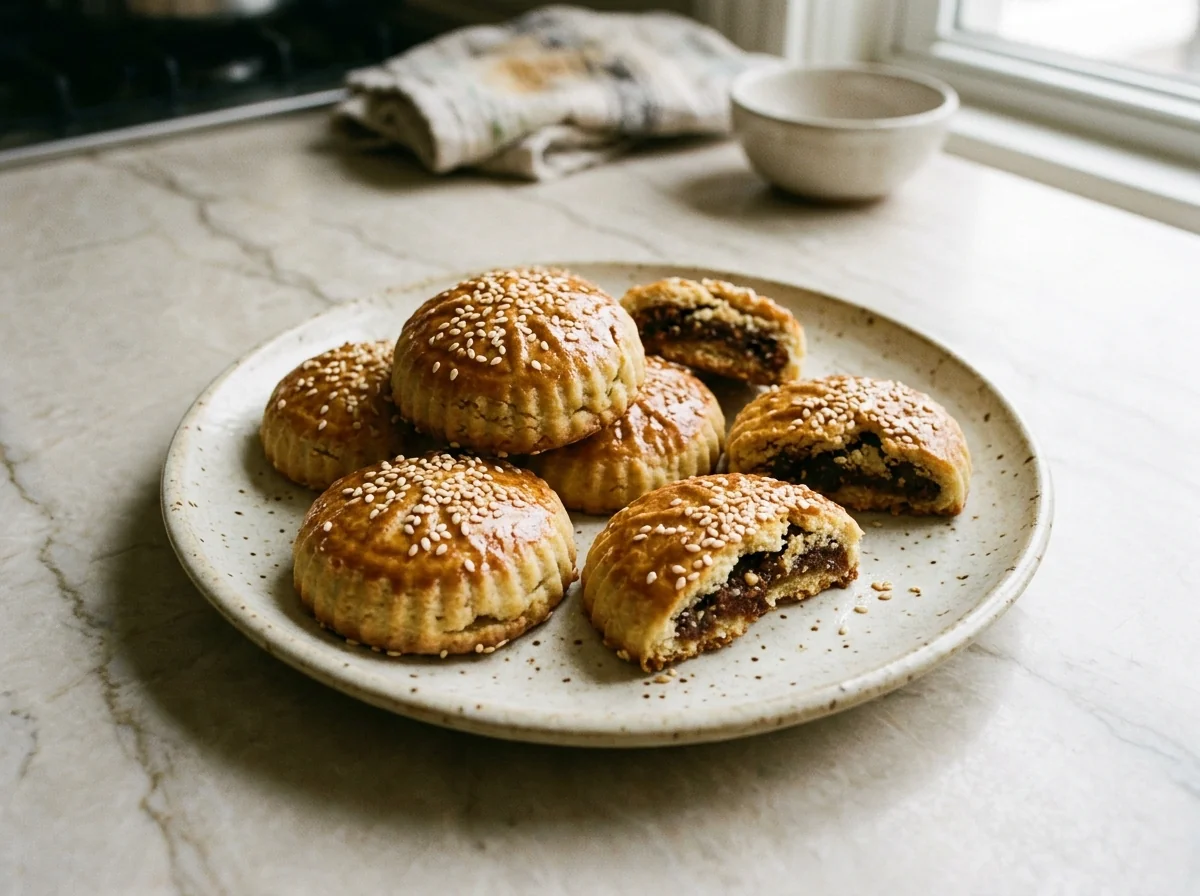
Flour rubbed with boiled butter and kneaded with proofed yeast, warm water, milk, and egg yolk, filled with date paste worked with cinnamon and nutmeg, sprinkled with sesame, and baked.
Date maamoul made with flour rather than semolina: its dough is closer to kaak than to sandy maamoul, and the yeast gives it an airiness semolina dough lacks.
Half a kilo of butter to a kilo of flour is a generous ratio, and it is what makes it melt without crumbling.
Preparation Steps
Grind the dates
For the filling, pour the date paste into the grinder bowl and grind it well until you have a cohesive dough.
Knead the dates with spice
Add the grated nutmeg, the cinnamon, and the water to the date dough and knead by hand until you have a soft, pliable dough that shapes easily.
Roll the filling
Oil your hands lightly and shape the whole mixture into small hazelnut-sized balls, setting them aside until needed.
Boil the butter
For the maamoul, put the butter in a small bowl over below-medium heat until it boils.
Pour it over the flour
In a large bowl put the flour, then add the butter and stir with a spoon until you have an even mixture, and leave the dough until it is merely warm, since hot dough burns the hand and cannot be rubbed.
Proof the yeast
Put the yeast in a separate bowl, add the warm water and the sugar, and stir for ten minutes until the yeast activates and foams on top.
Rub the mixture
Rub the butter and flour mixture while warm between your palms thoroughly until the flour absorbs the butter completely and it looks like wet sand.
Knead, fill, and bake
Add the yeast mixture to the dough and stir by hand, then add the warm water, the milk, and the egg yolk and knead until it comes together; fill each disc with a date ball, seal it, press it into the mold, sprinkle with sesame, and bake until the tops turn golden.
Blood Sugar Impact
The glycemic index (GI) measures how quickly a food raises blood sugar, while the glycemic load (GL) measures how much a full serving raises it. Together they give the complete picture.
Glycemic Index
GI
66Medium
Low0–55Medium56–69High70+
A low value (≤55) means a gradual rise in blood sugar — the most suitable range for diabetes and insulin resistance.
Glycemic Load
GL
11Medium
Low0–10Medium11–19High20+
Glycemic load reflects the impact of the full serving. To lower it: take half a serving, or pair the recipe with a source of protein and fiber.
Nutritional Information
Per ServingMakes 69 servings · one serving is about 35 g of raw ingredients
Calories128 kcal6%of Daily Value*
Protein2 g4%of Daily Value*
Carbohydrates17 g6%of Daily Value*
Fat6 g8%of Daily Value*
Fiber1 g4%of Daily Value*
Sodium2 mg0%of Daily Value*
Potassium71 mg2%of Daily Value*
Phosphorus25 mg2%of Daily Value*
* Percent Daily Values are based on a 2,000-calorie diet per FDA food-label reference values — your daily needs may be higher or lower. Values are derived from the recipe's ingredients via the USDA database.
Troubleshooting
The most common problems when preparing Date Maamoul with Flour and Yeast, and how to fix them:
The dough will not come together
It lacks liquid or was not rubbed enough. Rub until the mixture looks like wet sand, then add the warm water gradually.
The yeast did not foam
The water was hot and killed it, or cold and slowed it, or it is old. Use water at hand temperature and check its date.
The filling escapes the discs
The date ball is too large or the seal is loose. Make them hazelnut-sized as the source advises and close the dough fully around them.
The tops are pale
The heat is low or the yolk wash is short. Raise the heat slightly and brush the tops with the yolk and milk.
Storage and Make-Ahead
Outside the refrigerator
In a sealed container for up to two weeks, the usual way with Eid maamoul.
Refrigerator (4°C)
Up to a month, taken out an hour before serving to return to room temperature.
Freezing
Freeze it baked for up to three months in a sealed container and thaw at room temperature.
Make ahead
Roll the date filling into balls and keep them refrigerated for two days before shaping.
Tested Ingredient Substitutions
Original Ingredient
Tested Substitute
Ratio
Flavor Difference
Butter
Ghee
500 g
A closer Middle Eastern flavor, and the original in Levantine maamoul.
Date paste
Mashed ajwa dates
500 g
The direct homemade substitute, needing longer grinding.
Cinnamon
Ground cardamom
7 g
A closer Gulf aroma, gentler than the sharpness of cinnamon.
Sesame
Nigella seeds
18 g
A darker color and a distinctive flavor on top.
How Much Does It Make? Scaling Guide
Servings
Flour
Butter
Date paste
4 servings (half amount)
500 g
250 g
250 g
8 servings (base)
1000 g
500 g
500 g
16 servings (double)
2000 g
1000 g
1000 g
EEINA Nutrition Tip
The butter is poured onto the flour while boiling, then the mixture is left to warm down before rubbing: rubbing it hot burns the hand and does not distribute the fat, while rubbing it cold leaves the flour unable to absorb it. Warm is the only right state.
Add This Recipe to Your Plan
The EEINA app saves your favorite recipes, calculates them from their real ingredients, and shows your daily numbers toward your goal. Try it free now.
How does it differ from the date maamoul in our library?
That one is three cups of fine semolina with half a cup of flour, ghee, instant yeast, warm milk, and orange blossom and rose water for twenty servings. This is a kilo of flour with no semolina at all, half a kilo of boiled butter, yeast proofed separately, and sesame on top, for eight servings. The amounts and method both differ.
Why is the butter boiled?
Melting it to the boil evaporates its water so it becomes a clear fat closer to ghee, and that is what gives the dough its short texture and longer life.
How many pieces per serving?
The source estimates eight servings for a kilo of flour and half a kilo of dates, about 250 grams a serving. Maamoul is eaten two or three pieces with coffee, so divide by what you actually eat.
What oven temperature and time?
The source specifies neither and makes a golden top the sign. Maamoul bakes at a moderate heat, and watching it is more accurate since mold thickness varies.
Sources: USDA · University of Sydney · Our methodology · Updated on