Vegetarian curry is a cornerstone of Indian cuisine, and paneer is its usual star.
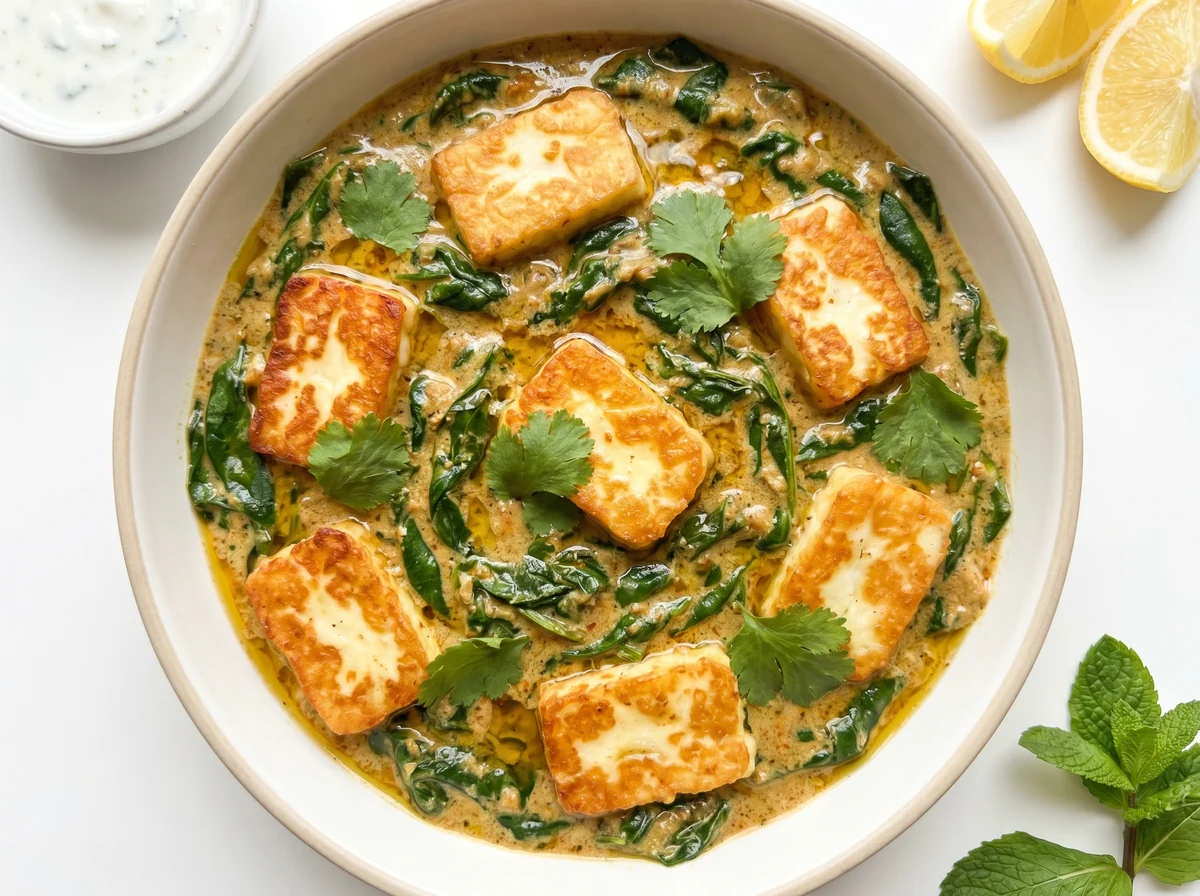
Eeina's version swaps in halloumi — widely available on our tables — which, when browned, develops a golden crust and a sturdy texture that holds up in the sauce. It meets spinach and spices in a warm, protein-rich, low-carb meatless dinner.
Preparation Steps
Brown the halloumi
Heat half a tablespoon of oil in a skillet over medium heat, and brown the halloumi cubes on all sides for 2–3 minutes until golden (look for a golden crust and crisped edges). Set aside — browning keeps it from crumbling in the sauce.
Build the spice base
In the same pan, add the remaining oil and the onion and stir for 4 minutes until softened and lightly golden, then add the garlic and ginger for 1 minute. Add the turmeric, cumin, and garam masala and stir for 30 seconds until their aroma blooms (toasting the spices releases their flavour).
Cook the sauce
Add the crushed tomatoes and cook for 5 minutes over medium heat until the sauce thickens, deepens in colour, and the oil just begins to separate at the edges (the sign that the curry base is ready). Add the coconut milk and stir.
Add the spinach and halloumi
Add the spinach in batches, stirring until fully wilted (2 minutes), then return the browned halloumi. Cook for just 2 more minutes until the halloumi is heated through and has absorbed the flavours without becoming too soft.
Serve
Taste and adjust salt and pepper (remember the halloumi's saltiness). Serve warm with basmati rice or whole-grain bread, or on its own as a low-carb dish.
Blood Sugar Impact
The glycemic index (GI) measures how quickly a food raises blood sugar, while the glycemic load (GL) measures how much a full serving raises it. Together they give the complete picture.
Glycemic Index
GI
6Low
Low0–55Medium56–69High70+
A low value (≤55) means a gradual rise in blood sugar — the most suitable range for diabetes and insulin resistance.
Glycemic Load
GL
0Low
Low0–10Medium11–19High20+
Glycemic load reflects the impact of the full serving. To lower it: take half a serving, or pair the recipe with a source of protein and fiber.
Nutritional Information
Per ServingMakes 4 servings · one serving is about 260 g of raw ingredients
Calories327 kcal16%of Daily Value*
Protein18 g36%of Daily Value*
Carbohydrates11 g4%of Daily Value*
Fat24 g31%of Daily Value*
Fiber3 g11%of Daily Value*
Sodium914 mg40%of Daily Value*
* Percent Daily Values are based on a 2,000-calorie diet per FDA food-label reference values — your daily needs may be higher or lower. Values are derived from the recipe's ingredients via the USDA database.
Troubleshooting
The most common problems when preparing Halloumi and Spinach Curry, and how to fix them:
The halloumi crumbled in the sauce
It was not browned first, or it cooked in the sauce too long. Brown the cubes until golden in step 1 (they firm up), then return them for only the final 2 minutes.
The dish is too salty
The halloumi released its salt. Soak it in cold water for ten minutes before browning, and add no salt at all until you taste the finished dish. A squeeze of lemon juice balances saltiness.
The sauce is watery and has not thickened
The spinach released its moisture or the tomatoes were not cooked down enough. Cook the tomato base until it thickens and the oil separates before adding the milk, and add the spinach in batches letting the water evaporate.
The spices taste raw or earthy
They were not toasted in oil. Add the ground spices after the onion and garlic and stir them for 30 seconds in the warm oil before the tomatoes — this cooks them and releases their flavour.
The spinach turned pale and bitter
It was overcooked. Spinach needs just 2 minutes to wilt. Prolonged cooking strips it of its bright green colour and much of its vitamins.
Storage and Make-Ahead
Refrigerator (4°C)
Three days in a sealed container after cooling. The halloumi becomes slightly softer the next day but the flavour remains good.
Freezer (-18°C)
Not recommended — the texture of the halloumi changes after freezing and becomes rubbery. Prefer refrigerating only or making it fresh.
Advance preparation
Brown the halloumi and prepare the tomato spice base in advance and store them separately in the refrigerator. At serving time: heat the base, add fresh spinach and the halloumi.
Reheating
Over low heat with a splash of water or coconut milk, or in the microwave for 2 minutes. Do not leave it unrefrigerated for more than 2 hours [1].
Tested Ingredient Substitutions
Original Ingredient
Tested Substitute
Ratio
Flavor Difference
Halloumi cheese
Indian paneer
Same quantity
Paneer is less salty and softer — the traditional Indian choice
Spinach
Kale or Swiss chard
Same weight
Kale needs a little longer to cook; stronger flavour
Coconut milk
Greek yogurt
Same quantity
Add over very low heat so it does not curdle; gives a pleasant tang
Garam masala
Ready-made curry powder
Same quantity
Similar flavour — make sure it is fresh for the best aroma
Halloumi (for fully vegan version)
Firm tofu, browned
Same weight
Dairy-free, high-protein option (adds soy to the allergen list)
How Much Does It Make? Scaling Guide
Number of servings
Halloumi
Spinach
Tomatoes
Pan
2 (individual × 2)
125 g
150 g
Piece
medium pan
4 (base)
250 g
300 g
2
wide pan
6 (family)
375 g
450 g
3
large pan
8 (entertaining)
500 g
600 g
4
wide pot
EEINA Nutrition Tip
An excellent dish for diabetics: very low in carbohydrates and rich in protein and spinach fibre. But halloumi is naturally salty, so do not add any salt before tasting. For those watching blood pressure: soak the halloumi cubes in cold water for ten minutes before cooking to reduce saltiness.
Add This Recipe to Your Plan
The EEINA app saves your favorite recipes, calculates them from their real ingredients, and shows your daily numbers toward your goal. Try it free now.
Yes — carbohydrates are low (about 12 g per serving), GI is low, and the protein and fibre slow the rise in blood sugar. Serve it on its own or with a small portion of brown rice.
How do I reduce the saltiness of halloumi?
Soak the cubes in cold water for ten minutes before browning, changing the water once. Add no salt to the dish at all until you taste it at the end.
Can it be made dairy-free?
Yes — swap the halloumi for firm browned tofu; the coconut milk stays as is. You will have a fully vegan, dairy-free dish.
Do I need special Indian spices?
Garam masala, turmeric, and cumin are all you need and they are available locally. If garam masala is not on hand, use ready-made curry powder.
Does it work as a meal prep dish?
Yes — up to 3 days in the refrigerator, but avoid freezing because the halloumi texture changes. Best to prepare the base in advance and add the halloumi and spinach fresh.
Sources: USDA · University of Sydney · Gulf GSO · Our methodology · Updated on